Loading...
Done
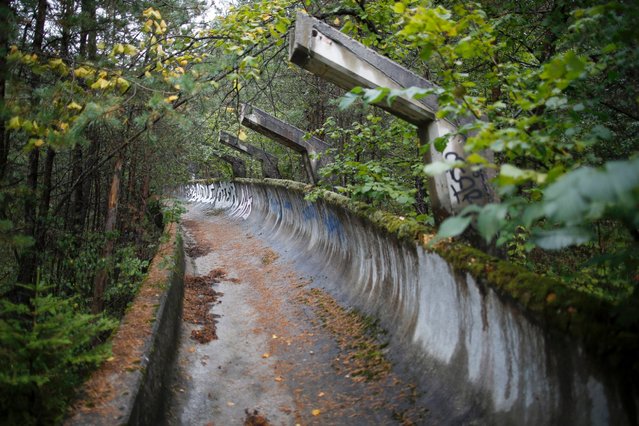
The disused bobsled track from the Sarajevo 1984 Winter Olympics is seen on Mount Trebevic, near Sarajevo, September 19, 2013. Abandoned and left to crumble into oblivion, most of the 1984 Winter Olympic venues in Bosnia's capital Sarajevo have been reduced to rubble by neglect as much as the 1990s conflict that tore apart the former Yugoslavia. (Photo by Dado Ruvic/Reuters)

The disused bobsled track from the Sarajevo 1984 Winter Olympics is seen on Mount Trebevic, near Sarajevo, September 19, 2013. Abandoned and left to crumble into oblivion, most of the 1984 Winter Olympic venues in Bosnia's capital Sarajevo have been reduced to rubble by neglect as much as the 1990s conflict that tore apart the former Yugoslavia. (Photo by Dado Ruvic/Reuters)
Details
05 Aug 2016 13:16:00
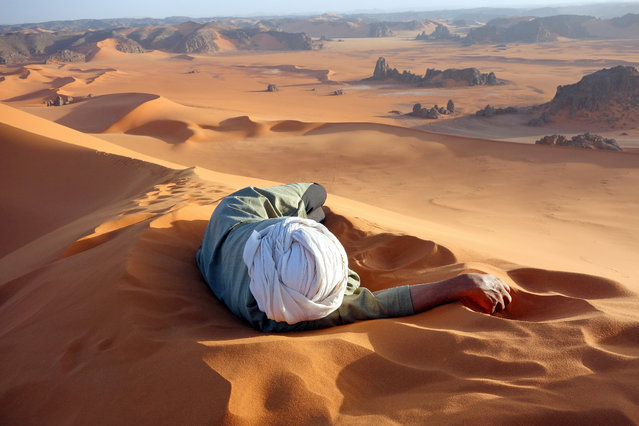
“A Well Earned Rest in the Sahara”. This photo of Moussa Macher, our Tuareg guide, was taken at the summit of Tin-Merzouga, the largest dune (or erg) in the Tadrat region of the Sahara desert in southern Algeria. Moussa rested while waiting for us to finish our 45-minute struggle to the top. Photo location: Summit of Tin-Merzouga, Tadrat, Tassili N'Ajjer National Park, Algeria. (Photo and caption by Evan Cole/National Geographic Photo Contest)

Merit Prize Winner: “A Well Earned Rest in the Sahara”. This photo of Moussa Macher, our Tuareg guide, was taken at the summit of Tin-Merzouga, the largest dune (or erg) in the Tadrat region of the Sahara desert in southern Algeria. Moussa rested while waiting for us to finish our 45-minute struggle to the top. It only took ten minutes of rolling, running, and jumping to get back down. The Tadrat is part of the Tassili N'Ajjer National Park World Heritage area, famous for its red sand and engravings and rock paintings of cattle, elephants, giraffes, and rhinos that lived there when the climate was milder. Photo location: Summit of Tin-Merzouga, Tadrat, Tassili N'Ajjer National Park, Algeria. (Photo and caption by Evan Cole/National Geographic Photo Contest)
Details
01 Aug 2014 11:38:00
A man and a woman take a selfie on Russian Navy Day in St Petersburg, Russia on July 26, 2020. (Photo by Roman Pimenov/TASS)

A man and a woman take a selfie on Russian Navy Day in St Petersburg, Russia on July 26, 2020. (Photo by Roman Pimenov/TASS)
Details
06 Aug 2020 00:05:00
A Sphynx cat stares sitting on its owner's lap during an international feline beauty competition in Bucharest, Romania, Saturday, April 14, 2018. More than 250 cats take part in the two-day competition in the Romanian capital. (Photo by Vadim Ghirda/AP Photo)

A Sphynx cat stares sitting on its owner's lap during an international feline beauty competition in Bucharest, Romania, Saturday, April 14, 2018. More than 250 cats take part in the two-day competition in the Romanian capital. (Photo by Vadim Ghirda/AP Photo)
Details
22 Apr 2018 00:03:00
A woman jumps with balloons while she poses for a picture at a park in Kiev, Ukraine May 6, 2018. (Photo by Valentyn Ogirenko/Reuters)

A woman jumps with balloons while she poses for a picture at a park in Kiev, Ukraine May 6, 2018. (Photo by Valentyn Ogirenko/Reuters)
Details
09 May 2018 00:03:00
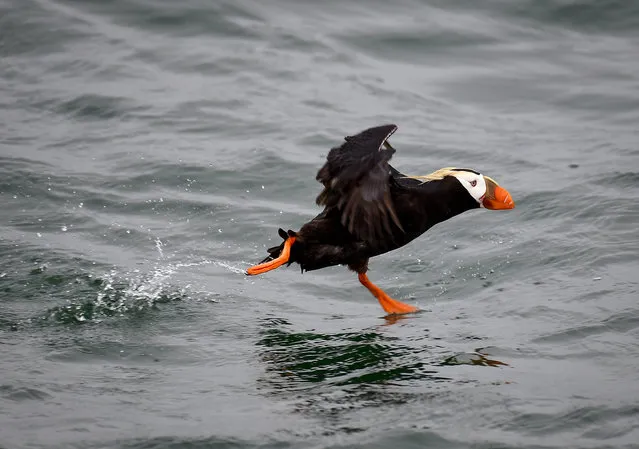
A tufted puffin is seen in Kamchatka Territory, Russia on July 17, 2018. (Photo by Yuri Smityuk/TASS)

A tufted puffin is seen in Kamchatka Territory, Russia on July 17, 2018. (Photo by Yuri Smityuk/TASS)
Details
29 Jul 2018 00:03:00
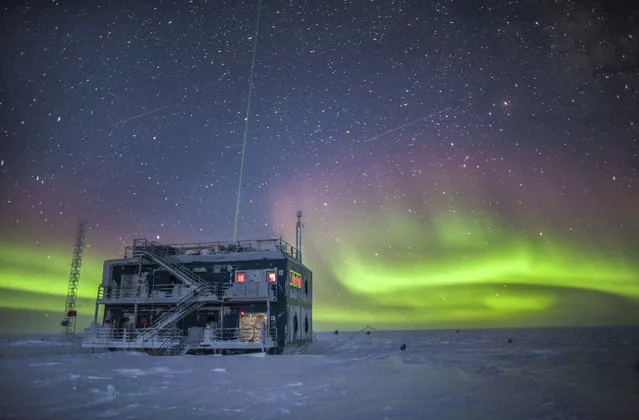
This undated photo provided by NOAA in May 2018 shows aurora australis near the South Pole Atmospheric Research Observatory in Antarctica. When a hole in the ozone formed over Antarctica, countries around the world in 1987 agreed to phase out several types of ozone-depleting chemicals called chlorofluorocarbons (CFCs). Production was banned, emissions fell and the hole shriveled. But according to a study released on Wednesday, May 16, 2018, scientists say since 2013, there’s more of a banned CFC going into the atmosphere. (Photo by Patrick Cullis/NOAA via AP Photo)

This undated photo provided by NOAA in May 2018 shows aurora australis near the South Pole Atmospheric Research Observatory in Antarctica. When a hole in the ozone formed over Antarctica, countries around the world in 1987 agreed to phase out several types of ozone-depleting chemicals called chlorofluorocarbons (CFCs). Production was banned, emissions fell and the hole shriveled. But according to a study released on Wednesday, May 16, 2018, scientists say since 2013, there’s more of a banned CFC going into the atmosphere. (Photo by Patrick Cullis/NOAA via AP Photo)
Details
15 Aug 2018 00:05:00
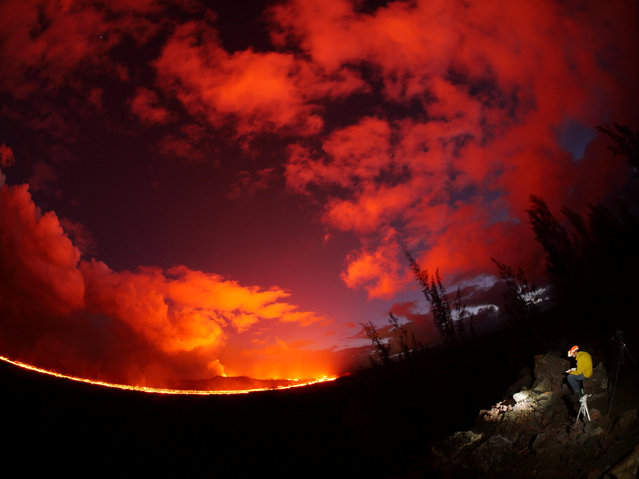
A USGS geologist making observations of the fissure 8 lava channel at sunset is pictured in this July 3, 2018 fisheye lens handout photograph near the Kilauea volcano eruption in Hawaii, U.S. (Photo by USGS/Handout via Reuters)

A USGS geologist making observations of the fissure 8 lava channel at sunset is pictured in this July 3, 2018 fisheye lens handout photograph near the Kilauea volcano eruption in Hawaii, U.S. (Photo by USGS/Handout via Reuters)
Details
19 Sep 2018 00:03:00