Loading...
Done
South African artist Tyla performs onstage during the MTV EMAs 2024 held at Co-op Live on November 10, 2024 in Manchester, England. (Photo by Jeff Kravitz/FilmMagic)

South African artist Tyla performs onstage during the MTV EMAs 2024 held at Co-op Live on November 10, 2024 in Manchester, England. (Photo by Jeff Kravitz/FilmMagic)
Details
26 Nov 2024 03:14:00
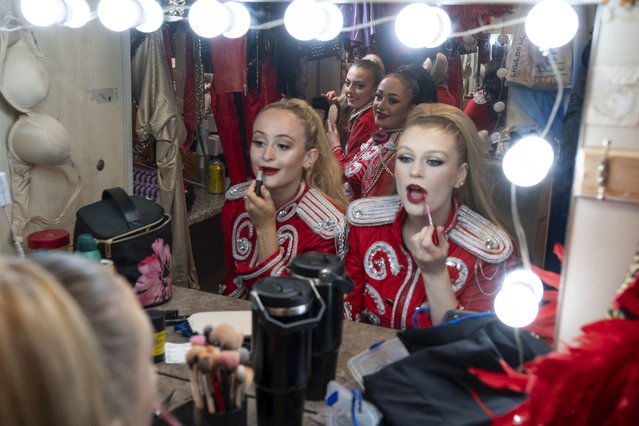
Behind the scenes at Rock it Out, a circus show fusing live music and death-defying stunts in West Thurrock, Essex on April 10, 2025. They will attempt a British first: a double somersault on a rotating wheel. (Photo by Jeff Moore)

Behind the scenes at Rock it Out, a circus show fusing live music and death-defying stunts in West Thurrock, Essex on April 10, 2025. They will attempt a British first: a double somersault on a rotating wheel. (Photo by Jeff Moore)
Details
26 May 2025 01:57:00
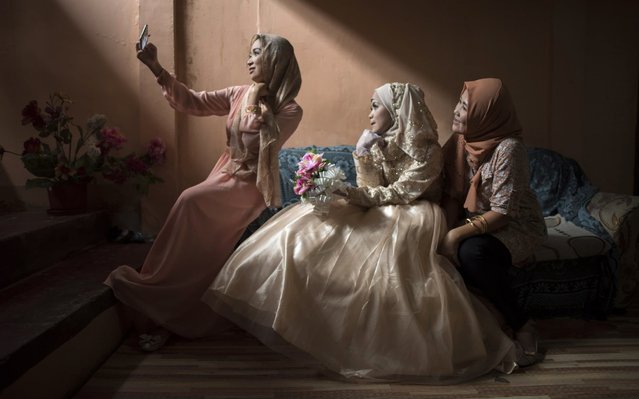
Bride Katty Malang Mikunug with friends, takes a photo before the wedding on October 21, 2017 in Saguiaran in Lanao del Sur, southern Philippines. Paulo Mamayo Ambor, 22, a resident of Marawi who got displaced by the fighting between government troops and IS-inspired militants, weds Katty Malang Mikunug, 22, a resident of an adjacent town in Saguiaran. Philippines President Rodrigo Duterte declared Marawi liberated, following the death of Abu Sayyaf leader Isnilon Hapilon and one of the Maute brothers, Omar Maute, after nearly five months of fierce urban battle inside the besieged city. The fighting started May 23, and left more than 1,000 people dead, whilst displacing at least 400,000 people. (Photo by Jes Aznar/Getty Images)


Bride Katty Malang Mikunug with friends, takes a photo before the wedding on October 21, 2017 in Saguiaran in Lanao del Sur, southern Philippines. Paulo Mamayo Ambor, 22, a resident of Marawi who got displaced by the fighting between government troops and IS-inspired militants, weds Katty Malang Mikunug, 22, a resident of an adjacent town in Saguiaran. Philippines President Rodrigo Duterte declared Marawi liberated, following the death of Abu Sayyaf leader Isnilon Hapilon and one of the Maute brothers, Omar Maute, after nearly five months of fierce urban battle inside the besieged city. The fighting started May 23, and left more than 1,000 people dead, whilst displacing at least 400,000 people. (Photo by Jes Aznar/Getty Images)
Details
23 Oct 2017 07:17:00
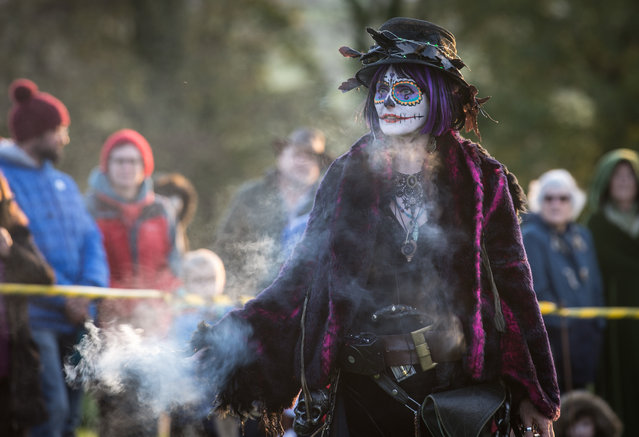
People take part in a sunset ceremony on the lower slopes of Glastonbury Tor as they celebrate Samhain at the Glastonbury Dragons Samhain Wild Hunt 2017 in Glastonbury on November 4, 2017 in Somerset, England. To celebrate Samhain, the Glastonbury Dragons, alongside Gwythyr Ap Greidal, the Summer King and the Winter King, Gwyn Ap Nudd, were paraded through the town to the lower slopes of Glastonbury Tor where the event was marked with ritual theatre, dancing and a fire to honour the dead. The Celtic festival of Samhain, which was later adopted by Christians and became Halloween, is a very important date in the Pagan calendar as it marks the division of the year between the lighter half (summer) and the darker half (winter). Pagans believe at Samhain, the division between this world and the otherworld was at its thinnest, allowing spirits to pass through. Many of the traditions of this ancient Celtic feast of the dead were later incorporated into the Christian calendar and Irish immigrants to America in the 19th century carried their customs, such as the wearing of costumes and masks to ward of harmful spirits and the harvest tradition of carving pumpkins, which have now blended into modern day Hallowee. (Photo by Matt Cardy/Getty Images)

People take part in a sunset ceremony on the lower slopes of Glastonbury Tor as they celebrate Samhain at the Glastonbury Dragons Samhain Wild Hunt 2017 in Glastonbury on November 4, 2017 in Somerset, England. To celebrate Samhain, the Glastonbury Dragons, alongside Gwythyr Ap Greidal, the Summer King and the Winter King, (Photo by Matt Cardy/Getty Images)
Details
07 Nov 2017 07:50:00
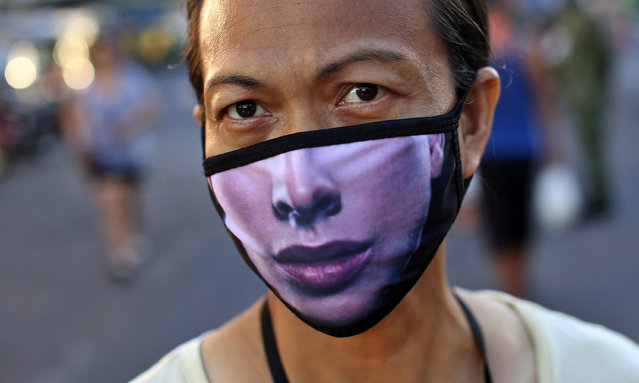
A Filipino woman wears a mask to try and protect against the spread of coronavirus in Malate district, Manila City on March 24, 2020. The Philippines has taken drastic measures to combat the spread of Covid-19. The entire country is under strict quarantine and the army is on the streets to monitor compliance. According to official figures, there are 462 positive cases and 33 dead in the Philippines, but it is thought that thousands of cases remain undetected due to lack of resources in a country where millions of people have no access to health care. In the poorest and most crowded areas, it’s almost impossible to adhere to the physical distancing required during quarantine. (Photo by Alejandro Ernesto/The Guardian)

A Filipino woman wears a mask to try and protect against the spread of coronavirus in Malate district, Manila City on March 24, 2020. The Philippines has taken drastic measures to combat the spread of Covid-19. The entire country is under strict quarantine and the army is on the streets to monitor compliance. According to official figures, there are 462 positive cases and 33 dead in the Philippines, but it is thought that thousands of cases remain undetected due to lack of resources in a country where millions of people have no access to health care. In the poorest and most crowded areas, it’s almost impossible to adhere to the physical distancing required during quarantine. (Photo by Alejandro Ernesto/The Guardian)
Details
08 Apr 2020 00:01:00
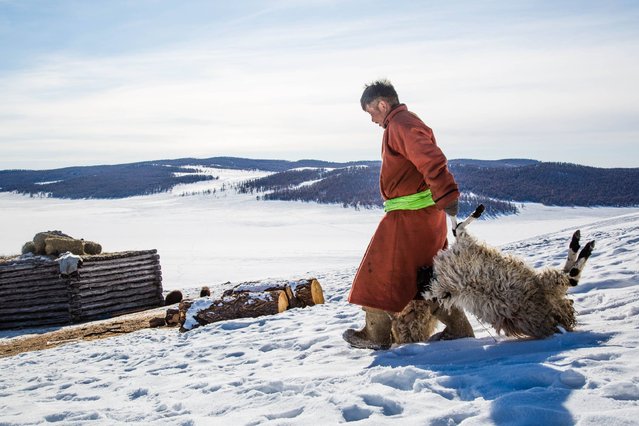
This handout photo taken on February 12, 2017 and released on February 16 by the International Federation of Red Cross and Red Crescent Societies (IFRC) shows Mongolian herder Munkhbat Bazarragchaa (C) dragging two sheep – which recently died due to the weather - to a pile of dead animals behind his “ger” in Khuvsgul province, northern Mongolia. Thousands of Mongolian herders face disastrous livestock losses from dreaded severe weather  known as the “dzud”, the Red Cross said on February 16, 2017 in launching an international emergency aid appeal. (Photo by Mirva Helenius/AFP Photo/IFRC)

This handout photo taken on February 12, 2017 and released on February 16 by the International Federation of Red Cross and Red Crescent Societies (IFRC) shows Mongolian herder Munkhbat Bazarragchaa (C) dragging two sheep – which recently died due to the weather - to a pile of dead animals behind his “ger” in Khuvsgul province, northern Mongolia. Thousands of Mongolian herders face disastrous livestock losses from dreaded severe weather known as the “dzud”, the Red Cross said on February 16, 2017 in launching an international emergency aid appeal. (Photo by Mirva Helenius/AFP Photo/IFRC)
Details
17 Feb 2017 11:40:00
Takeoka Chisaka, Hiroshima, Japan. “One morning in August 1945, I was walking home from the night shift at a factory in Hiroshima. As I reached my door, there was a huge explosion. When I came to, my head was bleeding and I had been blasted 30m away”. (Photo and caption by Sasha Maslov)

Takeoka Chisaka, Hiroshima, Japan. “One morning in August 1945, I was walking home from the night shift at a factory in Hiroshima. As I reached my door, there was a huge explosion. When I came to, my head was bleeding and I had been blasted 30m away. The atomic bomb had detonated. When I found my mother, her eyes were badly burned. A doctor said they had to come out, but he didn’t have the proper tools so used a knife instead. It was hellish. I became a peace-worker after the war. In the 1960s, at a meeting at the UN, I met one of the people who created the atomic bomb. He apologised”. (Photo and caption by Sasha Maslov)
Details
11 May 2015 11:56:00
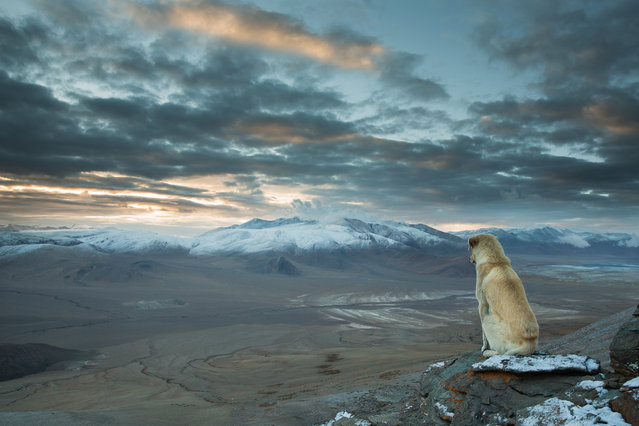
“Himalayan Dog”. This dog just appeared out of nowhere and followed us for an entire week during our trekking trip in the Himalayan outback. He always used to sleep in front of our tent and guarded us in the nights. When I decided to get up at 4 a.m. to climb the next 5000 m peak for sunrise he accompanied me as well. On the top he was sitting for the entire 30 minutes on this place looking straight into the countryside. Photo location: Ladakh, India. (Photo and caption by Sebastian Wahlhuetter/National Geographic Photo Contest)

“Himalayan Dog”. This dog just appeared out of nowhere and followed us for an entire week during our trekking trip in the Himalayan outback. He always used to sleep in front of our tent and guarded us in the nights. When I decided to get up at 4 a.m. to climb the next 5000 m peak for sunrise he accompanied me as well. On the top he was sitting for the entire 30 minutes on this place looking straight into the countryside. Photo location: Ladakh, India. (Photo and caption by Sebastian Wahlhuetter/National Geographic Photo Contest)
Details
01 Apr 2014 10:47:00