Loading...
Done
Asia Argento. (Photo by Denis Rouvre)

Denis Rouvre is a portraitist, living and working in France. His photos have been nationally and internationally published. Rouvre’s photo series have been widely exhibited in France and abroad. He has also published several books, and his numerous prizes include World Press Photo award, and a Sony World Photography Award. Photo: Asia Argento. (Photo by Denis Rouvre)
Details
19 Nov 2013 08:01:00
Rabbit Island in Japan

Only after World War II did the secret spill: Ōkunoshima, located in the Inland Sea of Japan between Hiroshima and Shikoku, was the top-secret site for manufacturing chemical warfare. When the factories were closed down, a number of exotic wild rabbits were seen freely roaming the island. They were assumed to have been the test subjects for the chemical weapons, which the military failed to eradicate when the factory was demolished.
Details
17 Feb 2014 12:23:00
Waitomo Glowworm Caves New Zealand

The Waitomo Glowworm Caves attraction is a cave at Waitomo on the North Island of New Zealand, known for its population of glowworms, Arachnocampa luminosa. This species is found exclusively in New Zealand. They are around the size of an average mosquito. This cave is part of the Waitomo Caves system that includes the Ruakuri Cave and the Aranui Cave.
Details
12 May 2014 09:55:00
New York, 1965. (Photo by Garry Winogrand/The Estate of Garry Winogrand, courtesy Fraenkel Gallery, San Francisco)

A retrospective of Garry Winogrand's photography is on display at the Metropolitan Museum of Art in New York. It is the first in 25 years of his work. The show was organized by the San Francisco Museum of Art, and the National Gallery in Washington, DC. Photo: New York, 1965. (Photo by Garry Winogrand/The Estate of Garry Winogrand, courtesy Fraenkel Gallery, San Francisco)
Details
17 Jul 2014 11:56:00
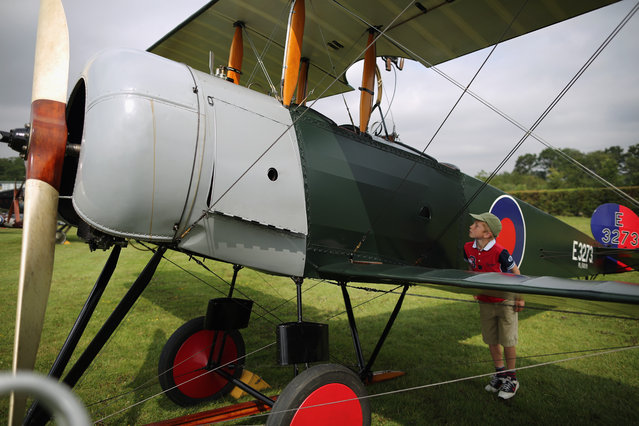
Aviation enthusiast Patrick Wilson 8, from Wetherby looks at  an Avro 504 k at “The Shuttlesworth Collection” at Old Warden on July 21, 2014 in Biggleswade, England. Of the 55,000 planes that were manufactured by the Royal Army Corps (RAC) during WWI, only around 20 remain in airworthy condition. (Photo by Dan Kitwood/Getty Images)

Aviation enthusiast Patrick Wilson 8, from Wetherby looks at an Avro 504 k at “The Shuttlesworth Collection” at Old Warden on July 21, 2014 in Biggleswade, England. Of the 55,000 planes that were manufactured by the Royal Army Corps (RAC) during WWI, only around 20 remain in airworthy condition. Six of these belong to The Shuttleworth Collection at Old Warden, Bedfordshire, making it the most complete collection of original airworthy WWI aircraft in the world. Amongst the collection is the SE5a. The SE5a is a single seater fighter aircraft. It is an original biplane designed by the Royal Aircraft Factory, with its engine built by Wolseley Motors Ltd, and it was issued to 84 Squadron in November 1918. The National Archive in Kew has recently verified that the plane saw action in France with 84 Squadron the day before Armistice, November 10, 1918. (Photo by Dan Kitwood/Getty Images)

Details
23 Jul 2014 10:00:00
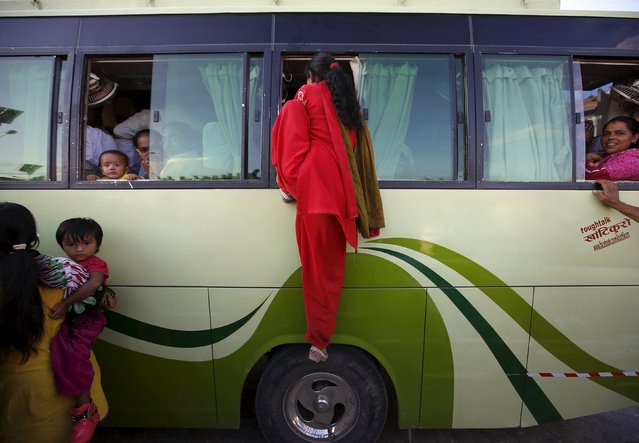
A passenger (C) climbs through the window of an overcrowded bus as limited public transportation operates in the city during the ongoing fuel crisis in Kathmandu, Nepal October 9, 2015. Nepal is considering air-lifting fuel, possibly from Bangladesh, as supply routes from India stay blocked by protesters opposing its new constitution, a short-term solution ahead of a key festival even as the government talks to China for help. (Photo by Navesh Chitrakar/Reuters)

A passenger (C) climbs through the window of an overcrowded bus as limited public transportation operates in the city during the ongoing fuel crisis in Kathmandu, Nepal October 9, 2015. Nepal is considering air-lifting fuel, possibly from Bangladesh, as supply routes from India stay blocked by protesters opposing its new constitution, a short-term solution ahead of a key festival even as the government talks to China for help. (Photo by Navesh Chitrakar/Reuters)
Details
12 Oct 2015 08:04:00
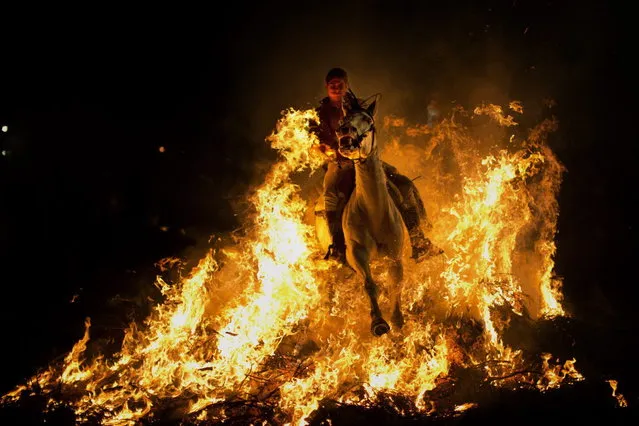
A man rides a horse through a bonfire as part of a ritual in honor of Saint Anthony, the patron saint of animals, in San Bartolome de Pinares, about 100 km west of Madrid, Spain on Thursday, January 16, 2014. On the eve of Saint Anthony's Day, hundreds ride their horses through the narrow cobblestone streets of the small village of San Bartolome during the “Luminarias”, a tradition that dates back 500 years and is meant to purify the animals with the smoke of the bonfires and protect them for the year to come. (Photo by Emilio Morenatti/AP Photo)

A man rides a horse through a bonfire as part of a ritual in honor of Saint Anthony, the patron saint of animals, in San Bartolome de Pinares, about 100 km west of Madrid, Spain on Thursday, January 16, 2014. On the eve of Saint Anthony's Day, hundreds ride their horses through the narrow cobblestone streets of the small village of San Bartolome during the “Luminarias”, a tradition that dates back 500 years and is meant to purify the animals with the smoke of the bonfires and protect them for the year to come. (Photo by Emilio Morenatti/AP Photo)
Details
24 Jan 2014 11:56:00
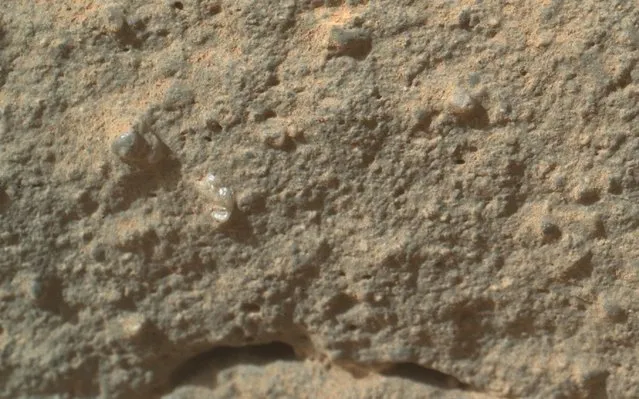
Scientists say that a “Martian flower”, seen here in an image from the Curiosity rover's Mars Hand Lens Imager, is a 2-millimeter-wide grain or pebble that's embedded in the surrounding rock. Another, darker-colored mineral grain can be seen above and to the left. (Photo by NASA)

“The scientists behind NASA's $2.5 billion Curiosity rover mission on Mars on Tuesday explained the nature of a tiny, gleaming "flower" embedded in Red Planet rock, and revealed where they'll be using the SUV-sized robot's drill for the first time”. – Alan Boyle via NBCNews.com

Photo: Scientists say that a “Martian flower”, seen here in an image from the Curiosity rover's Mars Hand Lens Imager, is a 2-millimeter-wide grain or pebble that's embedded in the surrounding rock. Another, darker-colored mineral grain can be seen above and to the left. (Photo by NASA)
Details
16 Jan 2013 11:12:00