Loading...
Done
An African migrant stranded in Costa Rica bathes at a makeshift camp at the border between Costa Rica and Nicaragua, in Penas Blancas, Costa Rica, July 14, 2016. (Photo by Juan Carlos Ulate/Reuters)

An African migrant stranded in Costa Rica bathes at a makeshift camp at the border between Costa Rica and Nicaragua, in Penas Blancas, Costa Rica, July 14, 2016. Thousands of African migrants are currently stranded in Costa Rica after they were denied entry into neighbouring Nicaragua, which they have been using as a crossing point in order to reach the United States. According to the Costa Rican Red Cross, most of these people from Africa, Asia and Haiti. It has been reported that many of them paid smugglers to reach Central America. However, when they arrived at the border gates, they were denied entry and were left with nowhere to go. (Photo by Juan Carlos Ulate/Reuters)
Details
16 Jul 2016 08:17:00
Winton Elementary fifth graders Juliana Ragan, from left, Chloe Windsor and Paisley Ganske wait backstage for their turn to perform as the Andrew Sisters during the Pearl Harbor/Veterans assembly at the school on Monday, December 7, 2015, in Coeur d'Alene, Idaho. Dec. 7 is the 74th anniversary of the Japanese bombing of Pearl Harbor. (Photo by Kathy Plonka/The Spokesman-Review via AP Photo)

Winton Elementary fifth graders Juliana Ragan, from left, Chloe Windsor and Paisley Ganske wait backstage for their turn to perform as the Andrew Sisters during the Pearl Harbor/Veterans assembly at the school on Monday, December 7, 2015, in Coeur d'Alene, Idaho. Dec. 7 is the 74th anniversary of the Japanese bombing of Pearl Harbor. (Photo by Kathy Plonka/The Spokesman-Review via AP Photo)
Details
08 Dec 2015 11:00:00


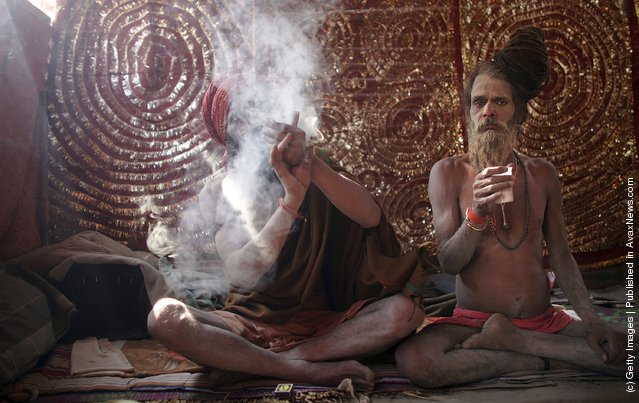
“Kumbh Mela is a mass Hindu pilgrimage in which Hindus gather at the Ganges river. The normal Kumbh Mela is celebrated every 3 years, the Ardh (half) Kumbh Mela is celebrated every six years at Haridwar and Prayag, the Purna (complete) Kumbh takes place every twelve years, at four places (Prayag (Allahabad), Haridwar, Ujjain, and Nashik). The Maha (great) Kumbh Mela which comes after 12 “Purna Kumbh Melas”, or 144 years, is held at Allahabad.

The last Ardh Kumbh Mela was held over a period of 45 days beginning in January 2007, more than 70 million Hindu pilgrims took part in the Ardh Kumbh Mela at Prayag, and on January 15, the most auspicious day of the festival of Makar Sankranti, more than 5 million participated. The previous Maha Kumbh Mela, held in 2001, was attended by around 60 million people, making it at the time the largest gathering anywhere in the world in recorded history”. – Wikipedia

Photo: Sadhus (holy men) smoke at their camp near the ritual site at Sangam, the confluence of the Ganges, Yamuna and mythical Saraswati rivers during the Ardh Kumbh Mela festival (Half Pitcher festival) January 18, 2007 in Allahabad, India. Millions of Hindu pilgrims have flocked to the largest religious gathering in the world which lasts for 45 days in northern India. The festival commemorates the mythical conflict between gods and demons over a pitcher filled with the “nectar of immortality”. Devotees believe that taking a holy dip in the Ganges at this time washes away their sins and paves the path to salvation. (Photo by Mario Tama/Getty Images)

Details
30 Jun 2011 10:27:00
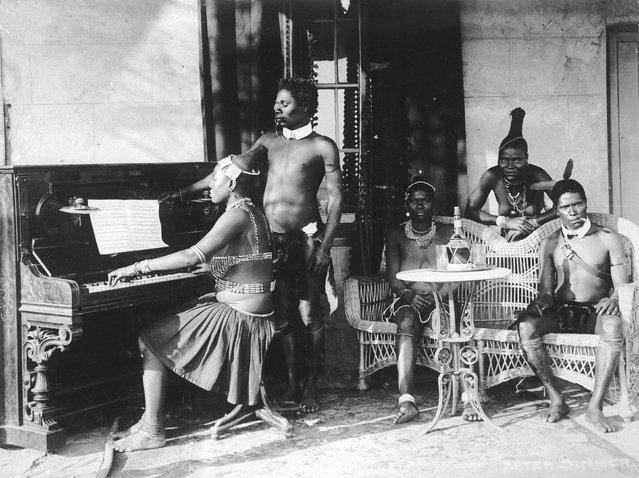
circa 1925:  A Zulu woman playing the piano while a group of others sit and listen.  (Photo by General Photographic Agency/Getty Images)

“The Zulu are the largest South African ethnic group, with an estimated 10–11 million people living mainly in the province of KwaZulu-Natal. Small numbers also live in Zimbabwe, Zambia, and Mozambique. Their language, Zulu, is a Bantu language; more specifically, part of the Nguni subgroup. The Zulu Kingdom played a major role in South African history during the 19th and 20th centuries. Under apartheid, Zulu people were classed as third-class citizens and suffered from state-sanctioned discrimination. They remain today the most numerous ethnic group in South Africa, and now have equal rights along with all other citizens”. – Wikipedia.

Photo: A Zulu woman playing the piano while a group of others sit and listen (to put it briefly, Englishmen scoff over Zulu). South Africa, circa 1925. (Photo by General Photographic Agency)

Details
03 Feb 2014 09:40:00


Film actress Audrey Hepburn (1929–1993) on a film set with her pet poodle, circa 1960. (Photo by Hulton Archive/Getty Images)
Details
19 Jul 2011 11:56:00
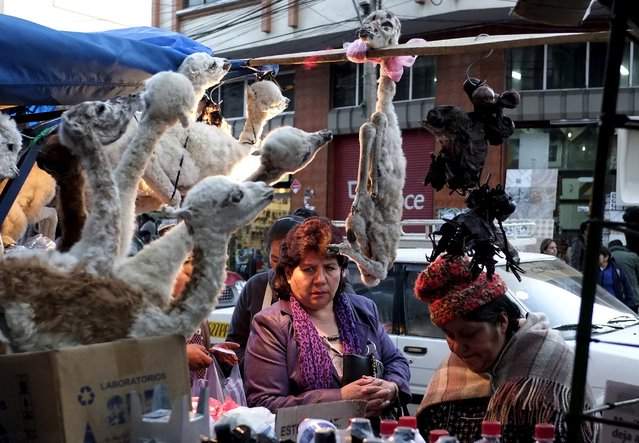
A woman (C) shops for an offering at the witch doctor's street in La Paz, July 31, 2015. (Photo by David Mercado/Reuters)

A woman (C) shops for an offering at the witch doctor's street in La Paz, July 31, 2015. According to Andean culture, the all the month of August is a time to give offerings to “Pachamama” to give thanks for their farms and health. The Aymaras use coca leaves, candies, animal fat, llama fetuses, some dried fruits, powdered minerals and alcohol during these rituals. (Photo by David Mercado/Reuters)
Details
02 Aug 2015 12:27:00
A woman poses next to two mailboxes along a street in Taipei on August 11, 2015 that were reportedly bent by strong winds brought by Typhoon Soudelor over the weekend. The two iron mailboxes have become an unlikely attraction, drawing thousands of snap-happy visitors and have even become a backdrop to a wedding photo shoot. (Photo by Benjamin Yeh/AFP Photo)

A woman poses next to two mailboxes along a street in Taipei on August 11, 2015 that were reportedly bent by strong winds brought by Typhoon Soudelor over the weekend. The two iron mailboxes have become an unlikely attraction, drawing thousands of snap-happy visitors and have even become a backdrop to a wedding photo shoot. The typhoon, which hit in the early hours of August 8 and was billed as the most powerful typhoon this year, uprooted trees, brought down electricity poles, knocking out power to a record 4.3 million households, while leaving eight dead and four missing. (Photo by Benjamin Yeh/AFP Photo)
Details
12 Aug 2015 13:44:00
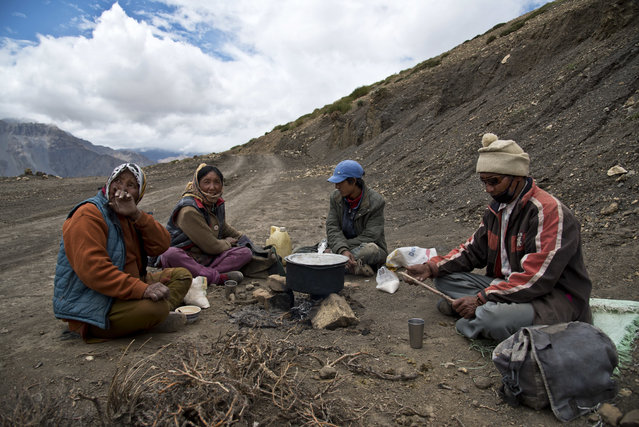
In this August 17, 2016, photo, from left to right, Chhering Chodom, 60, Tashi Yangzom, 50, Lobsang Chhering, 27, and Dorje Tandup, 58, drink milk tea on the side of the road. For centuries, the sleepy valley nestled in the Indian Himalayas remained a hidden Buddhist enclave forbidden to outsiders. Enduring the harsh year-round conditions of the high mountain desert, the people of Spiti Valley lived by a simple communal code – share the Earth's bounty, be hospitable to neighbors, and eschew greed and temptation at all turns. That's all starting to change, for better or worse. Since India began allowing its own citizens as well as outsiders to visit the valley in the early 1990s, tourism and trade have boomed. And the marks of modernization, such as solar panels, asphalt roads and concrete buildings, have begun to appear around some of the villages that dot the remote landscape at altitudes above 4,000 meters (13,000 feet). (Photo by Thomas Cytrynowicz/AP Photo)

In this August 17, 2016, photo, from left to right, Chhering Chodom, 60, Tashi Yangzom, 50, Lobsang Chhering, 27, and Dorje Tandup, 58, drink milk tea on the side of the road. For centuries, the sleepy valley nestled in the Indian Himalayas remained a hidden Buddhist enclave forbidden to outsiders. Enduring the harsh year-round conditions of the high mountain desert, the people of Spiti Valley lived by a simple communal code – share the Earth's bounty, be hospitable to neighbors, and eschew greed and temptation at all turns. That's all starting to change, for better or worse. (Photo by Thomas Cytrynowicz/AP Photo)
Details
15 Sep 2016 09:22:00