Loading...
Done
Number 10. BELL H-13 SIOUX was a two-bladed, single engine, light helicopter built by Bell Helicopter. Westland Aircraft manufactured the Sioux under license for the British military as the Sioux AH.1 and HT. (Photo by AP Photo)

Number 10. BELL H-13 SIOUX was a two-bladed, single engine, light helicopter built by Bell Helicopter. Westland Aircraft manufactured the Sioux under license for the British military as the Sioux AH.1 and HT. In 1947, the United States Air Force ordered the improved Bell Model 47A. Most were designated YR-13 and three winterized versions were designated YR-13A. The United States Army first ordered Bell 47s in 1948 under the designation H-13. These would later receive the name Sioux. The Bell-built H-13 B is seen airborne in this April 29, 1951 photo. The helicopter is equipped with a 173 horsepower engine, cruises at 85 miles per hour, climbs 900 feet in a minute and has a service ceiling of 11,500 feet. (Photo by AP Photo)
Details
08 Aug 2014 11:59:00
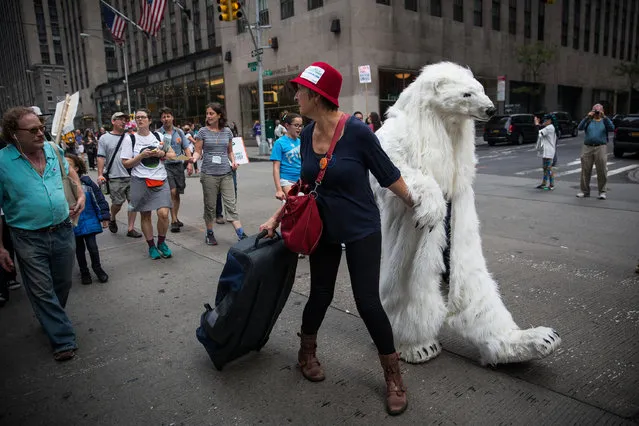
People protest for greater action against climate change during the People's Climate March on September 21, 2014 in New York City. The march, which calls for drastic political and economic changes to slow global warming, has been organized by a coalition of unions, activists, politicians and scientists. (Photo by Andrew Burton/Getty Images)

People protest for greater action against climate change during the People's Climate March on September 21, 2014 in New York City. The march, which calls for drastic political and economic changes to slow global warming, has been organized by a coalition of unions, activists, politicians and scientists. (Photo by Andrew Burton/Getty Images)
Details
22 Sep 2014 11:02:00
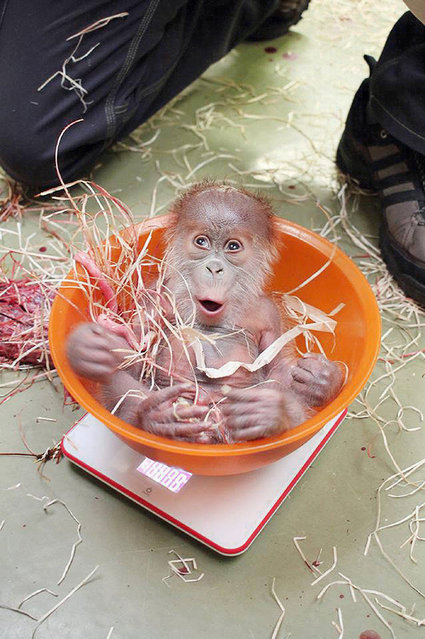
This female orangutan was born at the zoo in the German capital of Berlin.  German online users have fallen in love with Berlin Zoo's most recent addition – this newborn orangutan. (Photo by Europics/Zoo Berlin)

This female orangutan was born at the zoo in the German capital of Berlin. German online users have fallen in love with Berlin Zoo's most recent addition – this newborn orangutan. The female orangutan was born in the early hours of 12th January at the zoo in the German capital of Berlin and weighed a tiny 1.8 kilograms, normally regarded as small for an orangutan baby but nevertheless the infant is healthy and strong. (Photo by Europics/Zoo Berlin)
Details
23 Jan 2015 13:39:00
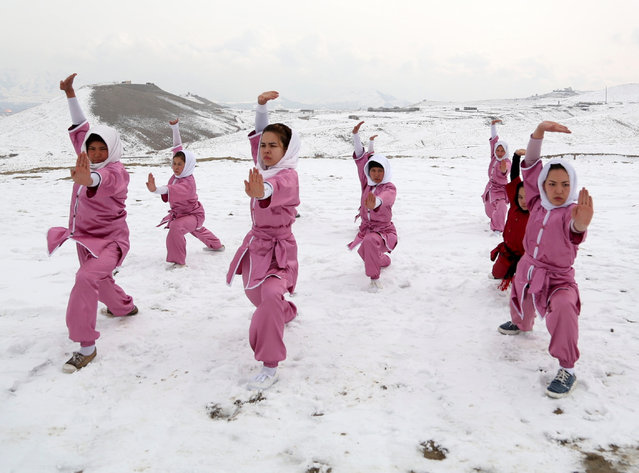
Afghan girl athletes perform Wushu on the top of a hill in Kabul, capital of Afghanistan, January 18, 2017. In the conservative Afghan society where people especially in the countryside deeply believe in the old traditions and don't allow their girls and female members of the family to go out of home, exercising sport in open is extremely risky, but a group of girls are broken the taboo and exercising Wushu on a hilltop where the temperature is minus 2 Celsius degrees. (Photo by Rahmat Alizadah/Xinhua/Barcroft Images)

Afghan girl athletes perform Wushu on the top of a hill in Kabul, capital of Afghanistan, January 18, 2017. In the conservative Afghan society where people especially in the countryside deeply believe in the old traditions and don't allow their girls and female members of the family to go out of home, exercising sport in open is extremely risky, but a group of girls are broken the taboo and exercising Wushu on a hilltop where the temperature is minus 2 Celsius degrees. (Photo by Rahmat Alizadah/Xinhua/Barcroft Images)
Details
21 Jan 2017 11:26:00
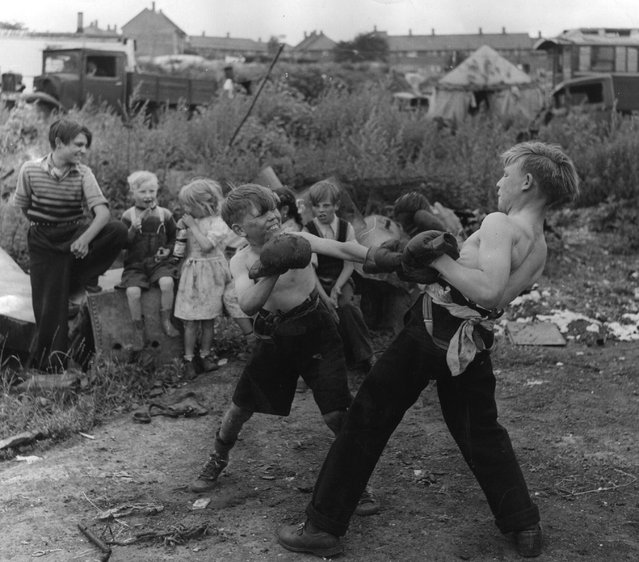
The unromantic gypsies. Children boxing in a gypsy camp in Kent, England on July 1, 1951. Like all boys these gypsy lads like to try their hand at boxing. Encouraged by their friends they fight it out on Corke's Meadow. Few Romanies now live a life of wandering romance. Most are like the three hundred squatters of Corke's Meadow, Kent, which is part of a “gypsy problem” that involves about 100,000 today. Of those about 25,000 can be rightly called gypsies, the rest are Mumpers and Posh-rats and Hobos. Corke's Meadow has both kinds. “Picture Post” cameraman Bert Hardy photographs the Corke's Meadow gypsies in their encampment. (Photo by Hulton-Deutsch Collection/Corbis via Getty Images)

The unromantic gypsies. Children boxing in a gypsy camp in Kent, England on July 1, 1951. Like all boys these gypsy lads like to try their hand at boxing. Encouraged by their friends they fight it out on Corke's Meadow. Few Romanies now live a life of wandering romance. Most are like the three hundred squatters of Corke's Meadow, Kent, which is part of a “gypsy problem” that involves about 100,000 today. Of those about 25,000 can be rightly called gypsies, the rest are Mumpers and Posh-rats and Hobos. Corke's Meadow has both kinds. “Picture Post” cameraman Bert Hardy photographs the Corke's Meadow gypsies in their encampment. (Photo by Hulton-Deutsch Collection/Corbis via Getty Images)
Details
12 Mar 2017 00:01:00
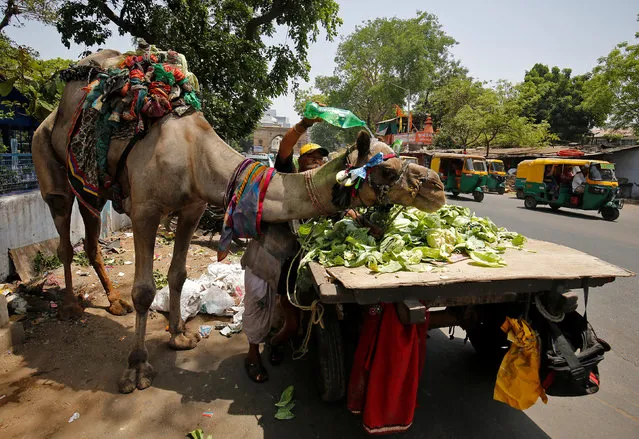
A man pours water on his camel on a hot summer day in Ahmedabad, India, May 18, 2017. (Photo by Amit Dave/Reuters)

A man pours water on his camel on a hot summer day in Ahmedabad, India, May 18, 2017. (Photo by Amit Dave/Reuters)
Details
22 May 2017 07:21:00
In this June 12, 2017 photo, a woman stands in front of a mural on the slope in Central district, Hong Kong. (Photo by Kin Cheung/AP Photo)

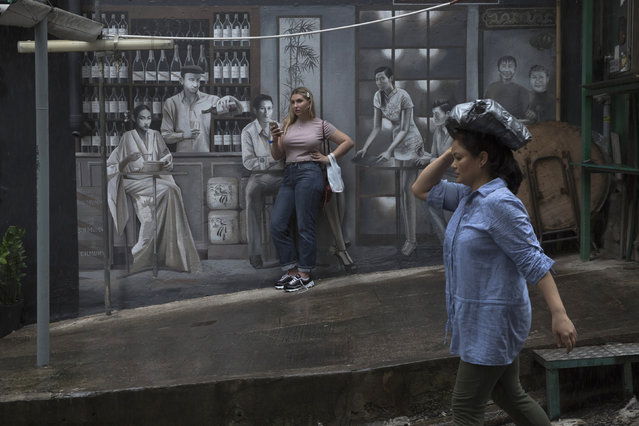
In this June 12, 2017 photo, a woman stands in front of a mural on the slope in Central district, Hong Kong. Once known as Victoria after the British queen, Hong Kong island's waterfront formed the core of the British settlement after Hong Kong island was handed over as a colony in 1842. Today as Hong Kong approaches the 20th anniversary of its return to China, it remains a bustling commercial and financial center as well as the location of the main government offices. However, along the streets that angle sharply upward toward the mountains above, a more relaxed pace of life endures. (AP Photo/Kin Cheung)
Details
28 Jun 2017 08:18:00
A devotee with his body painted poses as he waits to perform during a ritual as part of the annual Shiva Gajan religious festival at Sona Palasi village, in West Bengal, India, April 11, 2016. Devotees offer sacrifices and perform acts of devotion during the festival in the hopes of winning the favour of Hindu god Shiva and ensuring the fulfillment of their wishes, and also to mark the end of the Bengali calendar year. (Photo by Rupak De Chowdhuri/Reuters)

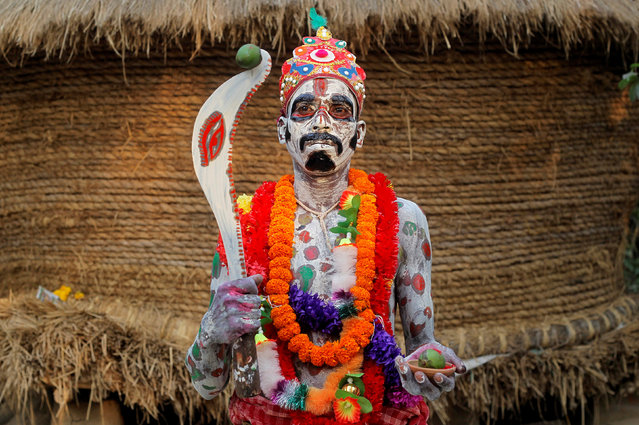
A devotee with his body painted poses as he waits to perform during a ritual as part of the annual Shiva Gajan religious festival at Sona Palasi village, in West Bengal, India, April 11, 2016. Devotees offer sacrifices and perform acts of devotion during the festival in the hopes of winning the favour of Hindu god Shiva and ensuring the fulfillment of their wishes, and also to mark the end of the Bengali calendar year. (Photo by Rupak De Chowdhuri/Reuters)
Details
13 Apr 2016 09:42:00