A worker puts up an advertising billboard for a recruiting company, featuring what resembles US President Donald Trump, in Zagreb, Croatia, Saturday, November 7, 2020. (Photo by Darko Bandic/AP Photo)
Vehicles move past a man wearing a protective mask against COVID-19 as he waits for the bus in Karachi, Pakistan on December 11, 2020. (Photo by Akhtar Soomro/Reuters)
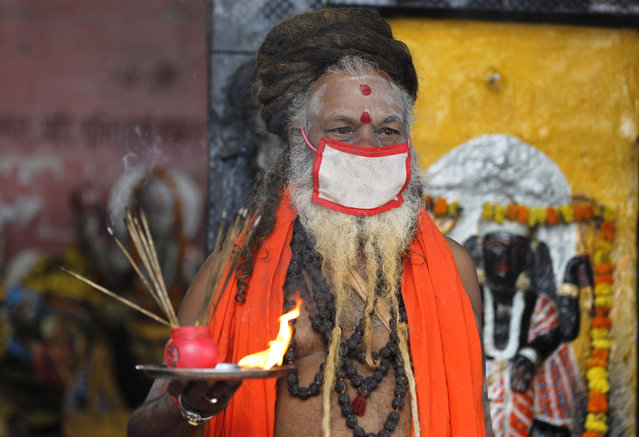
An Indian priest covers his face with a mask as a precaution against coronavirus and prays at a temple, in Prayagraj, India, Monday, June 8, 2020. (Photo by Rajesh Kumar Singh/AP Photo)
Caesar McCool, a therapy llama nicknamed the “No Drama Llama” and his handler Larry McCool greet a driver in a McLaren at the site of ongoing protests against police violence and racial inequality, in Portland, Oregon, U.S., August 6, 2020. (Photo by Nathan Howard/Reuters)
A fisherman carries a large Pirarucu (Arapaima gigas) at the Piagacu-Purus Sustainable Development Reserve in Amazonas state, Brazil, on October 24, 2019. The pirarucu -a giant fish of the Amazon, that had been on the verge of extinction- can measure up to three meters and weigh more than 200 kilos. The soft and tasty white meat fish is nowadays served in renowned restaurants in Rio de Janeiro. (Photo by Ricardo Oliveira/AFP Photo)
Harry Potter fan Emil Valkov, 7, from Bulgaria, who travelled to Britain with his family to attend the event for his older sister's birthday, poses for a photo at “Platform 9 3/4” during Back to Hogwarts Day at Kings Cross Station in London, Britain on September 1, 2023. (Photo by Hollie Adams/Reuters)
A Palestinian sits among the rubble of buildings destroyed during the Israeli offensive, amid a ceasefire between Israel and Hamas, in Rafah in the southern Gaza Strip on February 4, 2025. (Photo by Hatem Khaled/Reuters)
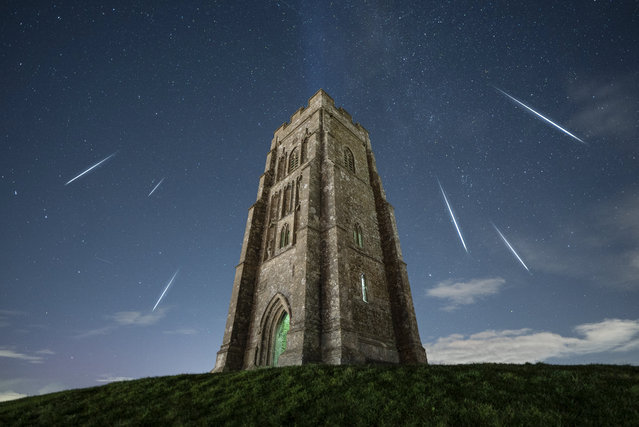
An amazing photo shows a rare meteor shower captured from Glastonbury Tor, UK. Astrophotographer Josh Dury took the photo when the skies cleared for 30 minutes in the early hours of the morning on January 4, 2024. Josh said the Quadrantids meteor shower is an active shower where up to 100 meteors can be seen per hour, although it only peaks for a few hours during January. He said that meteor showers are produced by debris left over from comets – but what produces the meteors during the Quadrantids meteor shower is unknown. (Photo by Josh Dury/South West News Service)