Loading...
Done
D-Day memory lane

World War II veteran Jack W. Schlegel, 91 years-old, from Mount Tremper, New York, of the 508th Parachute Infantry Division of the 82nd Airborne who parachuted near Sainte-Mere-Eglise on June 6,1944, poses with American and French flags as he visits the American War cemetery in Colleville-sur-Mer, on the Normandy coast June 2, 2014. REUTERS/Pascal Rossignol
Details
04 Jun 2014 19:12:00
Hungary, MAV 424 Steam Train. (Photo by Rebecca Bathory)

“Only the most intrepid urban explorers cross the tattered ruins of the old Iron Curtain to endure the excessive bureaucracy, military paranoia and freezing winds of the East to hunt for the ghosts of an empire. Rebecca Litchfield is one who couldn't resist the haunting allure of the ruins of the Soviet Union”. – Yahoo News. Photo: Hungary, MAV 424 Steam Train. (Photo by Rebecca Bathory)
Details
20 Jul 2014 11:14:00
Indian passengers travel on a local train in New Delhi, India, October 2017. (Photo by Ankur Dutta/Barcroft Media)

Indian passengers travel on a local train in New Delhi, India, October 2017. Constructed in 1975 to bypass the crowded and passenger-heavy Old Delhi, New Delhi and Hazrat Nizamuddin railway stations, the railway line once used to be the lifeline of the capital. (Photo by Ankur Dutta/Barcroft Media)
Details
02 Nov 2017 08:49:00
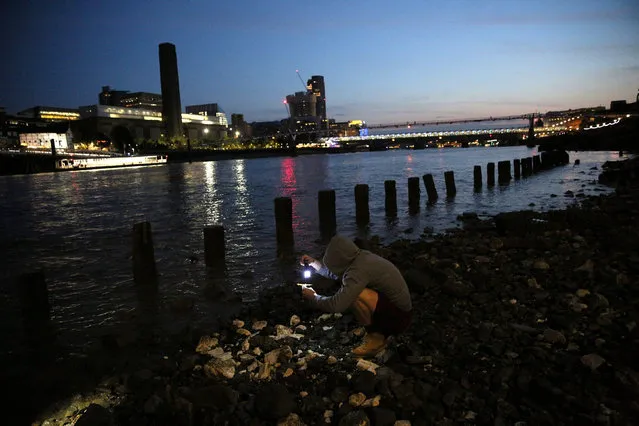
A mudlark uses a torch to look for items on the bank of the River Thames in London, Britain June 06, 2016. Mudlarking is believed to trace its origins to the 18th and 19th century, when scavengers searched the Thames' shores for items to sell. These days, history and archaeology fans are the ones hoping to find old relics such as coins, ceramics, artifacts or everyday items from across centuries. They wait for the low tide and then scour specific areas of exposed shores. "If you're in a field you could be out all day long, with the river you're restricted to about two or three hours," mudlark Nick Stevens said. While many just use the naked eye for their searches, others rely on metal detectors for which a permit from the Port of London Authority is needed. Digging also requires consent. (Photo by Neil Hall/Reuters)

A mudlark uses a torch to look for items on the bank of the River Thames in London, Britain June 06, 2016. Mudlarking is believed to trace its origins to the 18th and 19th century, when scavengers searched the Thames' shores for items to sell. These days, history and archaeology fans are the ones hoping to find old relics such as coins, ceramics, artifacts or everyday items from across centuries. their finds with the Portable Antiquities Scheme. Any item over 300 years old must be recorded. (Photo by Neil Hall/Reuters)
Details
27 Aug 2016 10:43:00
A handout photo provided by the Police department in Lippe on 01 June 2015 of a British “Challenger 2” tank after it rolled over a car's front in Lippe, Germany, 01 June 2015. Police reported that a 18-year old female driving beginner from Detmold apparently overlooked a convoy of tanks when she turned left onto the Panzeringstrasse (lit. Tank Ring Road). The driver of the convoy'e leading tank, a 24-year old British national, was not able to stop his vehicle fast enough, hit the car and overran the vehicle's front. The young female car driver remained unhurt. The exclusive damage to the car was estimated at about 12,000 euro. (Photo by EPA/Polizei Lippe)

A handout photo provided by the Police department in Lippe on 01 June 2015 of a British “Challenger 2” tank after it rolled over a car's front in Lippe, Germany, 01 June 2015. Police reported that a 18-year old female driving beginner from Detmold apparently overlooked a convoy of tanks when she turned left onto the Panzeringstrasse (lit. Tank Ring Road). (Photo by EPA/Polizei Lippe)
Details
06 Mar 2020 00:03:00
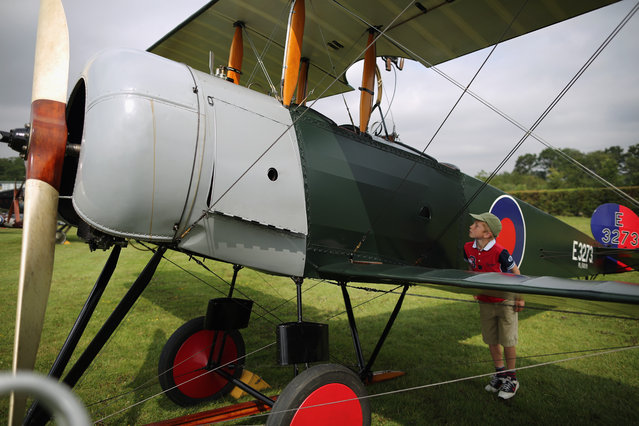
Aviation enthusiast Patrick Wilson 8, from Wetherby looks at  an Avro 504 k at “The Shuttlesworth Collection” at Old Warden on July 21, 2014 in Biggleswade, England. Of the 55,000 planes that were manufactured by the Royal Army Corps (RAC) during WWI, only around 20 remain in airworthy condition. (Photo by Dan Kitwood/Getty Images)

Aviation enthusiast Patrick Wilson 8, from Wetherby looks at an Avro 504 k at “The Shuttlesworth Collection” at Old Warden on July 21, 2014 in Biggleswade, England. Of the 55,000 planes that were manufactured by the Royal Army Corps (RAC) during WWI, only around 20 remain in airworthy condition. Six of these belong to The Shuttleworth Collection at Old Warden, Bedfordshire, making it the most complete collection of original airworthy WWI aircraft in the world. Amongst the collection is the SE5a. The SE5a is a single seater fighter aircraft. It is an original biplane designed by the Royal Aircraft Factory, with its engine built by Wolseley Motors Ltd, and it was issued to 84 Squadron in November 1918. The National Archive in Kew has recently verified that the plane saw action in France with 84 Squadron the day before Armistice, November 10, 1918. (Photo by Dan Kitwood/Getty Images)

Details
23 Jul 2014 10:00:00
An undated handout picture made available by the Symbio Wildlife Park on 28 November 2016 shows three Pygmy Marmoset monkeys including an adult male, a female juvenile and a four-week-old baby, at the Symbio Wildlife Park in Helensburgh, South of Sydney, New South Wales, Australia. Officers were called to the wildlife park in Helensburgh on 26 November, after staff discovered the monkeys were missing from their enclosure. According to reports on 27 November, two men have been charged with stealing the three rare monkeys after they were found while driving south-west Sydney with one of the missing monkeys, the four-week-old one. Wollongong Police found the missing female juvenile, Sofia, in the Campbelltown area on 27 November, and returned her to the care of the zoo. The male marmoset, father “Gomez”, was reported still missing. (Photo by EPA/Symbio Wildlife Park)

An undated handout picture made available by the Symbio Wildlife Park on 28 November 2016 shows three Pygmy Marmoset monkeys including an adult male, a female juvenile and a four-week-old baby, at the Symbio Wildlife Park in Helensburgh, South of Sydney, New South Wales, Australia. (Photo by EPA/Symbio Wildlife Park)
Details
04 Dec 2016 09:58:00


Mah Chan, a Long Neck Padaung hill tribe woman weaves a scraf for sale to tourists in a small village where 30 familes live July 13, 2006 in Chiang Dao, Thailand. All the Long Neck villages are set up for tourists and just over a year ago the hill tribe members were hand picked to move closer to Chiang Mai from more remote communities so that they could be more accessible. The Padaung women famously wear brass rings around their necks, beginning at five-years-old, to distort the growth of their collarbones and making them look like they have long necks. They are originally from eastern Burma near the Thailand border. (Photo by Paula Bronstein/Getty Images)
Details
19 Apr 2011 11:56:00