Loading...
Done
People attend The Night of Ancient Bonfires event in Saulkrasti, Latvia on August 27, 2022. During The Night of Ancient Bonfires people light bonfires along the coastline of the Baltic Sea. (Photo by Ints Kalnins/Reuters)

People attend The Night of Ancient Bonfires event in Saulkrasti, Latvia on August 27, 2022. During The Night of Ancient Bonfires people light bonfires along the coastline of the Baltic Sea. (Photo by Ints Kalnins/Reuters)
Details
07 Nov 2022 04:24:00
A row of abandoned oil tanks is filled with creepers on the riverside of Liyun River in Huai 'an, East China's Jiangsu Province, May 9, 2023. (Photo credit should read CFOTO/Future Publishing via Getty Images)

A row of abandoned oil tanks is filled with creepers on the riverside of Liyun River in Huai 'an, East China's Jiangsu Province, May 9, 2023. (Photo credit should read CFOTO/Future Publishing via Getty Images)
Details
21 Jun 2023 02:21:00
A girl runs with her face painted at a square in La Guaira, Venezuela, Wednesday, February 15, 2023. Venezuelans prepare for upcoming carnivals. (Photo by Ariana Cubillos/AP Photo)

A girl runs with her face painted at a square in La Guaira, Venezuela, Wednesday, February 15, 2023. Venezuelans prepare for upcoming carnivals. (Photo by Ariana Cubillos/AP Photo)
Details
01 Mar 2023 04:25:00
Workers in the first decade of June 2024 lacquering and organising parasols in neat lines to dry in the sunshine in Kampung Budaya Sindangbarang, West Java, so they will be preserved for longer. (Photo by Riza Amrullah/Solent News)

Workers in the first decade of June 2024 lacquering and organising parasols in neat lines to dry in the sunshine in Kampung Budaya Sindangbarang, West Java, so they will be preserved for longer. (Photo by Riza Amrullah/Solent News)
Details
18 Jul 2024 04:59:00
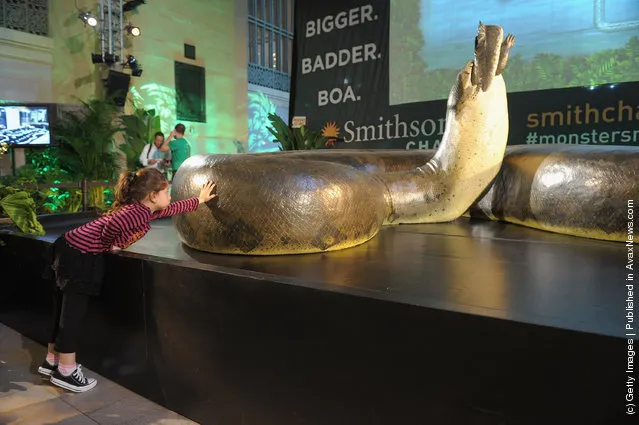
Attendees view a replica of the prehistoric Titanoboa, the largest snake to ever live, on display at Grand Central Terminal in New York City

“Titanoboa is a genus of snake that lived approximately 58–60 million years ago, during the Paleocene epoch, a 10-million-year period immediately following the dinosaur extinction event. The only known species is the Titanoboa cerrejonensis, the largest snake ever discovered, which supplanted the previous record holder, Gigantophis”. – Wikipedia

Photo: Leah Del Rio views a replica of the prehistoric Titanoboa, the largest snake to ever live, on display at Grand Central Terminal on March 23, 2012 in New York City. (Photo by Michael Loccisano/Getty Images)

Details
24 Mar 2012 10:14:00
Two women pose as they drink real ale at the Great British Beer Festival in the Olympia exhibition centre on August 13, 2013 in London, England. The festival, which runs until August 17, 2013, has over 24 bars serving over 800 different beers, ciders and perries. (Photo by Oli Scarff/Getty Images)

Two women pose as they drink real ale at the Great British Beer Festival in the Olympia exhibition centre on August 13, 2013 in London, England. The festival, which runs until August 17, 2013, has over 24 bars serving over 800 different beers, ciders and perries. (Photo by Oli Scarff)
Details
04 Sep 2013 08:18:00
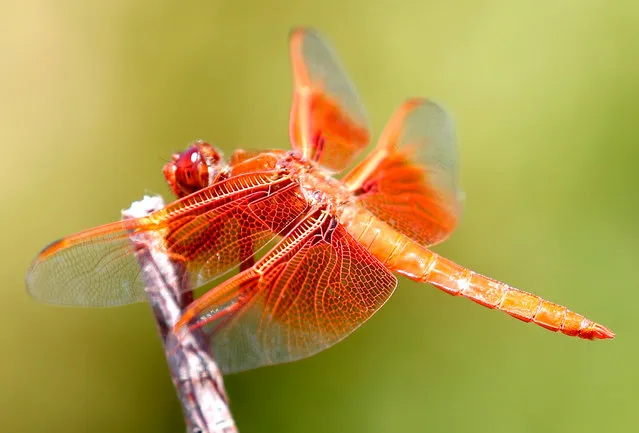
A Flame Skimmer or Firecracker Skimmer dragonfly (Libellula saturata) rests on a small branch in Topanga, California, USA, 18 June 2018. The Flame Skimmer dragonfly is found in the Western United States near ponds and creeks. (Photo by Mike Nelson/EPA/EFE)

A Flame Skimmer or Firecracker Skimmer dragonfly (Libellula saturata) rests on a small branch in Topanga, California, USA, 18 June 2018. The Flame Skimmer dragonfly is found in the Western United States near ponds and creeks. (Photo by Mike Nelson/EPA/EFE)
Details
24 Jun 2018 00:03:00
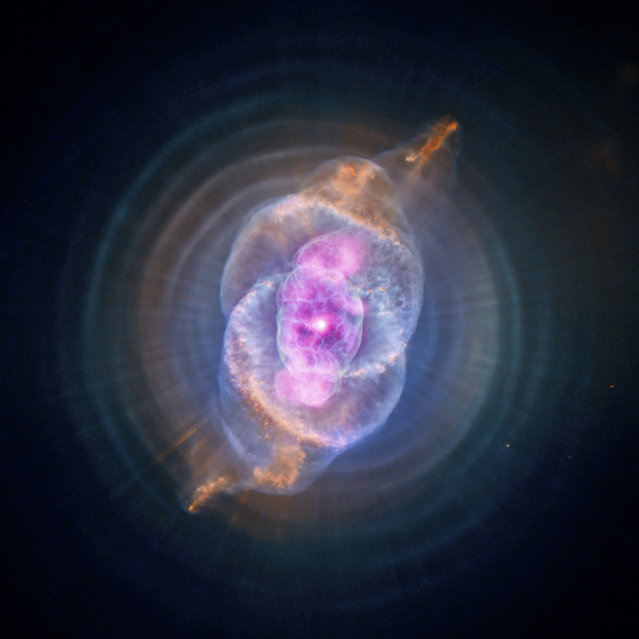
This image is NGC 6543 known as the Cat's Eye Nebula as it appears to the Chandra X-Ray Observatory and Hubble Telescope. A planetary nebula is a phase of stellar evolution that the sun should experience several billion years from now, when it expands to become a red giant and then sheds most of its outer layers, leaving behind a hot core that contracts to form a dense white dwarf star. This image was released October 10, 2012. (Photo by J. Kastner/NASA/CXC/RIT)

This image is NGC 6543 known as the Cat's Eye Nebula as it appears to the Chandra X-Ray Observatory and Hubble Telescope. A planetary nebula is a phase of stellar evolution that the sun should experience several billion years from now, when it expands to become a red giant and then sheds most of its outer layers, leaving behind a hot core that contracts to form a dense white dwarf star. This image was released October 10, 2012. (Photo by J. Kastner/NASA/CXC/RIT)
Details
15 Apr 2013 10:09:00