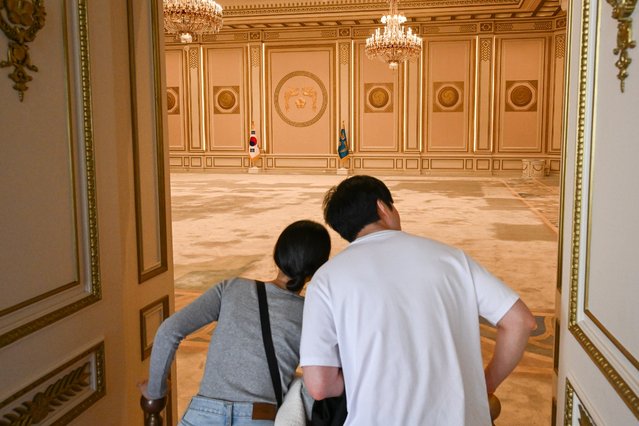
Citizens who visited the Blue House guest house on April 20, 2025 are looking around the interior. The number of visitors has skyrocketed since the impeachment of former President Yoon Seok-yeol, as the possibility of the next government returning to the Blue House has been raised. (Photo by Koh Woon-ho)
American model Emily Ratajkowski wore a cut out red dress while taking her dog Colombo for a stroll in New York City on Friday, July 25, 2023. (Photo by Santi/Splash News and Pictures)
Russian army servicewomen march during the Victory Day military parade at the Palace Square in St. Petersburg, Russia, Thursday, May 9, 2024, marking the 79th anniversary of the end of World War II. (Photo by Dmitri Lovetsky/AP Photo)
Uruguay's Julia Paternain reacts after crossing the finish line to win the bronze medal in the women's marathon at the World Athletics Championships in Tokyo, Sunday, September 14, 2025. (Photo by Matthias Schrader/AP Photo)
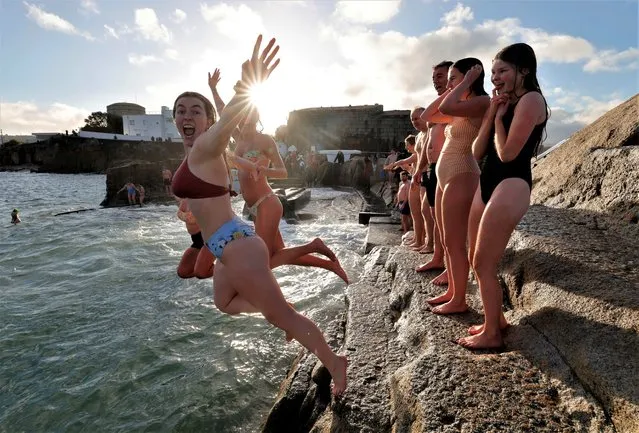
Members of the O’Neill and Gallagher families from Sydney, Australia take to the water at the 40 Foot for a Christmas Day Swim in Ireland on December 25, 2022. (Photo by Alan Betson/The Irish Times)
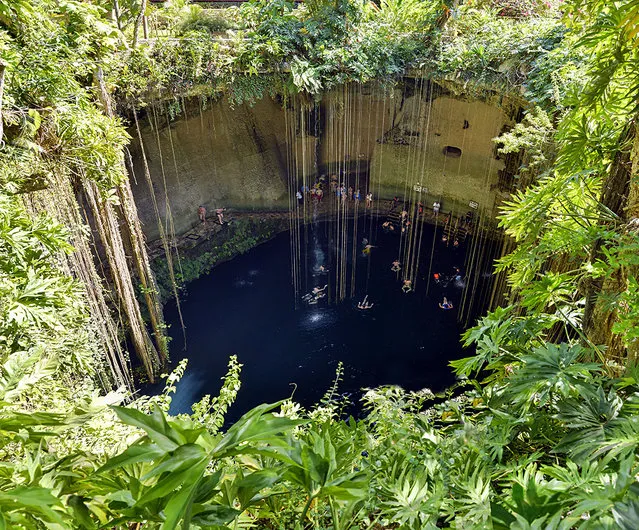
A cenote is a natural phenomenon, a sinkhole in the Earth’s surface. The Yucatan Peninsula in Mexico has an estimated 7,000 cenotes because it is primarily made up of porous limestone. For millions of years, rainfall slowly ate away at the limestone and a huge system of underground caves and caverns was formed. Many filled with water from rain or from the underground water table. When the roof of a water filled cave collapses, a cenote is born. The water found in a cenote may be fresh water, salt water, or both. Structurally it may be completely open, like a lake, almost completely closed with just a small opening at the top, or somewhere in between.