Loading...
Done
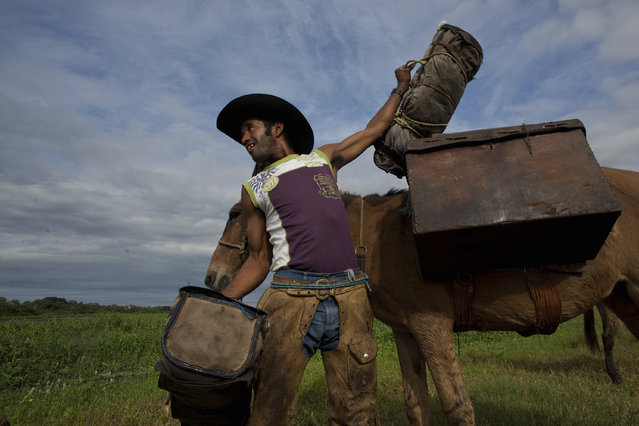
In this May 17, 2017 photo, cowboy cook Odair Batista carries a case with food in Corumba, the Pantanal wetlands of Mato Grosso do Sul state, Brazil. Dressed with leather chaps on top of their jeans, stetson hats and a machete attached to their waists, before setting off, the men finish their breakfast with Terere, an herbal “mate” beverage served ice cold in an ox drinking horn. (Photo by Eraldo Peres/AP Photo)

In this May 17, 2017 photo, cowboy cook Odair Batista carries a case with food in Corumba, the Pantanal wetlands of Mato Grosso do Sul state, Brazil. Dressed with leather chaps on top of their jeans, stetson hats and a machete attached to their waists, before setting off, the men finish their breakfast with Terere, an herbal “mate” beverage served ice cold in an ox drinking horn. (Photo by Eraldo Peres/AP Photo)
Details
12 Jun 2017 09:00:00
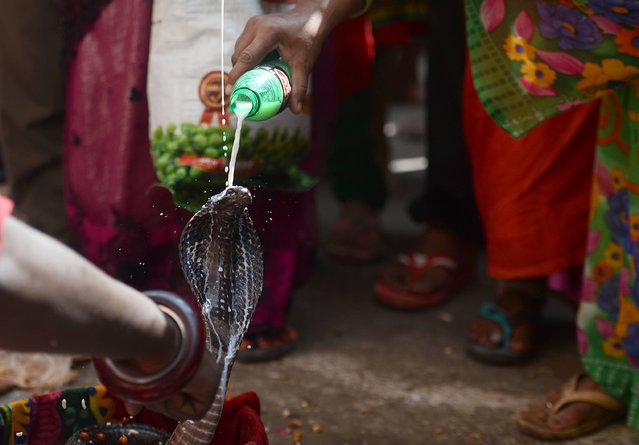
An Indian Hindu devotee pours milk on a snake as an offering during the annual Nag Panchami festival, dedicated to the worship of snakes outside the Nagvasuki temple, in Allahabad, on July 28, 2017. (Photo by Sanjay Kanojia/AFP Photo)

An Indian Hindu devotee pours milk on a snake as an offering during the annual Nag Panchami festival, dedicated to the worship of snakes outside the Nagvasuki temple, in Allahabad, on July 28, 2017. Officially the snake charmers' profession is banned in India, but many in the country offered prayers and milk blessings to cobras and other deadly serpents on July 28 in an annual tribute. The 800,000 charmers and their young apprentices come to the fore for the Nag Panchami festival which dates back several centuries. (Photo by Sanjay Kanojia/AFP Photo)
Details
31 Jul 2017 09:17:00
People visit an art installation “Alley of Flying Umbrellas” in central St. Petersburg, Russia, May 15, 2015. Art installation inspired by “Umbrella Sky Project” of Portuguese town of Agueda and was made of 500 colored umbrellas. (Photo by Anatoly Maltsev/EPA)

People visit an art installation “Alley of Flying Umbrellas” in central St. Petersburg, Russia, May 15, 2015. Art installation inspired by “Umbrella Sky Project” of Portuguese town of Agueda and was made of 500 colored umbrellas. (Photo by Anatoly Maltsev/EPA)
Details
19 May 2015 12:13:00
Extreme On Water By Kurt Arrigo

Kurt Arrigo is Malta’s most eminent and one of the world’s finest marine photographers. ­­His illustrious and diverse career has seen him capture dramatic action at elite international sporting events.
Details
24 Aug 2015 10:22:00
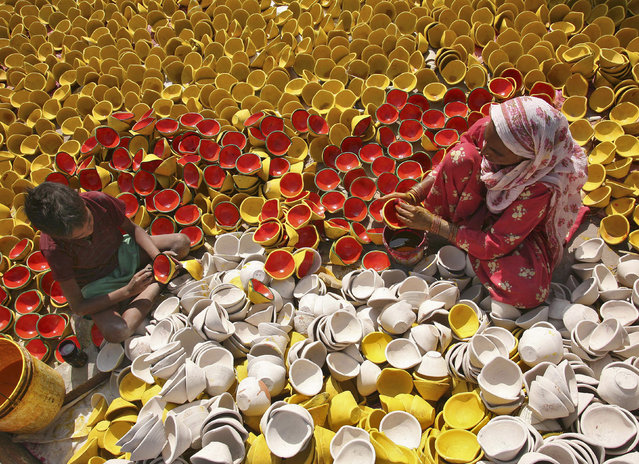
Potters colour earthen lamps at a workshop ahead of the Hindu festival of Diwali in Amritsar October 15, 2014. Earthen lamps are sold in large numbers during Diwali, the annual Hindu festival of lights, as people use them to decorate their homes. (Photo by Munish Sharma/Reuters)

Potters colour earthen lamps at a workshop ahead of the Hindu festival of Diwali in Amritsar October 15, 2014. Earthen lamps are sold in large numbers during Diwali, the annual Hindu festival of lights, as people use them to decorate their homes. (Photo by Munish Sharma/Reuters)
Details
21 Oct 2014 12:01:00
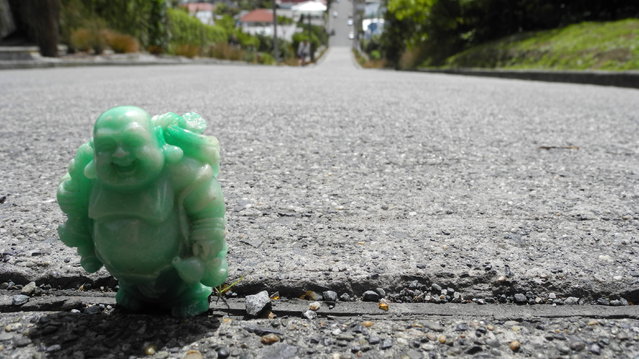
Baldwin Street - The World's Steepest Street

Baldwin Street, in Dunedin, New Zealand, is considered the world's steepest residential street. It is located in the residential suburb of North East Valley, 3.5 kilometres (2.2 mi) northeast of Dunedin's city centre.
Details
19 Jan 2014 15:26:00
A wild macaque monkey eats fruit dropped by pedestrians in a suburb of Kuala Lumpur, Malaysia, on June 11, 2013. (Photo by Mohd Rasfan/AFP Photo)

A wild macaque monkey eats fruit dropped by pedestrians in a suburb of Kuala Lumpur, Malaysia, on June 11, 2013. (Photo by Mohd Rasfan/AFP Photo)
Details
15 Jun 2013 11:38:00
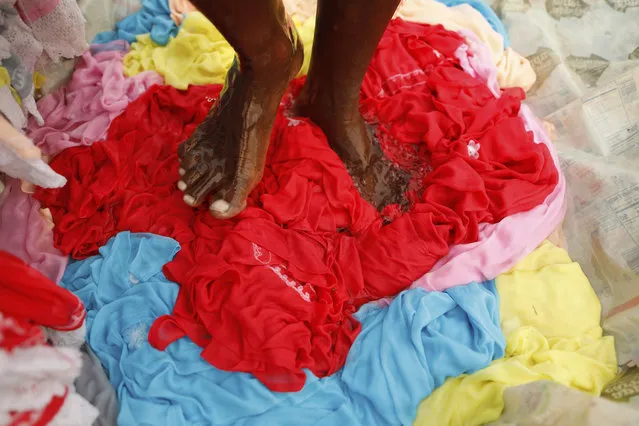
A dhobi, or a washerman washes cloths on the banks of the River Gomti in Lucknow, India, Saturday, September 12, 2020. Dhobis are traditional laundry workers who wash clothes by hand and dry them in the sun, an occupation which has been in existence for generations. Most cities in India have a Dhobi Ghat, or washermen's area, where the city's pile of clothes is laundered. This practice is still popular in India, despite of modern technology. Around 1,000 families work in Lucknow's Dhobi Ghat. However, in light of the novel coronavirus, their wages have decreased drastically. With each family earning around US$100-200 per month. (Photo by Rajesh Kumar Singh/AP Photo)

A dhobi, or a washerman washes cloths on the banks of the River Gomti in Lucknow, India, Saturday, September 12, 2020. Dhobis are traditional laundry workers who wash clothes by hand and dry them in the sun, an occupation which has been in existence for generations. Most cities in India have a Dhobi Ghat, or washermen's area, where the city's pile of clothes is laundered. This practice is still popular in India, despite of modern technology. Around 1,000 families work in Lucknow's Dhobi Ghat. However, in light of the novel coronavirus, their wages have decreased drastically. With each family earning around US$100-200 per month. (Photo by Rajesh Kumar Singh/AP Photo)
Details
25 Sep 2020 00:03:00