Loading...
Done
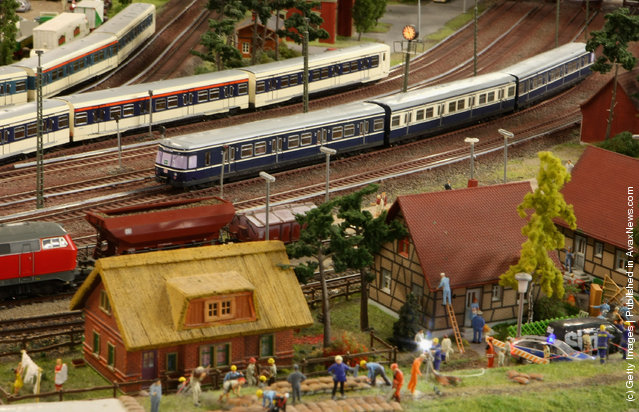
Miniatur Wunderland – The World's Biggest Model Train

“Miniatur Wunderland is a model railway attraction in Hamburg, Germany and the largest of its kind in the world. As of January 2011, the railway consists of 12,000 metres (39,370 ft) of track in HO scale, divided into seven sections: Harz, the fictitious city of Knuffingen, the Alps and Austria, Hamburg, America, Scandinavia, and Switzerland. Of the 6,400 square metres (68,889 sq ft) of floorspace, the model takes 1,150 m2 (12,378 sq ft)”. – Wikipedia

Photo: Details of the “Miniatur Wunderland” are pictured on April 2, 2009 in Hamburg, Germany. The world's largest model railway and one of the most popular tourist attractions in Germany is located next to the Elbe in Hamburg's Speicherstadt. (Photo by Joern Pollex/Getty Images)
Details
29 Nov 2011 09:02:00
Indian Muslim devotees travel in an auto rickshaw during the Urs festival in Ajmer, India, Thursday, April 23, 2015. Thousands of devotees from different parts of India travel to the shrine of Sufi saint Khwaja Moinuddin Chisht for the annual festival marking the saint's death anniversary. (Photo by Deepak Sharma/AP Photo)

Indian Muslim devotees travel in an auto rickshaw during the Urs festival in Ajmer, India, Thursday, April 23, 2015. Thousands of devotees from different parts of India travel to the shrine of Sufi saint Khwaja Moinuddin Chisht for the annual festival marking the saint's death anniversary. (Photo by Deepak Sharma/AP Photo)
Details
26 Apr 2015 08:48:00
A participant poses with his laptop during the 33rd Chaos Communication Congress on its opening day on December 27, 2016 in Hamburg, Germany. The annual event is bringing together 12,000 computer hackers and activists who will meet over the next four days to share expertise and discuss topics related to the society and the digital world. (Photo by Morris MacMatzen/Getty Images)

A participant poses with his laptop during the 33rd Chaos Communication Congress on its opening day on December 27, 2016 in Hamburg, Germany. The annual event is bringing together 12,000 computer hackers and activists who will meet over the next four days to share expertise and discuss topics related to the society and the digital world. (Photo by Morris MacMatzen/Getty Images)
Details
28 Dec 2016 10:21:00
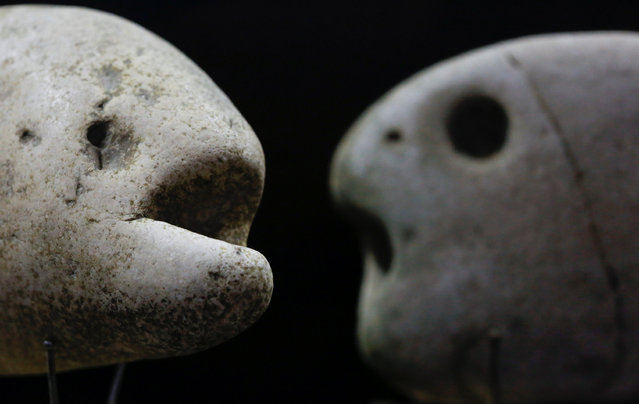
Stones collected and categorised by shape (fish) are seen at the home workshop of Luigi Lineri in Zevio, near Verona, Italy, June 10, 2016. (Photo by Alessandro Bianchi/Reuters)

Stones collected and categorised by shape (fish) are seen at the home workshop of Luigi Lineri in Zevio, near Verona, Italy, June 10, 2016. Luigi Lineri's home workshop is covered in stones – tens of thousands of them. They resemble animal heads, human faces and other forms, and the artist and poet believes may have been shaped by prehistoric humans. (Photo by Alessandro Bianchi/Reuters)
Details
17 Aug 2016 11:23:00
Nepalese women and young girls struggle to drink homemade alcohol poured through a pipe sticking out of the mouth of Swet Bhairab, a god of Power, during the Indra Jatra festival at Basantapur Durbar Square in Kathmandu, Nepal, 17 September 2016. Hundreds of women and young girls gathered to drink alcohol as a blessing from idol of Swet Bhairab which they believes will keep them free from all diseases. The Indra Jatra festival is celebrated to honor Indra, the king of gods and god of rains. The festival also marks the end of the monsoon. (Photo by Narendra Shrestha/EPA)

Nepalese women and young girls struggle to drink homemade alcohol poured through a pipe sticking out of the mouth of Swet Bhairab, a god of Power, during the Indra Jatra festival at Basantapur Durbar Square in Kathmandu, Nepal, 17 September 2016. Hundreds of women and young girls gathered to drink alcohol as a blessing from idol of Swet Bhairab which they believes will keep them free from all diseases. The Indra Jatra festival is celebrated to honor Indra, the king of gods and god of rains. The festival also marks the end of the monsoon. (Photo by Narendra Shrestha/EPA)
Details
18 Sep 2016 08:31:00
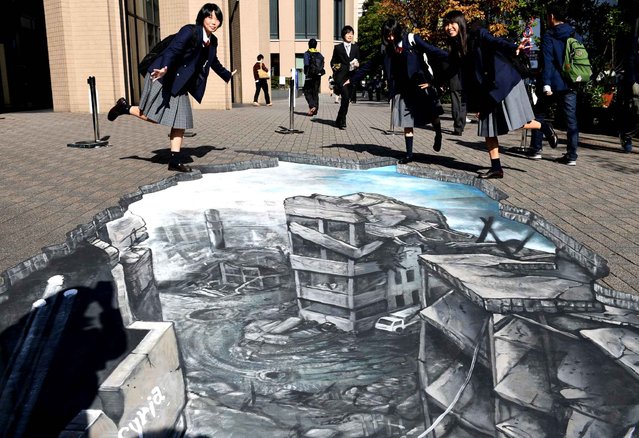
Students pose for a picture with a 3- D optical illusion artwork of a devastated cityscape in Aleppo, Syria at the campus of the Meiji University in Tokyo on November 18, 2016. The Japanese branch of the human rights organisation Amnesty International displayed the artwork to encourage people to think about the Syrian civil war. (Photo by Toshifumi Kitamura/AFP Photo)

Students pose for a picture with a 3- D optical illusion artwork of a devastated cityscape in Aleppo, Syria at the campus of the Meiji University in Tokyo on November 18, 2016. The Japanese branch of the human rights organisation Amnesty International displayed the artwork to encourage people to think about the Syrian civil war. (Photo by Toshifumi Kitamura/AFP Photo)
Details
19 Nov 2016 11:36:00
Tourists take pictures of straw figurines of traditional deities Shennong (R) and Zhang Wulang (L back) during China's National Day Holiday, in Xinhua county, Hunan province, October 4, 2015. (Photo by Reuters/China Daily)

Tourists take pictures of straw figurines of traditional deities Shennong (R) and Zhang Wulang (L back) during China's National Day Holiday, in Xinhua county, Hunan province, October 4, 2015. (Photo by Reuters/China Daily)
Details
07 Oct 2015 08:08:00
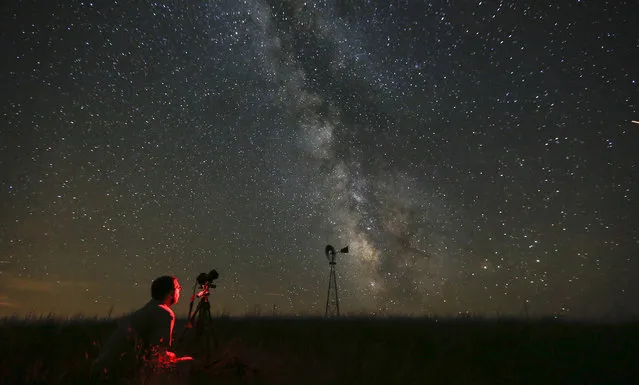
In this Wednesday, July 23, 2014 file photo, Omaha photographer Lane Hickenbottom photographs the night sky in a pasture near Callaway, Neb. With no moon in the sky, the Milky Way was visible to the naked eye. More than one-third of the world’s population can no longer see the Milky Way because of man-made lights, according to a scientific paper by Light Pollution Science and Technology Institute's Fabio Falchi and his team members, published on Friday, June 10, 2016. (Photo by Travis Heying/The Wichita Eagle via AP Photo)

In this Wednesday, July 23, 2014 file photo, Omaha photographer Lane Hickenbottom photographs the night sky in a pasture near Callaway, Neb. With no moon in the sky, the Milky Way was visible to the naked eye. More than one-third of the world’s population can no longer see the Milky Way because of man-made lights, according to a scientific paper by Light Pollution Science and Technology Institute's Fabio Falchi and his team members, published on Friday, June 10, 2016. (Photo by Travis Heying/The Wichita Eagle via AP Photo)
Details
11 Jun 2016 12:37:00