Children dressed up as Hindu Lord Krishna pose during Janmashtami festival celebrations marking the birth anniversary of Krishna in Agartala, India August 24, 2016. (Photo by Jayanta Dey/Reuters)
Rescue workers stand next to TK Bremen cargo ship which ran aground during a powerful storm, spilling oil off the coast of France's northwestern region of Brittany as it lies stranded on Kerminihy beach in Erdeven, on December 16, 2011. (Photo by Damien Meyer/AFP Photo)
Girls play in the makeshift refugee camp at the northern Greek border point of Idomeni, Greece, Thursday, March 17, 2016. Leaders of the EU's 28 divided nations reconvene in Brussels in hopes of ironing out disagreements on a proposed agreement with Turkey in the migrants crisis. (Photo by Vadim Ghirda/AP Photo)
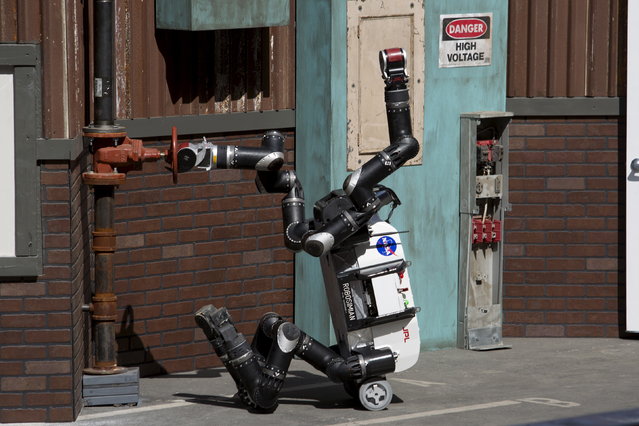
The Jet Propulsion Lab team's RoboSimian robot turns on a valve at a simulated disaster-response course during day one of the Defense Advanced Research Projects Agency (DARPA) Robotics Challenge finals in Pomona, California, June 5, 2015. (Photo by David McNew/Reuters)
U.S. players push head coach Adam Krikorian into the pool after they defeated the Netherlands in their women's water polo gold medal match during the Aquatics World Championships in Kazan, Russia, August 7, 2015. (Photo by Michael Dalder/Reuters)
America may be a nation obsessed with automobiles, but today the bicycle is giving the car a run for its money. And while New York is just one of many cities that is implementing new bikefriendly policies, the local cyclist population stands out as one of the most diverse, inventive, and stylish in the world.
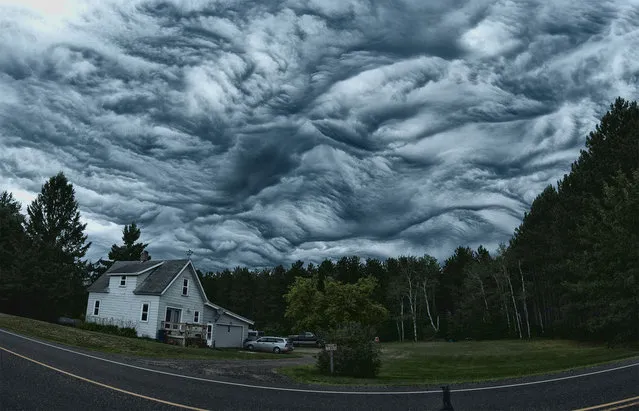
Undulatus asperatus (or alternately, asperatus) is a cloud formation, proposed in 2009 as a separate cloud classification by the founder of the Cloud Appreciation Society. If successful it will be the first cloud formation added since cirrus intortus in 1951 to the International Cloud Atlas of the World Meteorological Organization. The name translates approximately as “roughened or agitated waves”.
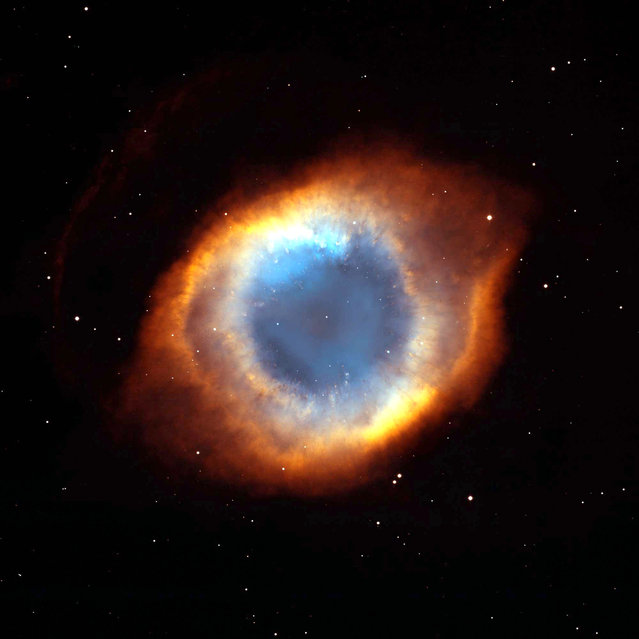
A coil-shaped Helix Nebula showing a fine web of filamentary “bicycle-spoke” features embedded in the colorful red and blue ring of gas. At 650 light-years away, the Helix is one of the nearest planetary nebulae to Earth. A planetary nebula is the glowing gas around a dying, Sun-like star. (Photo by Reuters/NASA)