Reveller Jacqueline Fernandez looks on in the rain during the 26th Annual Kensington Market Winter Solstice Parade in Toronto, Canada, December 21, 2015. (Photo by Mark Blinch/Reuters)
An Indian Sikh devotee takes a dip in the holy sarover (water tank) at the Golden Temple on the eve of “Ghallughara Diwas”, the 29th Anniversary of Operation Bluestar, in Amritsar on June 5, 2013. The 1984 assault on the Golden Temple complex by the Indian army was conducted in an attempt to arrest separatists Sikh leader Sant Jarnail Singh Bhindranwale and his militant followers who had initiated a movement for a separate Sikh state. (Photo by Narinder Nanu/AFP Photo)
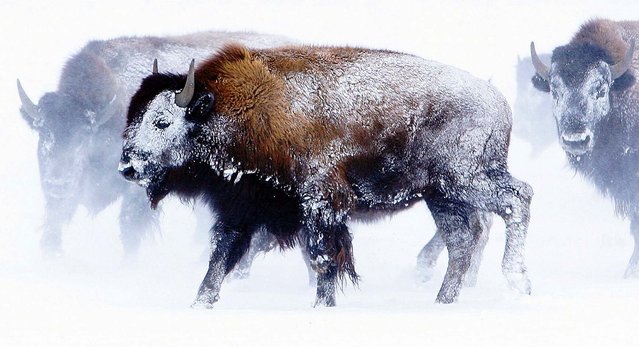
Bison along the Bitterroot Valley's Eastside Highway north of Stevensville, Montana, are covered in snow following a blizzard on November 23, 2010. (Photo by Perry Backus/The Missoulian)
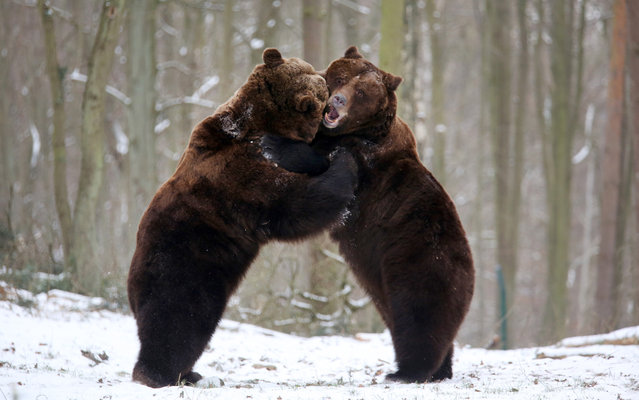
Swedish brown bears “Fred” and “Frode” play in the snow on January 30, 2014 at the Natur- und Umweltpark (NUP) animal park in Guestrow, northeastern Germany. Despite of icy temperatures, the bear brothers took a break from their winter rest. (Photo by Bernd Wuestneck/AFP Photo/DPA)
A receptionist dinosaur robot performs at the new robot hotel, aptly called Henn na Hotel or Weird Hotel, in Sasebo, southwestern Japan, Wednesday, July 15, 2015. From the receptionist that does the check-in and check-out to the porter that’s a stand-on-wheels taking luggage up to the room, the hotel, that is run as part of Huis Ten Bosch amusement park, is “manned” almost totally by robots to save labor costs. (Photo by Shizuo Kambayashi/AP Photo)
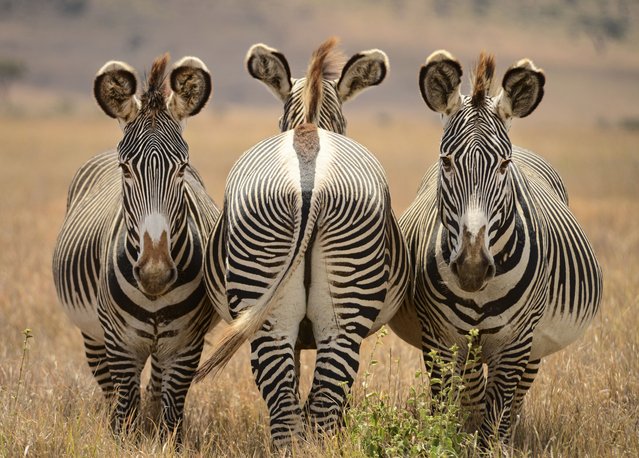
It doesn’t make for the most flattering photoshoot, but there is a reason these zebras at Lewa wildlife conservancy in Kenya in the second decade of August 2025 are stood head to tail: they use their tails to swat flies from each others’ faces. (Photo by Andrew Campbell/Solent News & Photo Agency)
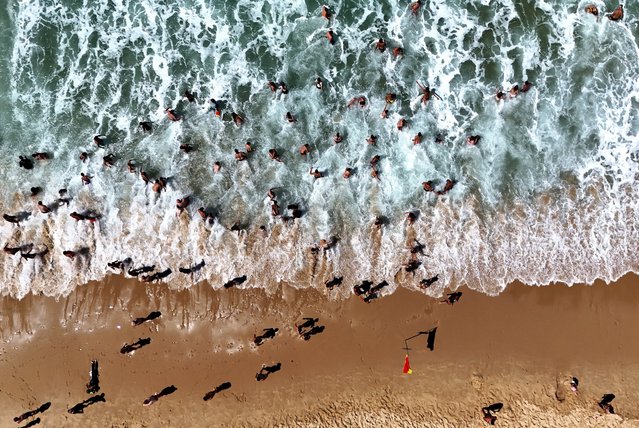
This aerial photograph shows beach-goers gathering on a beach alongside the Atlantic Ocean in Carcans, south-western France on July 22, 2025. (Photo by Christophe Archambault/AFP Photo)
Luling, Louisiana, US. New evidence contradicts previous claims of the relative safety of glyphosate, the world’s most widely used herbicide, which is manufactured here. It is often used in conjunction with seeds that have been genetically modified to tolerate its application, meaning that anyone consuming these crops is eating a genetically modified plant, and whatever residue of the pesticide that remains. (Photo by J. Henry Fair/Industrial Scars/Papadakis Publisher)