Argentina's forward #22 Lautaro Martinez shoots to score during the 2026 FIFA World Cup South American qualifiers football match between Argentina and Peru at the La Bombonera stadium in Buenos Aires on November 19, 2024. (Photo by Juan Mabromata/AFP Photo)
Camelot, with rider Kris Anderson, wins an exhibition race billed as “The Cameltonian” at the Meadowlands Race Track in East Rutherford, New Jersey June 21, 2014. Run by Hedrick's Promotions in Nickerson, Kansas, this is the third year the race has been run at the track, in tandem with an ostrich race. (Photo by Ray Stubblebine/Reuters)
Brian Skerry can be called many things – explorer, journalist, conservation advocate – but he is first and foremost a photographer. His journeys to capture amazing underwater photographs have taken him across the world’s oceans. Photo: This Bahamian oceanic whitetip shark, known for the distinctive coloring on its white-tipped, rounded extremities, is part of a globally threatened species due to overfishing demands, primarily for its fins. (Photo by Brian Skerry)
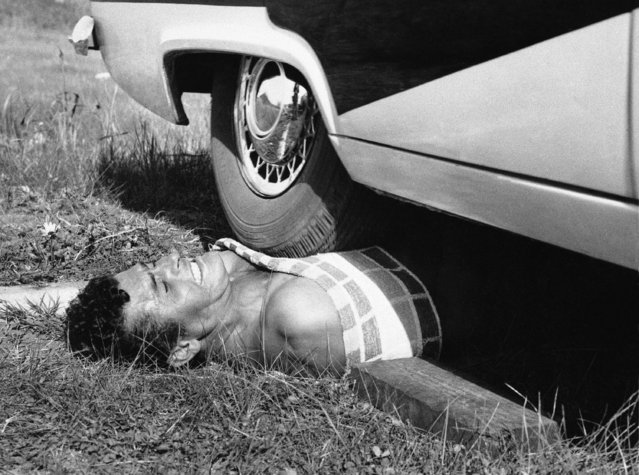
Leon Samson, 24-year-old showman, grimaces as an automobile is driven across his chest at Perth, Australia on October 9, 1960. Samson said the towel on his chest is to prevent the wheel from tearing his flesh. (Photo by AP Photo)
Visitors walk past a family of scarecrows during the Scarecrow Festival in Heather, Britain July 29, 2015. The annual event asks residents of Heather to make scarecrows to raise thousands of pounds for local groups and charities. (Photo by Darren Staples/Reuters)
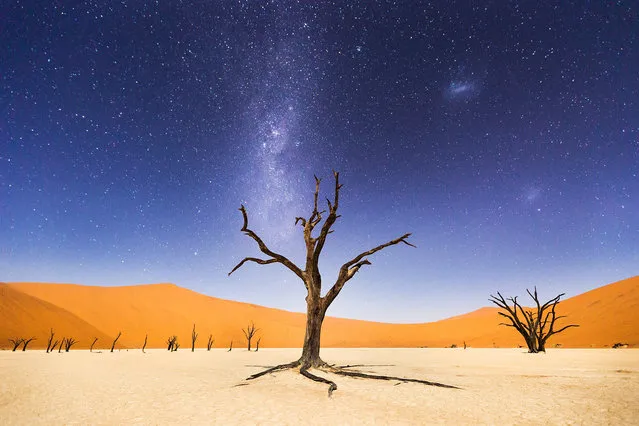
Merit: A Night at Deadvlei. The night before returning to Windhoek, we spent several hours at Deadveli. The moon was bright enough to illuminate the sand dunes in the distance, but the skies were still dark enough to clearly see the milky way and magellanic clouds. Deadveli means “dead marsh. The camelthorn trees are believed to be about 900 years old, but have not decomposed because the environment is so dry. (Photo and caption by Beth McCarley/National Geographic Traveler Photo Contest)
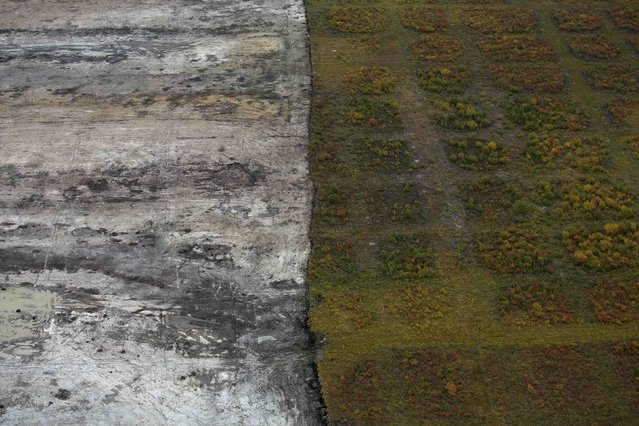
The top layer of muskeg and earth (L) is removed at the Syncrude tar sands operations near Fort McMurray, Alberta, September 17, 2014. Syncrude currently produces 350,000 barrels per day of high quality light, low sulphur crude oil according to company reports. (Photo by Todd Korol/Reuters)