Loading...
Done


“Space Exploration Technologies Corp. (SpaceX) is an American space transport company founded by PayPal co-founder Elon Musk. It has developed the Falcon 1 and Falcon 9 rockets, both of which are built with a goal of being reusable launch vehicles. SpaceX is also developing the Dragon spacecraft to be carried to orbit by Falcon 9 launch vehicles. SpaceX designs, tests and fabricates the majority of their components in-house, including the Merlin, Kestrel, and Draco rocket engines. In December 2010, SpaceX became the first private company to successfully launch, orbit and recover a spacecraft (a Dragon)”. – Wikipedia

Photo: Elon Musk, CEO of Space Exploration Technologies Corp, speaks during a news conference at the National Press Club April 5, 2011 in Washington, DC. Elon Musk, CEO of Space Exploration Technologies Corp (SpaceX) and Tesla Motors, held the news conference to announce SpaceX's Falcon Heavy rocket which could complete missions to the International Space Station and Moon and should be ready for use by the end of 2012. (Photo by Brendan Smialowski/Getty Images)
Details
06 Apr 2011 09:05:00


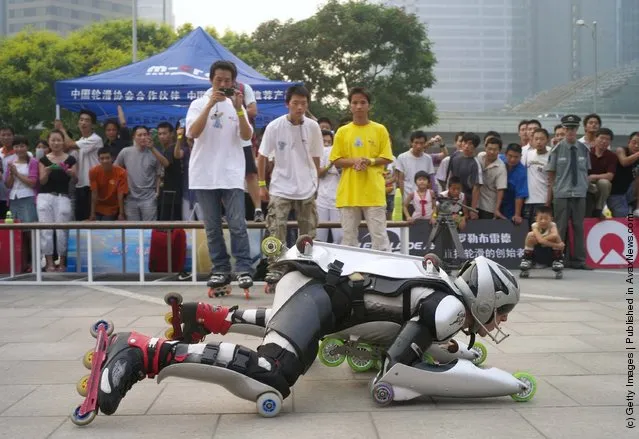
“Body blading (also known as buggy rollin') is an extreme sport that involves descending down a slope while wearing a flexible aerodynamic plastic roller suit that has wheels on the feet, knees, torso, and arms. This suit was created by Jean-Yves Blondeau, and he is one of the premier body bladers. Body blading is similar to roller blading, and in fact a body blader often starts out using the rollers on their feet in the same fashion as roller blades in order to gain initial speed, but then the rider generally assumes a position laying on the stomach facing down the hill. A body blader is capable of reaching very high speeds. Maneuverability is achieved by moving the body into various positions to change direction”. – Wikipedia

Photo: French designer Jean-Yves Blondeau demonstrates his “Buggy Rollin” suit during a performance on August 16, 2007 in Beijing, China. Blondeau is able to roll along in any position and can achieve high speeds wearing the suit. (Photo by China Photos/Getty Images)
Details
29 Jun 2011 11:00:00
The Lun-class Ekranoplane was used by the Soviet Navy starting in 1987, and wasn't retired until the late 1990s, after the Soviet Union's fall. (Igor113)

“The Lun-class ekranoplan (NATO reporting name Duck) was a ground effect vehicle (GEV) designed by Rostislav Evgenievich Alexeev and used by the Soviet and Russian navies from 1987 until sometime in the late 1990s. It “flew” using the lift generated by the ground effect of its large wings when close to the surface of the water – about four metres or less. Although they might look similar and/or have related technical characteristics, ekranoplans like the Lun are not aircraft, seaplanes, hovercraft, or hydrofoils – ground effect is a separate technology altogether. The International Maritime Organization classifies these vehicles as maritime ships. The name Lun comes from the Russian for harrier”. – Wikipedia (Photo by Igor113)
Details
08 Aug 2014 10:51:00
We Build Tomorrow – Sagrada Familia 2026 ( VIDEO )

For more than a century, the Barcelona skyline has been graced (or marred, depending on who’s talking) by the spectacle of the Basilica designed by Anton Gaudi, first started in 1882. If you want to know what it’ll look like when finished, don’t fret — 2026 is right around the corner. Or you can watch this video, released last week on YouTube by Basílica de la Sagrada Família and titled simply “2026 We Build Tomorrow,” a 3-D artists’ rendering of the building stages through completion.
(If 144 years sounds like a long time to finish a cathedral, keep in mind that there were decades that they didn’t work on it — and that Notre Dame de Paris took 182 years, although the 13th century Parisians didn’t have diesel-powered industrial cranes.) Now, if only the video could show us what the admission and hours will be in 2026 (and how to avoid the inevitable long lines).
Details
11 Jan 2014 10:59:00
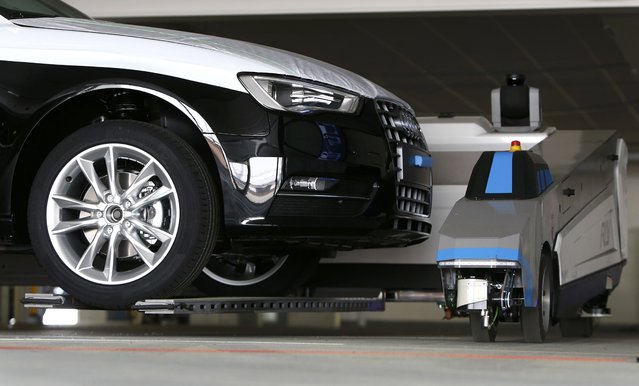
Automated guided vehicle robot “Ray” lifts up an Audi car during a pilot project at the parking area of the Audi plant in Ingolstadt, Germany, May 13, 2015. (Photo by Michaela Rehle/Reuters)

Automated guided vehicle robot “Ray” lifts up an Audi car during a pilot project at the parking area of the Audi plant in Ingolstadt, Germany, May 13, 2015. The robot has been designed to help make work more efficient and more comfortable for employees, some whom walk up to eight kilometres a day, while coordinating the finished cars for the subsequent train transportation. “Robot Ray” technology, currently being used at Dusseldorf International Airport in Germany, claims to be able to park 60 per cent more vehicles in one area compared with a human driver. (Photo by Michaela Rehle/Reuters)
Details
14 May 2015 12:04:00
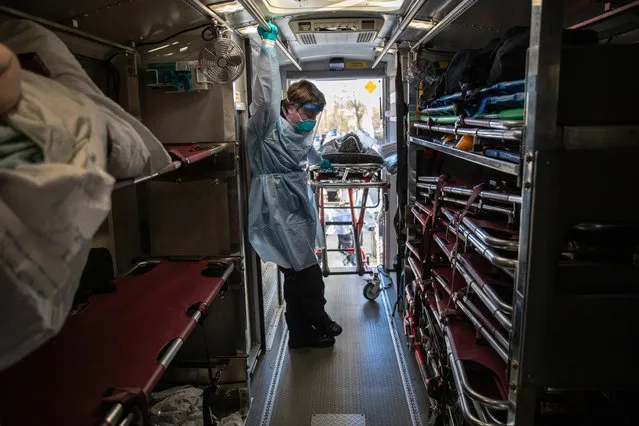
EMT Christian Amoroso, wearing personal protective equipment (PPE), pauses while unloading COVID-19 patients at the Montefiore Medical Center Wakefield Campus on April 06, 2020 in the Bronx borough of New York City. A specialized bus known as a Medical Evacuation Transport Unit (METU), caries infected patients on stretchers and benches between hospitals. The patient transfers are designed to help overwhelmed hospitals even out caseloads in Westchester County and New York City at the epicenter of the U.S. coronavirus pandemic. The patients were being transferred from the Einstein Campus, Wyler Hospital, also a Bronx Montefiore hospital. The transfers are staffed by Empress EMS, Yonkers police and hospital staff on both ends wearing PPE. (Photo by John Moore/Getty Images)

EMT Christian Amoroso, wearing personal protective equipment (PPE), pauses while unloading COVID-19 patients at the Montefiore Medical Center Wakefield Campus on April 06, 2020 in the Bronx borough of New York City. A specialized bus known as a Medical Evacuation Transport Unit (METU), caries infected patients on stretchers and benches between hospitals. (Photo by John Moore/Getty Images)
Details
19 Apr 2020 00:01:00
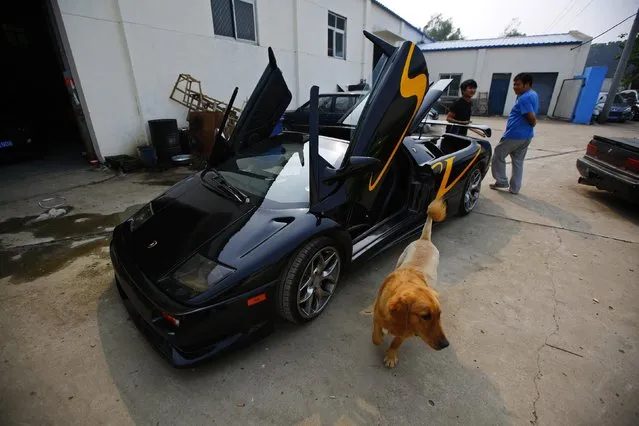
A dog walks past a handmade replica of Lamborghini Diablo outside a garage rented by Wang Yu and Li Lintao on the outskirts of Beijing, August 21, 2014. (Photo by Petar Kujundzic/Reuters)

A dog walks past a handmade replica of Lamborghini Diablo outside a garage rented by Wang Yu and Li Lintao on the outskirts of Beijing, August 21, 2014. Chinese race car enthusiasts Wang Yu and Li Lintao, both in their 30s, have finished designing and making two replicas of the Lamborghini Diablo, which can reach the top speed of 310km/h, and are currently working on a replica of the T-Rex motorcycle. They spent approximately 5 million yuan (around USD 811,899) to buy parts and hire workers, and about 6 years to assemble them with the knowledge they gained from studying mechanology for nearly a decade abroad. Wang and Li went popular after showing their first handmade replica of Lamborghini Diablo at the Beijing International Automobile Exhibition in 2012, and sold their second Lamborghini replica to Alibaba as a collection. (Photo by Petar Kujundzic/Reuters)
Details
26 Aug 2014 09:50:00
“Flashy Lady”. (Photo and caption by Roderique Arisiaman)

Some artists want to convey some deep message through their art, while some are simply satisfied with shocking the audience. Roderique Arisiaman is the latter kind. Though his works do not play on the strings of our emotion, they can pique the interest with their flashy and sometimes humorous appearance. Many of his works have a zombie theme, and are surprisingly well done, especially the one where a man pushes his fingers through his cheek and into his eye. If given the chance, Roderique Arisiaman would probably do a great job of designing a poster for some zombie apocalypse movie. (Photo and caption by Roderique Arisiaman)
Details
18 Mar 2015 09:27:00