Loading...
Done


Two Tibetan women wearing traditional striped aprons, elaborate headdresses and abundant jewellery. Original Publication: From a photograph by Shephard. (Photo by Hulton Archive/Getty Images). Circa 1910
Details
27 Mar 2011 13:52:00


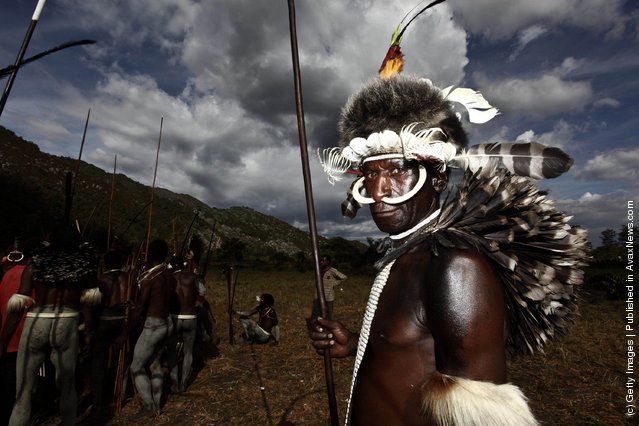
A Papuanese tribal man poses for a photograph during the Baliem Valley Festival on August 9, 2010 in Wamena, Indonesia. The Dani, Yali and Lani tribes gather at this annual festival each dressed in distinctive tribal attire, stage mock battles, perform traditional music and dance, and celebrate with a pig feast. (Photo by Ulet Ifansasti/Getty Images)
Details
01 May 2011 10:10:00
Camilla, Duchess Of Cornwall And Prince Charles Visit Tanzania

A Maasai woman smiles as Camilla, Duchess of Cornwall is presented with a traditional Maasai necklace as Prince Charles, Prince of Wales looks on during a visit to Majengo Maasai Boma on November 9, 2011 in Arusha, Tanzania. (Photo by Chris Jackson/Getty Images)
Details
10 Nov 2011 09:34:00
Bamboo drifting

Athletes of single bamboo drifting perform during the 9th National Traditional Games of Ethnic Minorities of the People's Republic of China on September 11, 2011 in Guiyang, China. (Photo by Feng Li/Getty Images)
Details
14 Sep 2011 11:25:00
This Thursday, January 22, 2015 photo made with a long exposure shows the glow from a Noctiluca scintillans algal bloom along the seashore in Hong Kong. The luminescence, also called Sea Sparkle, is triggered by farm pollution that can be devastating to marine life and local fisheries, according to University of Georgia oceanographer Samantha Joye. (Photo by Kin Cheung/AP Photo)

This Thursday, January 22, 2015 photo made with a long exposure shows the glow from a Noctiluca scintillans algal bloom along the seashore in Hong Kong. The luminescence, also called Sea Sparkle, is triggered by farm pollution that can be devastating to marine life and local fisheries, according to University of Georgia oceanographer Samantha Joye. Noctiluca itself does not produce neurotoxins like other similar organisms do. But its role as both prey and predator tends can eventually magnify the accumulation of toxins in the food chain, according to R. Eugene Turner at Louisiana State University. (Photo by Kin Cheung/AP Photo)
Details
23 Jan 2015 13:12:00
Chinese artist Zhou Jie takes a nap on an unfinished iron wire bed, one of her sculpture works, after lunch as a friend of hers looks on at Beijing Now Art Gallery, in Beijing August 11, 2014. (Photo by Jason Lee/Reuters)

Chinese artist Zhou Jie takes a nap on an unfinished iron wire bed, one of her sculpture works, after lunch as a friend of hers looks on at Beijing Now Art Gallery, in Beijing August 11, 2014. Zhou started her art project titled “36 Days” on August 9, in which she would live inside an exhibition hall with an unfinished iron wire bed, some iron wire sculptures in the shape of stuffed animal dolls, a certain amount of food and her mobile phone, for 36 days. The entire process is open to visitors and she may also interact with them, according to Zhou. (Photo by Jason Lee/Reuters)

Details
16 Aug 2014 10:37:00
A Tara BONETHROWER pumpkin created by the Maniac Pumpkin Carvers at Cotton Candy Machine in Brooklyn, N.Y. on October 18, 2014. (Photo by Siemond Chan/Yahoo Finance)


In time for Halloween the Maniac Pumpkin Carvers, creative art studio, held the Cotton Candy Machine workshop in Brooklyn, N.Y., demonstrating techniques and tools to create intricate pumpkin art. Maniac Pumpkin Carvers, which focuses on elevating the art of pumpkin carving, were a past winner of the Food Network's Halloween Wars. Their work has been displayed at MOMA, the Whitney Museum and Yankee Stadium. Here: A Tara Bonethrower pumpkin created by the Maniac Pumpkin Carvers at Cotton Candy Machine in Brooklyn, N.Y. on October 18, 2014. (Photo by Siemond Chan/Yahoo Finance)
Details
22 Oct 2014 14:08:00
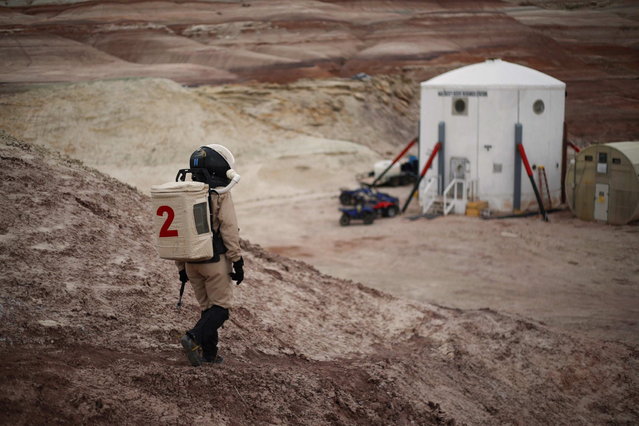
Csilla Orgel, a geologist of Crew 125 EuroMoonMars B mission, makes her way back to the Mars Desert Research Station (MDRS) in the Utah desert March 3, 2013. (Photo by Jim Urquhart/Reuters)

NASA says it could be another 20 years before humans touch down on Mars, but in a sense, the Mars Society has been exploring the red planet for more than a decade – in Utah. Photo: Csilla Orgel, a geologist of Crew 125 EuroMoonMars B mission, makes her way back to the Mars Desert Research Station (MDRS) in the Utah desert March 3, 2013. The MDRS aims to investigate the feasibility of a human exploration of Mars and uses the Utah desert's Mars-like terrain to simulate working conditions on the red planet. Scientists, students and enthusiasts work together developing field tactics and studying the terrain. All outdoor exploration is done wearing simulated spacesuits and carrying air supply packs and crews live together in a small communication base with limited amounts of electricity, food, oxygen and water. Everything needed to survive must be produced, fixed and replaced on site. (Photo by Jim Urquhart/Reuters)
Details
14 Mar 2013 12:11:00