Loading...
Done
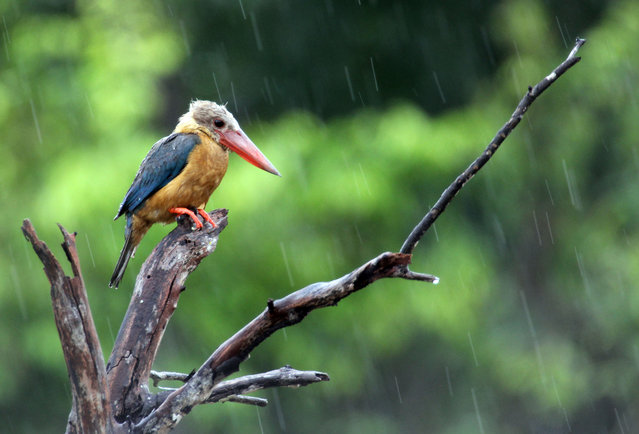
Stork-billed kingfisher during rain in Bintan, Indonesia. The tree species is sparsely distributed in the tropical Indian subcontinent and south-east Asia, from India to Indonesia. (Photo by Sijori Images/Barcroft Images)

A stork-billed kingfisher (Pelargopsis capensis) is seen perched on a tree during monsoon rain on July 25, 2016 in Bintan, Indonesia. The stork-billed kingfisher is a tree species which is widely but sparsely distributed in the tropical Indian subcontinent and Southeast Asia, from India to Indonesia. This kingfisher is resident throughout its range. It is very large, measuring 35 to 38 cm (14 to 15 in) in length. The adult has a green back, blue wings and tail, and grey head. (Photo by Sijori Images/Barcroft Images)
Details
27 May 2017 07:47:00
People stand by a damaged car at a train station at a makeshift camp for migrants and refugees at the Greek-Macedonian border near the village of Idomeni, Greece, May 10, 2016. (Photo by Marko Djurica/Reuters)

People stand by a damaged car at a train station at a makeshift camp for migrants and refugees at the Greek-Macedonian border near the village of Idomeni, Greece, May 10, 2016. (Photo by Marko Djurica/Reuters)
Details
12 May 2016 14:10:00
A bus goes through a flooded street in Wuhan, Hubei province, China July 6, 2016. (Photo by Reuters/China Daily)

A bus goes through a flooded street in Wuhan, Hubei province, China July 6, 2016. (Photo by Reuters/China Daily)
Details
11 Jul 2016 12:29:00
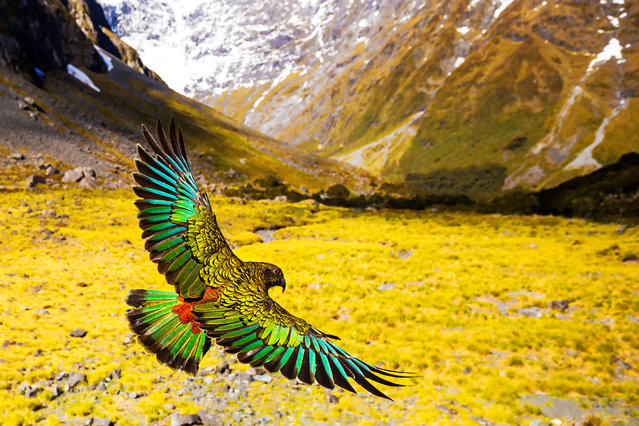
Kea are the only true alpine parrots in the world and thrive as cunning opportunists in the freezing conditions of the Southern Alps. Kea are thought to have developed their wide array of food-finding strategies during the last great ice age, where they learned to adapt using their unusual powers of curiosity. (Photo by Tom Walker/BBC Pictures/The Guardian)

Kea are the only true alpine parrots in the world and thrive as cunning opportunists in the freezing conditions of the Southern Alps. Kea are thought to have developed their wide array of food-finding strategies during the last great ice age, where they learned to adapt using their unusual powers of curiosity. (Photo by Tom Walker/BBC Pictures/The Guardian)
Details
19 Jul 2016 13:03:00
A Hindu holy man or Sadhu walks back to his ashram after taking a dip at Sangam, confluence of Ganges river, Yamuna river and mythical Saraswati river in Allahabad, India, Thursday, August 4, 2016. (Photo by Rajesh Kumar Singh/AP Photo)

A Hindu holy man or Sadhu walks back to his ashram after taking a dip at Sangam, confluence of Ganges river, Yamuna river and mythical Saraswati river in Allahabad, India, Thursday, August 4, 2016. (Photo by Rajesh Kumar Singh/AP Photo)
Details
07 Aug 2016 09:17:00
Kaylee Cantler, 15, of Waynesboro, Pa., applies blush during a natural makeup exercise at a modeling camp at the Courtyard Marriott Hotel in McLean, Va., on Monday, August 17th, 2015. (Photo by Brittany Greeson/The Washington Post)

Kaylee Cantler, 15, of Waynesboro, Pa., applies blush during a natural makeup exercise at a modeling camp at the Courtyard Marriott Hotel in McLean, Va., on Monday, August 17th, 2015. (Photo by Brittany Greeson/The Washington Post)
Details
10 Sep 2015 13:12:00
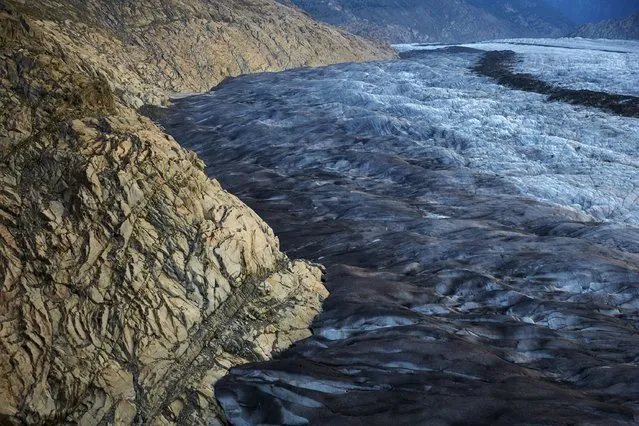
The Aletsch Glacier is pictured at dusk in Fiesch, Switzerland, August 11, 2015. (Photo by Denis Balibouse/Reuters)

The Aletsch Glacier is pictured at dusk in Fiesch, Switzerland, August 11, 2015. One of Europe's biggest glaciers, the Great Aletsch coils 23 km (14 miles) through the Swiss Alps – and yet this mighty river of ice could almost vanish in the lifetimes of people born today because of climate change. The glacier, 900 metres (2,950 feet) thick at one point, has retreated about 3 km (1.9 miles) since 1870 and that pace is quickening. (Photo by Denis Balibouse/Reuters)
Details
18 Oct 2015 08:05:00
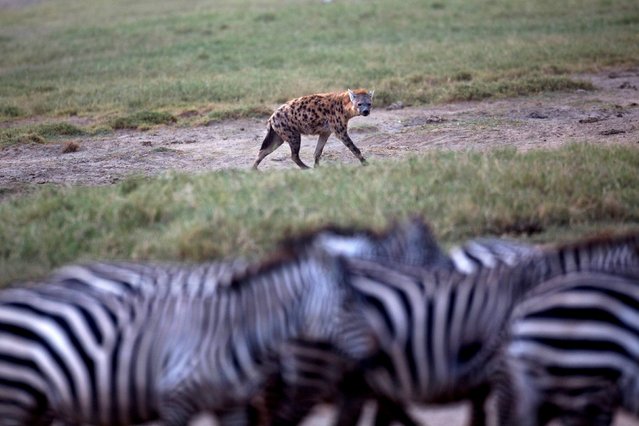
A hyena eyes a herd of zebra at Lake Nakuru National Park, Kenya, August 19, 2015. (Photo by Joe Penney/Reuters)

A hyena eyes a herd of zebra at Lake Nakuru National Park, Kenya, August 19, 2015. The Park is home to some of the world's most majestic wildlife including lions, rhinos, zebras and flamingos. The scenery is stunning, from forests of acacia trees to animals congregating at the shores to drink. UNESCO says that with rapid population growth nearby, the area is under "considerable threat from surrounding pressures," particularly deforestation, a contributing factor in floods. (Photo by Joe Penney/Reuters)
Details
28 Oct 2015 08:00:00