Loading...
Done
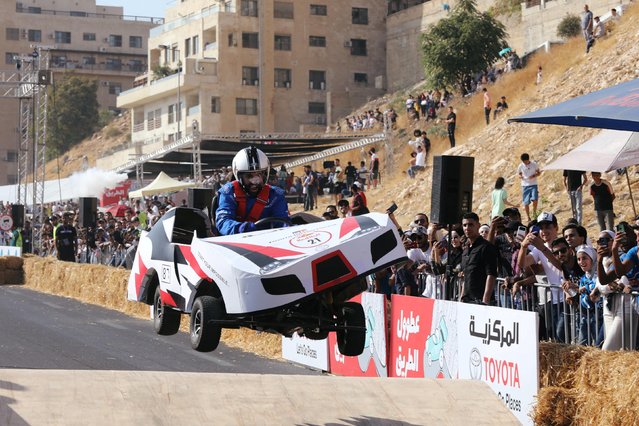
A competitor drives his homemade vehicle without an engine during the Red Bull Soapbox Race in Amman, Jordan on September 20, 2019. (Photo by Muhammad Hamed/Reuters)

A competitor drives his homemade vehicle without an engine during the Red Bull Soapbox Race in Amman, Jordan on September 20, 2019. (Photo by Muhammad Hamed/Reuters)
Details
26 Sep 2019 00:05:00
Competitors drive their homemade vehicle without an engine during the Red Bull Soapbox Race in Almaty, Kazakhstan on September 11, 2022. (Photo by Pavel Mikheyev/Reuters)

Competitors drive their homemade vehicle without an engine during the Red Bull Soapbox Race in Almaty, Kazakhstan on September 11, 2022. (Photo by Pavel Mikheyev/Reuters)
Details
30 Nov 2023 00:11:00
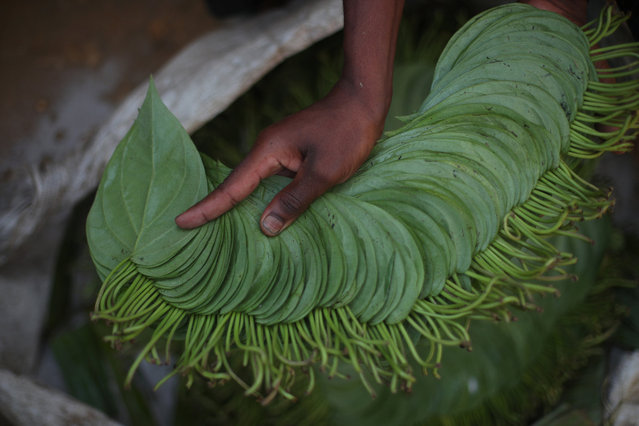
Faruk, 17, a Rohingya refugee trader holds betel leaves which are on sale at a stall in Palong Khali refugee camp near Cox's Bazar, Bangladesh, November 3, 2017. He left his village in Myanmar when the military opened fire towards the Rohingya. “I buy this betel leaf from Palong Khali market, in one bundle there are 160 pieces, I buy it for 80 taka and I sell it for 100 taka. Bangladeshi's and I sell for the same rate in the camp. Outside in the local market it is 80 taka per bundle. My problem is that I don't have money so I can't buy anything to eat, I can't buy fish to eat”, he said. (Photo by Hannah McKay/Reuters)

Faruk, 17, a Rohingya refugee trader holds betel leaves which are on sale at a stall in Palong Khali refugee camp near Cox's Bazar, Bangladesh, November 3, 2017. He left his village in Myanmar when the military opened fire towards the Rohingya. “I buy this betel leaf from Palong Khali market, in one bundle there are 160 pieces, I buy it for 80 taka and I sell it for 100 taka (1 Bangladeshi Taka = 0.012 US Dollar). Bangladeshi's and I sell for the same rate in the camp. Outside in the local market it is 80 taka per bundle. My problem is that I don't have money so I can't buy anything to eat, I can't buy fish to eat”, he said. (Photo by Hannah McKay/Reuters)
Details
27 Nov 2017 08:54:00
Female and male trainees run during a bodyguard training program at the boot camp of Genghis Security Academy in Beijing, China. (Photo by ImagineChina/The Grosby Group)

This summer China opened its door to its first private bodyguard training company in Beijing. Genghis Security Academy offers rigorous training course which includes aquatic training, martial arts, vehicle safety training and other necessary skills. Photo: Female and male trainees run during a bodyguard training program at the boot camp of Genghis Security Academy in Beijing, China. (Photo by ImagineChina/The Grosby Group)
Details
28 Nov 2013 09:01:00
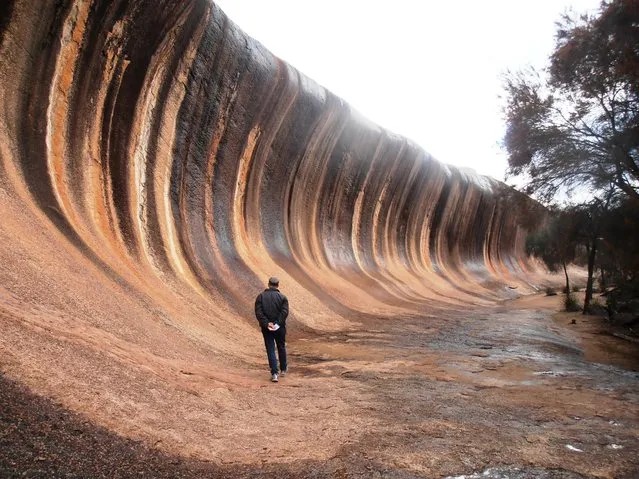
Wave Rock, Arizona

Wave Rock is a natural rock formation that is shaped like a tall breaking ocean wave. The "wave" is about 14 m (46 ft) high and around 110 m (360 ft) long. It forms the north side of a solitary hill, which is known as “Hyden Rock”. This hill, which is a granite inselberg, lies about 3 km (2 mi) east of the small town of Hyden and 296 km (184 mi) east-southeast of Perth, Western Australia. Wave Rock and Hyden Rock are part of a 160 ha (395-acre) nature reserve, Hyden Wildlife Park.
Details
12 Aug 2014 10:21:00
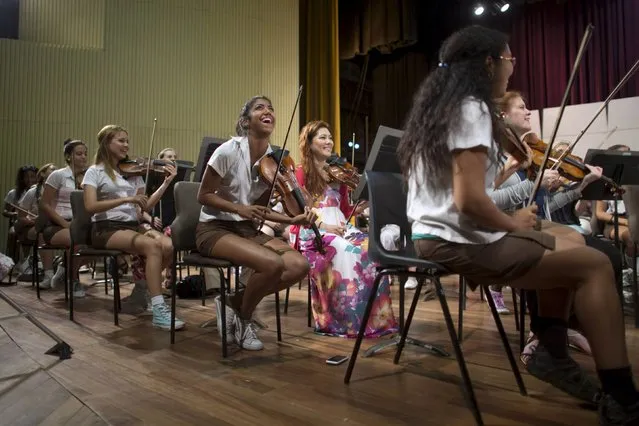
Music student Daniele Gonzalez, (centre row, L), and Australian musician Susie Park from the Minnesota Orchestra (centre row, 2nd L), react during a rehearsal in Havana, May 15, 2015. (Photo by Alexandre Meneghini/Reuters)

Music student Daniele Gonzalez, (centre row, L), and Australian musician Susie Park from the Minnesota Orchestra (centre row, 2nd L), react during a rehearsal in Havana, May 15, 2015. The Minnesota Orchestra will offer two concerts in Havana and is the first major U.S. orchestra to play in Cuba since 1999. The trip cost nearly $1 million. It was underwritten by Marilyn Carlson Nelson, an heir to the Carlson hotel company fortune, and her husband Glen. The U.S. government gave special permission for a direct charter flight from Minneapolis to Havana for the event, putting 4 tons of equipment and 160 people on an Airbus 330. (Photo by Alexandre Meneghini/Reuters)
Details
17 May 2015 11:34:00
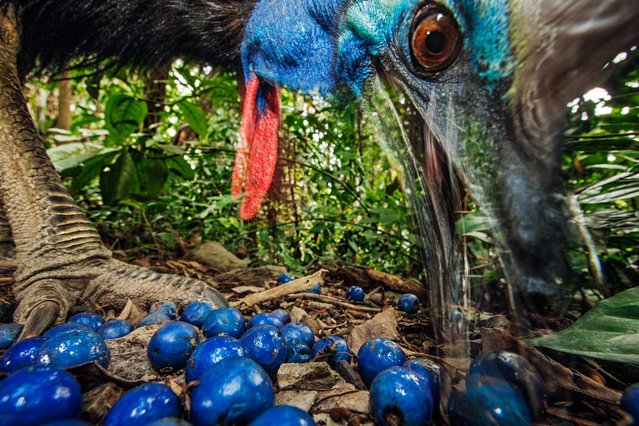
“Cassowaries are large, flightless birds related to emus and (more distantly) to ostriches, rheas, and kiwis”, writes Olivia Judson in the September issue of National Geographic magazine. (Photo by Christian Ziegler/National Geographic)

“Cassowaries are large, flightless birds related to emus and (more distantly) to ostriches, rheas, and kiwis”, writes Olivia Judson in the September issue of National Geographic magazine. How large? People-size: Adult males stand well over five foot five and top 110 pounds. Females are even taller, and can weigh more than 160 pounds. Dangerous when roused, they’re shy and peaceable when left alone. But even birds this big and tough are prey to habitat loss. The dense New Guinea and Australia rain forests where they live have dwindled. Today cassowaries might number 1,500 to 2,000. And because they help shape those same forests – by moving seeds from one place to another – “if they vanish”, Judson writes, “the structure of the forest would gradually change” too. (Photo by Christian Ziegler/National Geographic)
Details
06 Jan 2014 12:21:00
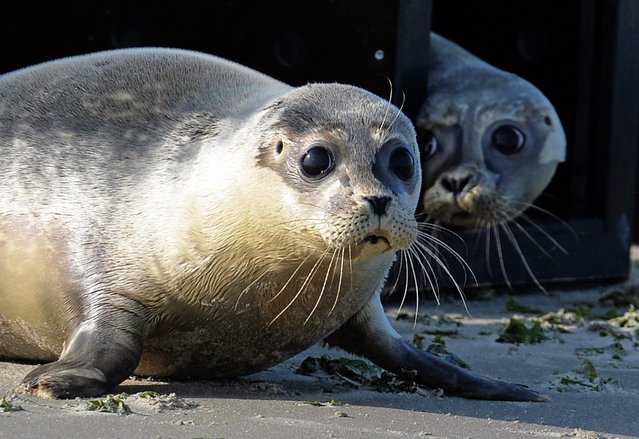
Common seals are reintroduced to the wild on the beach of the island Juist, Germany, 28 July 2014. It is the first reintroduction to the wild drive of the seal breading station Norddeich this year. (Photo by Carmen Jaspersen/EPA)

Common seals are reintroduced to the wild on the beach of the island Juist, Germany, 28 July 2014. It is the first reintroduction to the wild drive of the seal breading station Norddeich this year. (Photo by Carmen Jaspersen/EPA)
Details
02 Aug 2014 14:50:00