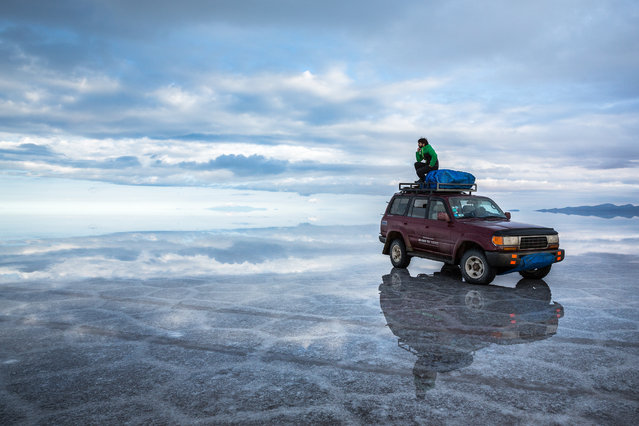
At 10,582 square kilometres, the Bolivian salt flats – otherwise known as Salar de Uyuni – are the largest on the planet and contain between 50 and 70% of the world’s lithium reserves. After exploring Chile and Argentina, photographer Joel Santos decided to travel to Bolivia in January 2017 to check the salt flats off his bucket list. With an electrical storm rolling in, Joel and his two travelling companions were the only souls left on the vast flats and captured the eerie flats without a person in sight. (Photo by Joel Santos/Barcroft Images)
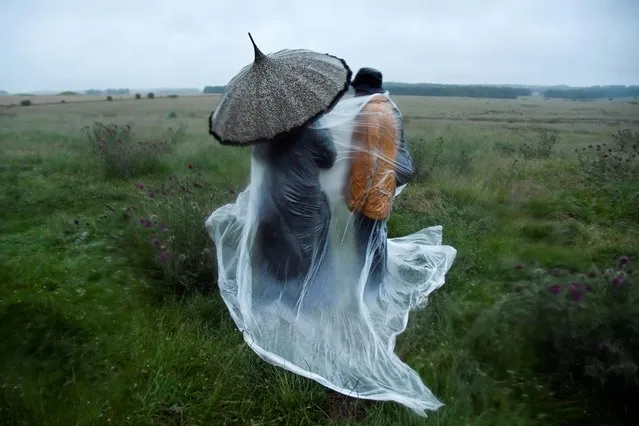
Revellers shield themselves as they celebrate in the rain near Stonehenge stone circle, despite official Summer Solstice celebrations being cancelled due to the spread of the coronavirus disease (COVID-19), near Amesbury, Britain, June 21, 2020. (Photo by Toby Melville/Reuters)
Woman enjoying the sun on one of Maui's black sand beaches, Hawaii, United States of America, North America on February 25, 2022. (Photo by Laura Grier/Robert Harding RF via AFP Photo)
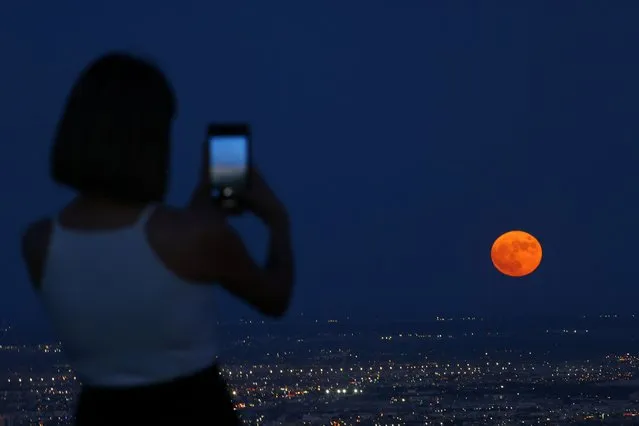
A woman takes a picture as a super moon, known as the Blue Moon, rises above Ciudad Juarez, Mexico on August 30, 2023. (Photo by Jose Luis Gonzalez/Reuters)
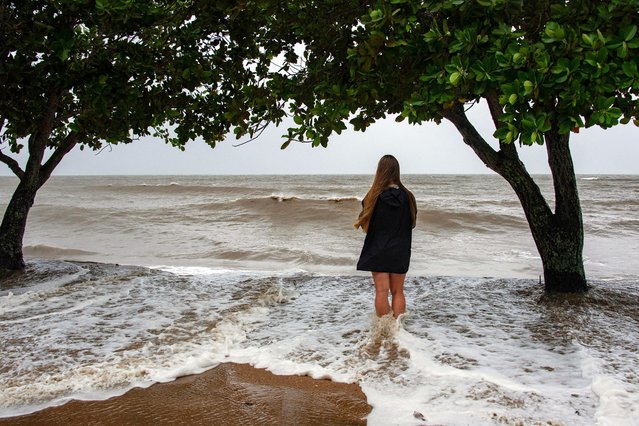
Holloways Beach resident Lisa Methven watches the storm across the Coral Sea as Cyclone Jasper approaches landfall in Cairns in far north Queensland on December 13, 2023. A tropical cyclone was building strength as it rolled towards northeastern Australia on December 13, with authorities warning “life-threatening” floods could swamp coastal regions for days. (Photo by Brian Cassey/AFP Photo)
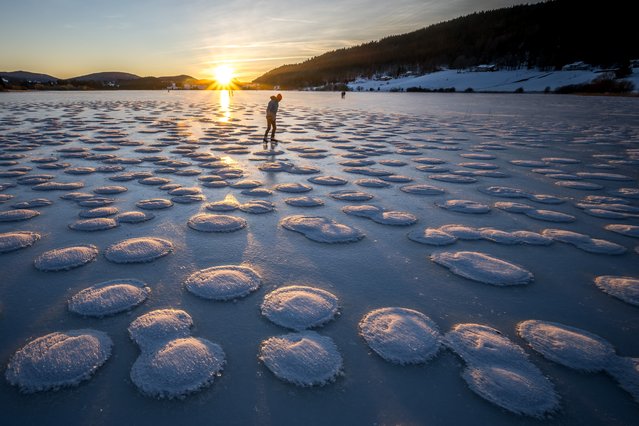
A skater observes pancakes snow on the frozen Lake des Rousses in Les Rousses, central-eastern France, on January 1, 2025. This phenomenon forms when slushy ice in water clumps into round, pancake-like shapes due to waves or currents. (Photo by Fabrice Coffrini/AFP Photo)
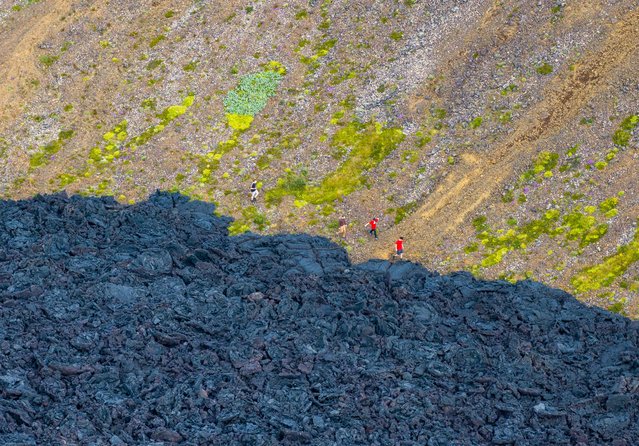
An aerial view taken with a drone shows people walking past dried lava (L) from a previous volcanic eruption as they make their way to a location closer to watch the fresh volcano eruption near Grindavik, Reykjanes, Iceland, 17 July 2025. According to the Icelandic Meteorological Office, a magma flow has begun at the Sundhnuk crater range on 16 July. (Photo by Jakob Vegerfors/EPA)