Loading...
Done


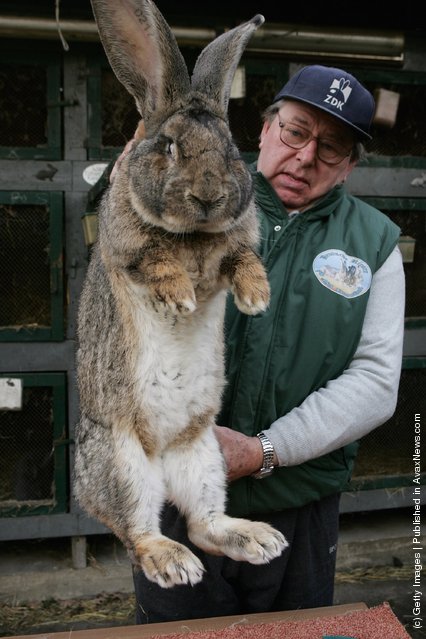
Pensioner Karl Szmolinsky, who raises a breed of rabbits called giant grays, shows Robert 2, an 8.5kg giant grey who is 74cm long and has ears 25.5cm long, in the backyard of his house on January 15, 2006 in Eberswalde, Germany. In November Szmolinsky sold eight giant greys to a delegation from North Korea, whom he said want to raise the breed as a source of meat for the North Korean population. Szmolinsky said his rabbits reach a maximum weight of 10.5 kg (23.1lbs.). (Photo by Sean Gallup/Getty Images)
Details
23 Mar 2011 10:47:00
Goyo, an eight-month-old mini pig, plays with a dog in Mexico City, December 21, 2015. (Photo by Edgard Garrido/Reuters)

Goyo, an eight-month-old mini pig, plays with a dog in Mexico City, December 21, 2015. Mini pigs can grow to about 30 kg (66.1 lbs) in weight and about 35 cm (1.1 ft) in height, according to the company Mini Pigs Mexico. The company says that the mini pigs' popularity as pets is growing and around 300 are sold every year in Mexico, with prices ranging from $350 to $1,600. (Photo by Edgard Garrido/Reuters)
Details
29 Dec 2015 08:03:00
Edinburgh Zoo is proud to introduce this baby three-banded armadillo Rica who was born to mum Rio and dad Rodar in Edinburgh, Scotland, UK on Sunday 24 August 2014. (Photo by SWNS/ABACAPress)

Edinburgh Zoo is proud to introduce this baby three-banded armadillo Rica who was born to mum Rio and dad Rodar in Edinburgh, Scotland, UK on Sunday 24 August 2014. A tiny 81g at birth and around the same size as a golf ball, Rica is a female three banded armadillo who has grown rapidly in her first month, already quadrupling in weight. (Photo by SWNS/ABACAPress)
Details
29 Sep 2014 10:31:00
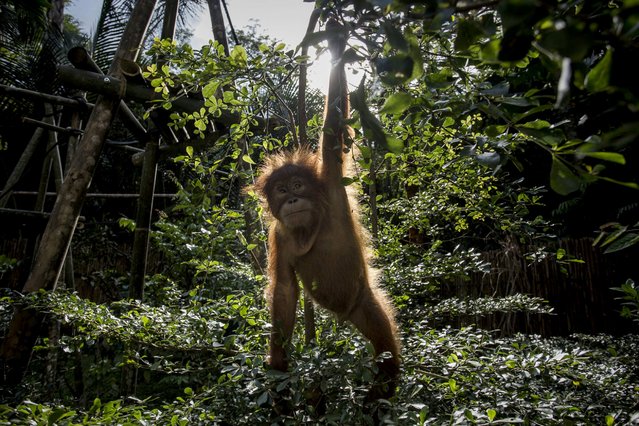
A Baby sumatran orangutan (Pongo abelii) plays around in a tree as they train at Sumatran Orangutan Conservation Programme's rehabilitation center on November 12, 2016 in Kuta Mbelin, North Sumatra, Indonesia. The Orangutans in Indonesia have been known to be on the verge of extinction as a result of deforestation and poaching. Found mostly in South-East Asia, where they live on the islands of Sumatra and Borneo, the endangered species continue to lose their habitat as a result of corporate expansion in a developing economy. Indonesia approved palm oil concessions on nearly 15 million acres of peatlands over the past years and thousands of square miles have been cleared for plantations, including the lowland areas that are the prime habitat for orangutans. (Photo by Ulet Ifansasti/Getty Images)

A Baby sumatran orangutan (Pongo abelii) plays around in a tree as they train at Sumatran Orangutan Conservation Programme's rehabilitation center on November 12, 2016 in Kuta Mbelin, North Sumatra, Indonesia. The Orangutans in Indonesia have been known to be on the verge of extinction as a result of deforestation and poaching. Found mostly in South-East Asia, where they live on the islands of Sumatra and Borneo, the endangered species continue to lose their habitat as a result of corporate expansion in a developing economy. Indonesia approved palm oil concessions on nearly 15 million acres of peatlands over the past years and thousands of square miles have been cleared for plantations, including the lowland areas that are the prime habitat for orangutans. (Photo by Ulet Ifansasti/Getty Images)
Details
16 Nov 2016 11:14:00
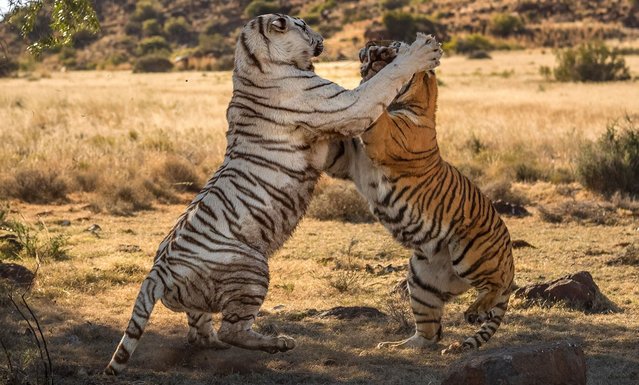
Dont get catty. These roar-some images show the moment two female tigers came to blows in a bitter dispute over territory. Rarely ever seen in the wild let alone on camera, the dramatic images show a white Siberian tiger and orange-coloured tiger slashing ferociously at each others face and eyes. (Photo by Alex Kirichko/Caters News/SIPA Press)

Dont get catty. These roar-some images show the moment two female tigers came to blows in a bitter dispute over territory. Rarely ever seen in the wild let alone on camera, the dramatic images show a white Siberian tiger and orange-coloured tiger slashing ferociously at each others face and eyes. The intense altercation erupted into violence when the smallest of the pair, the orange striped tiger known as Shadow, attempted to expand its hunting ground. But white tiger, TiBo, wasnt willing to give up the ground without a fight and was forced to use its size and weight to put Shadow firmly back in her place. (Photo by Alex Kirichko/Caters News/SIPA Press)
Details
26 Dec 2014 15:28:00
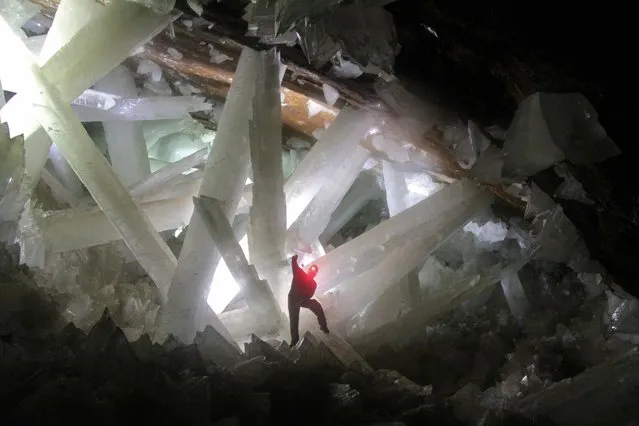
Giant Crystal Cave in Naica, Mexico

Cave of the Crystals or Giant Crystal Cave is a cave connected to the Naica Mine 300 metres (980 ft) below the surface in Naica, Chihuahua, Mexico. The main chamber contains giant selenite crystals (gypsum, CaSO4·2 H2O), some of the largest natural crystals ever found. The cave's largest crystal found to date is 12 m (39 ft) in length, 4 m (13 ft) in diameter and 55 tons in weight. The cave is extremely hot with air temperatures reaching up to 58 °C (136 °F) with 90 to 99 percent humidity. The cave is relatively unexplored due to these factors. Without proper protection people can only endure approximately ten minutes of exposure at a time.
Details
20 May 2014 07:56:00


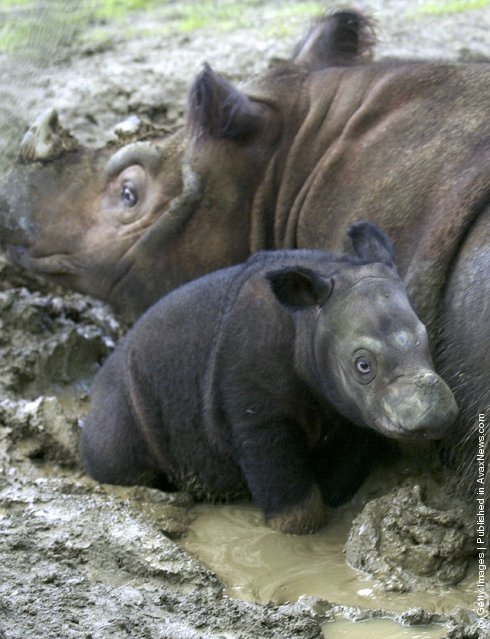
“The Sumatran Rhinoceros (Dicerorhinus sumatrensis) is a member of the family Rhinocerotidae and one of five extant rhinoceroses. It is the only extant species of the genus Dicerorhinus. It is the smallest rhinoceros, standing about 120–145 centimetres (3.9–4.76 ft) high at the shoulder, with a body length of 250 centimetres (8.2 ft) and weight of 500–800 kilograms (1,100–1,800 lb). Like the African species, it has two horns; the larger is the nasal horn, typically 15–25 centimetres (5.9–9.8 in), while the other horn is typically a stub. A coat of reddish-brown hair covers most of the Sumatran Rhino's body”. – Wikipedia

Photo: Emi, a Sumatran rhinoceros lies in the mud with her three-week-old female calf at the Cincinnati Zoo and Botanical Garden August 19, 2004 in Cincinnati, Ohio. Emi made history by becoming the first Sumatran rhino to produce two calves in captivity. (Photo by Mike Simons/Getty Images)
Details
22 Jun 2011 12:37:00
What the World Eats By Peter Menzel And Faith D'Aluisio Part 1

A stunning photographic collection featuring portraits of people from 30 countries and the food they eat in one day. In this fascinating study of people and their diets, 80 profiles are organized by the total number of calories each person puts away in a day. Featuring a Japanese sumo wrestler, a Massai herdswoman, world-renowned Spanish chef Ferran Adria, an American competitive eater, and more, these compulsively readable personal stories also include demographic particulars, including age, activity level, height, and weight. Essays from Harvard primatologist Richard Wrangham, journalist Michael Pollan, and others discuss the implications of our modern diets for our health and for the planet. This compelling blend of photography and investigative reportage expands our understanding of the complex relationships among individuals, culture, and food.
Details
23 Apr 2014 14:34:00