Loading...
Done
Egg Sculptures By Franc Grom

Slovenian artist Franc Grom, aged 72, makes unbelievably intricate egg sculptures using just a tiny electric drill and enormous patience. According to National Geographic, when finished, each egg contains approximately 2,500 to 3,500 holes. While Slovene artisans usually paint their eggs using a technique called drsanka by lightly scratching intricate patterns into the surfaces of colored eggs, carving them was solely Grom’s idea.
Details
24 Nov 2016 08:00:00
Wire Sculptures By Richard Stainthorp

The English artist Richard Stainthorp creates life-size sculptures with metal wire. Its special feature is to capture, accurately, all the energy and fluidity of the human body. A selection of his works is available in the article.
Details
03 Aug 2015 08:24:00
Luke Jerram’s Glass Microbiology Sculptures

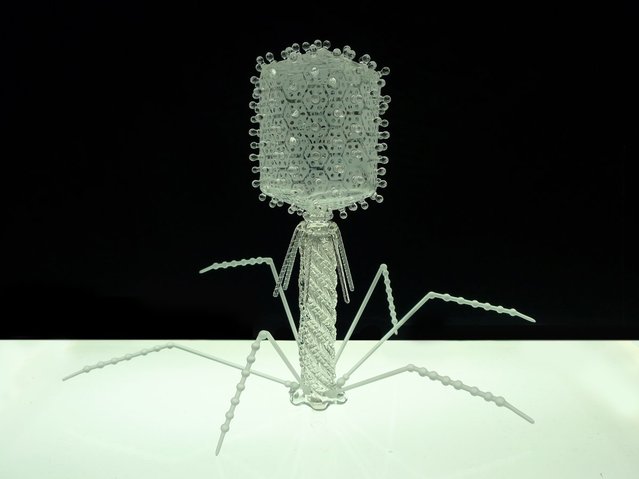
British artist Luke Jerram’s glass sculptures represent a variety of viruses, such as Smallpox and HIV, and are made to encourage viewers to contemplate the global impact of each disease.
Details
18 Feb 2013 10:59:00
Gavin Worth's Steel Wire Sculptures

“I was born in Zimbabwe, Africa in 1981 and grew up in Las Cruces, New Mexico. I graduated with a degree in Acting, and after college, worked as an actor and musician for the Santa Fe Shakespeare Festival, the San Francisco Shakespeare Festival, and the California Shakespeare Theater. I have had a lifelong passion for drawing, painting, and sculpture since I first saw Michelangelo's “Head of Leda” in a book in the library”.

Gavin Worth
Details
09 Mar 2013 10:54:00
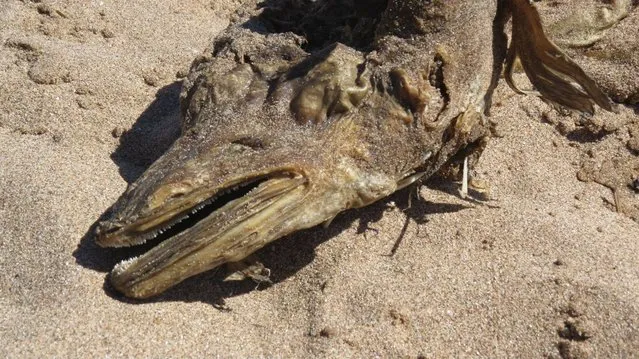
A mysterious sea creature with some frighteningly sharp teeth washed up on a beach in England last week, where David Mackland snapped these photos. A Grind TV story reports that Mackland estimated the creature to be about 4-5 feet in length. (Photo by David Mackland/OurCarnoustie)

A mysterious sea creature with some frighteningly sharp teeth washed up on a beach in England last week, where David Mackland snapped these photos. A Grind TV story reports that Mackland estimated the creature to be about 4-5 feet in length. (Photo by David Mackland/OurCarnoustie)
Details
06 Jun 2013 10:15:00
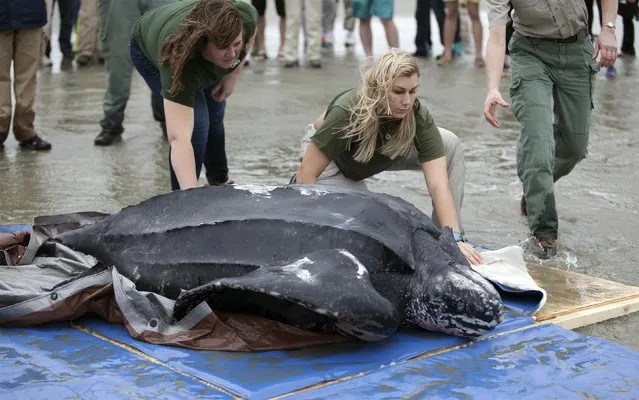
Biologists Jenna Cormany (L) and Lauryn Wright of the South Carolina Department of Natural Resources help to release a leatherback turtle in Isle of Palms, South Carolina March 12, 2015. (Photo by Randall Hill/Reuters)

Biologists Jenna Cormany (L) and Lauryn Wright of the South Carolina Department of Natural Resources help to release a leatherback turtle in Isle of Palms, South Carolina March 12, 2015. The 475-pound turtle was the first living leatherback turtle to be recovered in South Carolina and one of only a handful ever treated at rehabilitation facilities in the United States. It was found March 7 on the beach on Yawkey-South Island Reserve, a 3.5-mile-long (5.6-km-long) barrier island and wildlife preserve near Georgetown, South Carolina. (Photo by Randall Hill/Reuters)
Details
14 Mar 2015 13:32:00
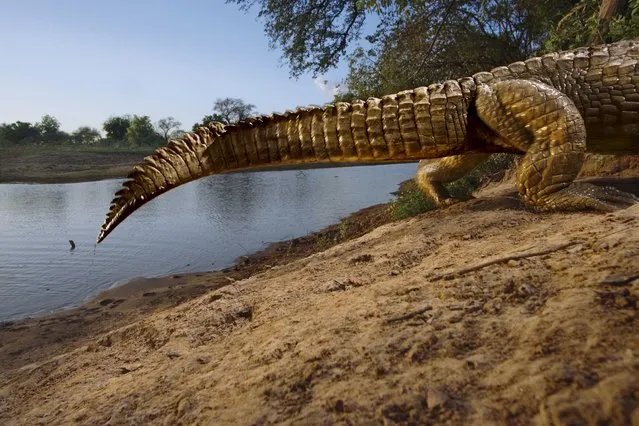
CT4 Crocodile cave on the Salamat river. Set up with Nathan Williamson last chip rain came while we were with the nomads. (Photo by Michael Nichols/National Geographic)

National Geographic has created “Air, Land & Sea: the 50 greatest wildlife photographs” exhibition. Here: CT4 Crocodile cave on the Salamat river. Set up with Nathan Williamson last chip rain came while we were with the nomads. (Photo by Michael Nichols/National Geographic)
Details
13 Sep 2018 00:03:00
Artist Jason deCaires Taylor’s Museo Atlantico, off Lanzarote, is peopled with concrete casts of refugees and people taking selfies. Drowned world: welcome to Europe’s first undersea sculpture museum. Here: The Raft of Lampedusa, Taylor’s modern-day concrete echo of Géricault’s The Raft of the Medusa. The work has particular significance given the huge movement of refugees across the sea to Europe – and the frequent fatalities that result. (Photo by Jason deCaires Taylor)

Artist Jason deCaires Taylor’s Museo Atlantico, off Lanzarote, is peopled with concrete casts of refugees and people taking selfies. Drowned world: welcome to Europe’s first undersea sculpture museum. Here: The Raft of Lampedusa, Taylor’s modern-day concrete echo of Géricault’s The Raft of the Medusa. The work has particular significance given the huge movement of refugees across the sea to Europe – and the frequent fatalities that result. (Photo by Jason deCaires Taylor)
Details
03 Feb 2016 13:11:00