Loading...
Done
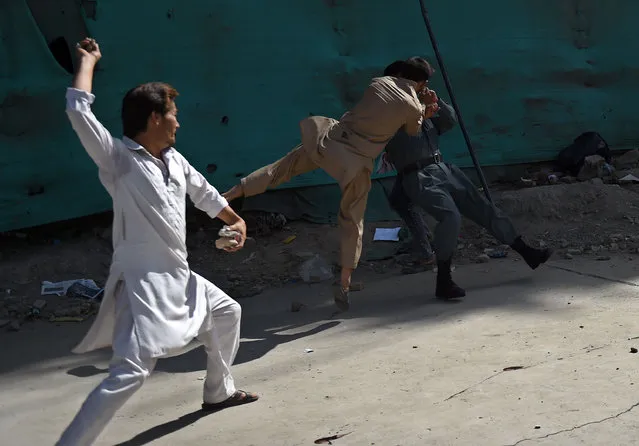
Afghan protesters beat a policeman after a suicide attack that targeted crowds of minority Shiite Hazaras during a demonstration at the Deh Mazang Circle of Kabul on July 23, 2016. Islamic State jihadists claimed responsibility for twin explosions July 23 that ripped through crowds of Shiite Hazaras in Kabul, killing at least 61 people and wounding 207 others in apparently their deadliest attack in the Afghan capital. The bombings during a huge protest over a power transmission line could deepen sectarian divisions in a country well known for communal harmony despite decades of war. (Photo by Wakil Kohsar/AFP Photo)

Afghan protesters beat a policeman after a suicide attack that targeted crowds of minority Shiite Hazaras during a demonstration at the Deh Mazang Circle of Kabul on July 23, 2016. Islamic State jihadists claimed responsibility for twin explosions July 23 that ripped through crowds of Shiite Hazaras in Kabul, killing at least 61 people and wounding 207 others in apparently their deadliest attack in the Afghan capital. The bombings during a huge protest over a power transmission line could deepen sectarian divisions in a country well known for communal harmony despite decades of war. (Photo by Wakil Kohsar/AFP Photo)
Details
25 Jul 2016 11:46:00
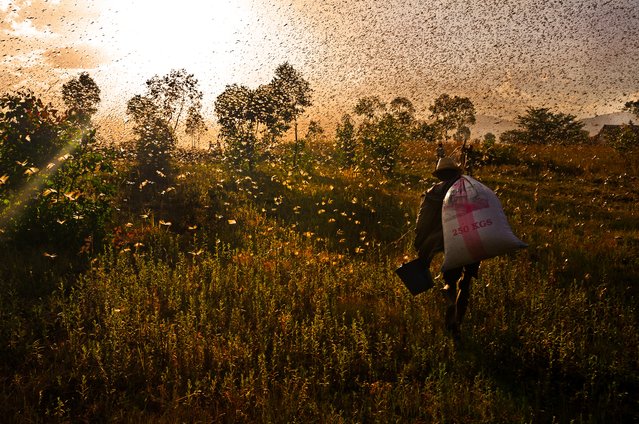
“Locusts & Men”. Oppression, interaction, collaboration. In the life cycle of nature nothing is lost, but the coexistence of different species is sometimes difficult. In Madagascar periodically returns the archaic antagonism between man and the migratory locust, in a circle of life where the two species are looking for space and food for their survival. Photo location: Madagascar, 2013. (Photo and caption by Michele Martinelli/National Geographic Photo Contest)

“Locusts & Men”. Oppression, interaction, collaboration. In the life cycle of nature nothing is lost, but the coexistence of different species is sometimes difficult. In Madagascar periodically returns the archaic antagonism between man and the migratory locust, in a circle of life where the two species are looking for space and food for their survival. At the end of the day a man walks home carrying on his shoulders the heavy bag which contains the locusts captured during the day. The insects provide nutritious meals for the man and his family. Photo location: Madagascar, 2013. (Photo and caption by Michele Martinelli/National Geographic Photo Contest)

ATTENTION! All pictures are presented in high resolution. To see Hi-Res images – just TWICE click on any picture. In other words, click small picture – opens the BIG picture. Click BIG picture – opens VERY BIG picture.
Details
03 Dec 2013 10:59:00
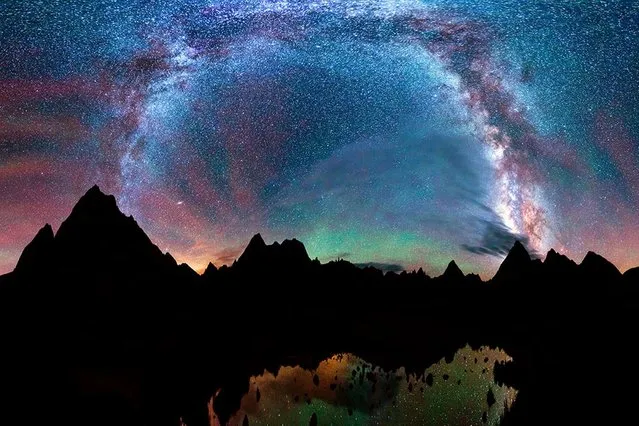
A photographer has captured these amazing rainbow-like images of stars high above the skies of Colorado. Stargazer Matt Payne, from Oregon, loves the evening skies so much, he has devoted hours to shooting the marvels of the Milky Way. The 35-year-old has to meticulously plan his work, taking into account weather, terrain, season and even the cycle of the moon to get the perfect snap. (Photo by Matt Payne/Caters News)

A photographer has captured these amazing rainbow-like images of stars high above the skies of Colorado. Stargazer Matt Payne, from Oregon, loves the evening skies so much, he has devoted hours to shooting the marvels of the Milky Way. The 35-year-old has to meticulously plan his work, taking into account weather, terrain, season and even the cycle of the moon to get the perfect snap. (Photo by Matt Payne/Caters News)
Details
02 Sep 2014 12:35:00
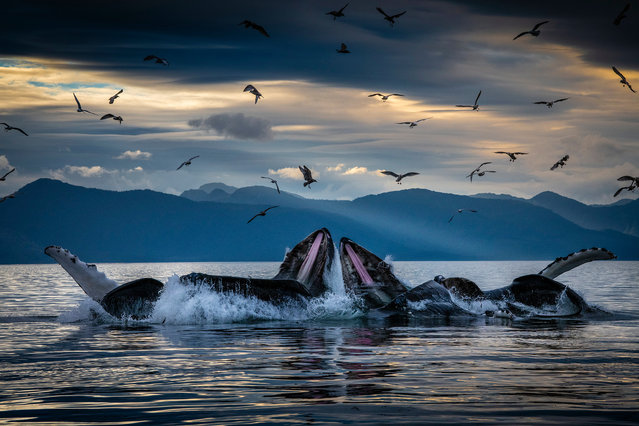
“Secrets of the Whales”. Skerry’s photographs celebrate the lives and culture of whales, illuminating recent research and their diverse behaviours. His latest work focuses on four key species: sperm whales, humpbacks, orca and beluga whales. Humpback whales bubble-net feeding off the coast of Alaska. They work cooperatively to feed on herring by blowing a perfect ring of bubbles underwater to form a net encircling the fish. The whales then swim up through the centre of the bubble net with their mouths open. (Photo by Brian Skerry/National Geographic Photo/Visa pour l'Image)

“Secrets of the Whales”. Skerry’s photographs celebrate the lives and culture of whales, illuminating recent research and their diverse behaviours. His latest work focuses on four key species: sperm whales, humpbacks, orca and beluga whales. Humpback whales bubble-net feeding off the coast of Alaska. They work cooperatively to feed on herring by blowing a perfect ring of bubbles underwater to form a net encircling the fish. The whales then swim up through the centre of the bubble net with their mouths open. (Photo by Brian Skerry/National Geographic Photo/Visa pour l'Image)
Details
04 Sep 2021 09:02:00
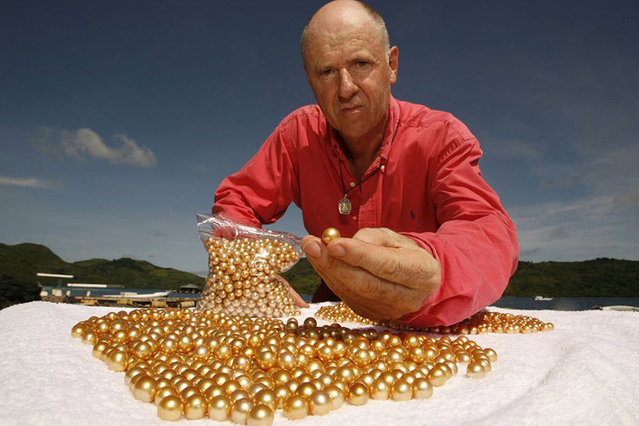
Golden Pearl Farming In Philippines

Jewelmer is the only pearl producer in the world that has successfully produced pearls with a rich, natural golden color. Through decades of research and biotechnology, Jewelmer was able to perfect the breeding process that produces gold-lipped Pinctada maxima pearl oysters capable of growing large, lustrous, golden pearls. This deep, rich color can only be found in South Sea pearls produced in the Philippines.
Details
08 Oct 2014 11:50:00
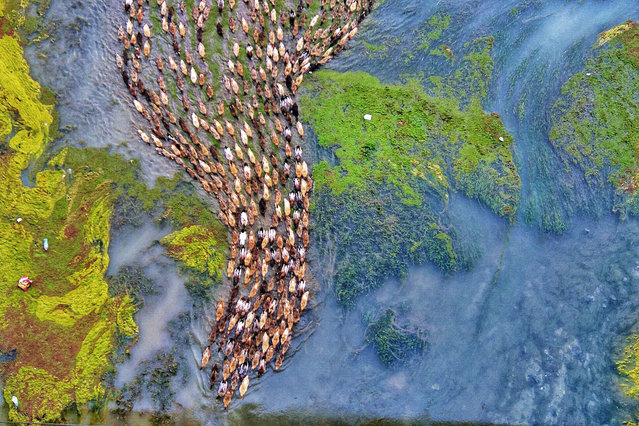
Ducks in the river Baral in Bangladesh. (Photo by Rafeur Rahman/Caters News Agency)

These photographs of hundreds of ducks following their leader down a river are truly mesmerizing. Rafeur Rahman of Bangladesh climbed a high bridge and saw hundreds of ducks apparently playing a game of follow the leader. More than 500 ducks live on the river, where the mosses and snails provide the perfect habitat. Here: Ducks in the river Baral in Bangladesh. (Photo by Rafeur Rahman/Caters News Agency)
Details
08 May 2018 00:05:00
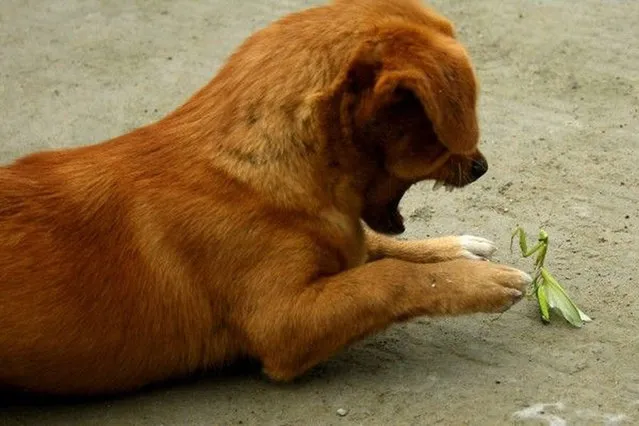
Puppy VS. Mantis

Here are a few truly unique painting a beautiful dog to play with “dangerous mantid” of course we know who the winner of this “struggle”. These photos were probably caused by accident one fine day in a beautiful park. Enjoy the perfect posing this beautiful home in the beautiful game with mantid.
Details
04 Jan 2013 11:48:00
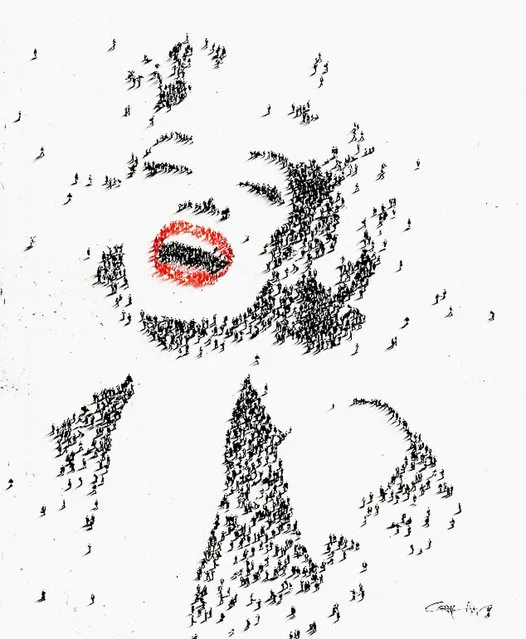
Craig Alan  By Famous Faces In A Crowd

Craig Alan was born in 1971 in San Bernardino, California and has always been attracted to the artistic side of life. Craig Alan’s earliest experimentation was street portraiture, helping him perfect his flair for replicating the human figure and afforded the budding artist a sense of economic autonomy.
Details
16 Jan 2013 15:48:00