Loading...
Done
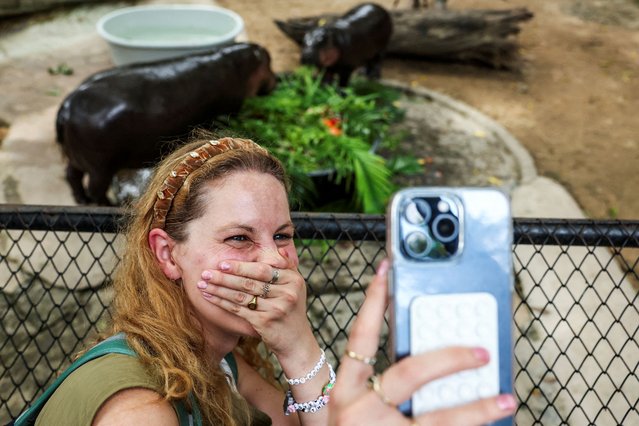
Molly Swindall, 30, who travelled from the United States to meet Moo Deng for the third time, reacts as she takes a selfie with the one-year-old female pygmy hippo, who became a viral internet sensation last year, and her mother Jona, at Khao Kheow Open Zoo in Chonburi province, Thailand, on July 10, 2025. (Photo by Chalinee Thirasupa/Reuters)

Molly Swindall, 30, who travelled from the United States to meet Moo Deng for the third time, reacts as she takes a selfie with the one-year-old female pygmy hippo, who became a viral internet sensation last year, and her mother Jona, at Khao Kheow Open Zoo in Chonburi province, Thailand, on July 10, 2025. (Photo by Chalinee Thirasupa/Reuters)
Details
20 Jul 2025 02:45:00
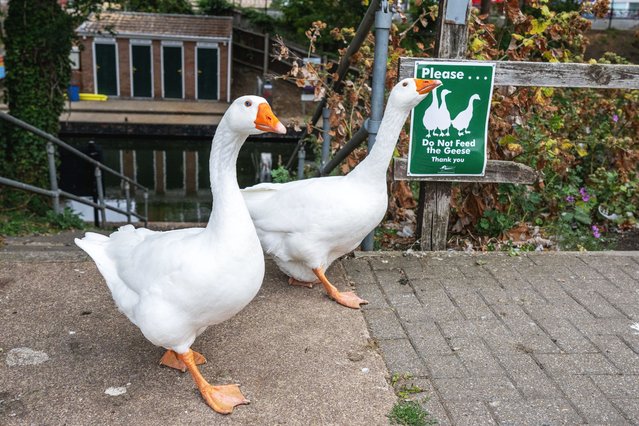
The geese in March, Cambs, UK on August 25, 2025. The family of around 20 white waterfowl have been a fixture in March, Cambs, for years and have made their mark by regularly waddling to the high street. (Photo by South West News Service)

The geese in March, Cambs, UK on August 25, 2025. The family of around 20 white waterfowl have been a fixture in March, Cambs, for years and have made their mark by regularly waddling to the high street. (Photo by South West News Service)
Details
07 Sep 2025 04:38:00
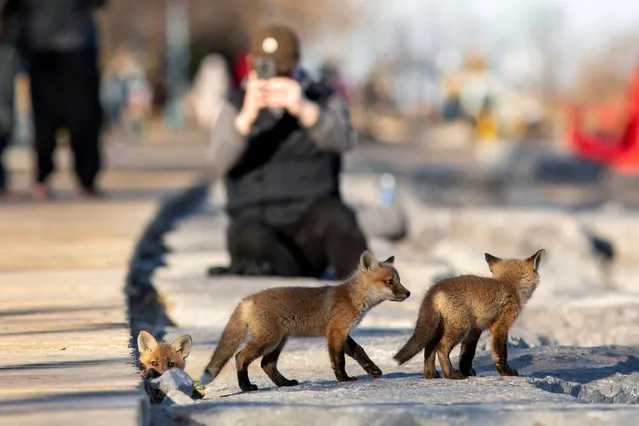
Fox cubs venture out from their den under a popular boardwalk alongside Lake Ontario during the global outbreak of the coronavirus disease (COVID-19), in Toronto, Ontario, Canada on April 22, 2020. (Photo by Carlos Osorio/Reuters)

Fox cubs venture out from their den under a popular boardwalk alongside Lake Ontario during the global outbreak of the coronavirus disease (COVID-19), in Toronto, Ontario, Canada on April 22, 2020. (Photo by Carlos Osorio/Reuters)
Details
26 Apr 2020 00:05:00
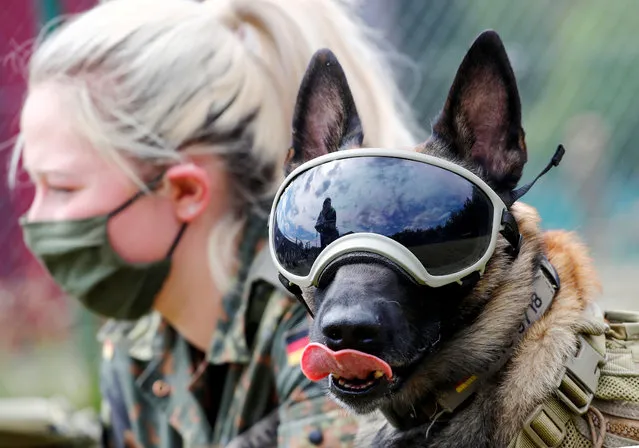
Five-year-old sniffing dog “Vine” wears protection goggles against the sun and dust as he poses together with Giulia Gausemann for photographers, at the sniffing dogs school of the German Army (Bundeswehr) in Daun, Germany, July 24, 2020. The Bundeswehr sniffing dogs school and the veterinarian university of Hanover are developing a training programme to sniff out the coronavirus disease (COVID-19) with dogs at airports, border crossings and other highly frequented places. (Photo by Wolfgang Rattay/Reuters)

Five-year-old sniffing dog “Vine” wears protection goggles against the sun and dust as he poses together with Giulia Gausemann for photographers, at the sniffing dogs school of the German Army (Bundeswehr) in Daun, Germany, July 24, 2020. The Bundeswehr sniffing dogs school and the veterinarian university of Hanover are developing a training programme to sniff out the coronavirus disease (COVID-19) with dogs at airports, border crossings and other highly frequented places. (Photo by Wolfgang Rattay/Reuters)
Details
26 Jul 2020 00:01:00
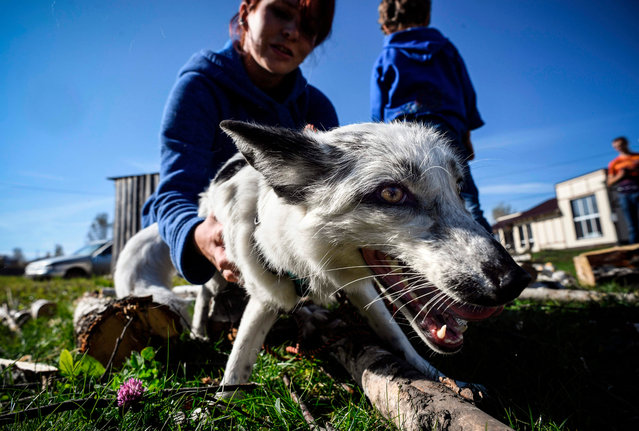
Tatyana Abramova, 33, plays with her home fox Plombir at her countryside house outside Siberian city of Novosibirsk on September 12, 2020. The official start of the Soviet experiment to better understand the domestication of animals by humans began in 1959, and was initiated by geneticists Dmitri Beliaiev and Lioudmila Trout on a farm in Akademgorodok, the scientific center of excellence in Siberia. Their primary objective was to domesticate foxes, to understand how the ancestor of wolves, another canine, evolved into a loyal and loving dog. And understand what this domestication tells us about the genetic evolution of species. (Photo by Alexander Nemenov/AFP Photo)

Tatyana Abramova, 33, plays with her home fox Plombir at her countryside house outside Siberian city of Novosibirsk on September 12, 2020. The official start of the Soviet experiment to better understand the domestication of animals by humans began in 1959, and was initiated by geneticists Dmitri Beliaiev and Lioudmila Trout on a farm in Akademgorodok, the scientific center of excellence in Siberia. Their primary objective was to domesticate foxes, to understand how the ancestor of wolves, another canine, evolved into a loyal and loving dog. And understand what this domestication tells us about the genetic evolution of species. (Photo by Alexander Nemenov/AFP Photo)
Details
25 Oct 2020 00:05:00
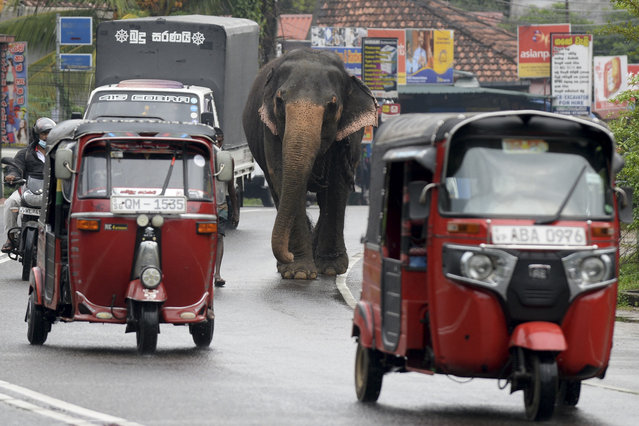
A mahout walks next to his elephant through a busy street in Horana, a suburb of Sri Lanka's capital Colombo on March 23, 2021. (Photo by Lakruwan Wanniarachchi/AFP Photo)

A mahout walks next to his elephant through a busy street in Horana, a suburb of Sri Lanka's capital Colombo on March 23, 2021. (Photo by Lakruwan Wanniarachchi/AFP Photo)
Details
04 Apr 2021 08:42:00
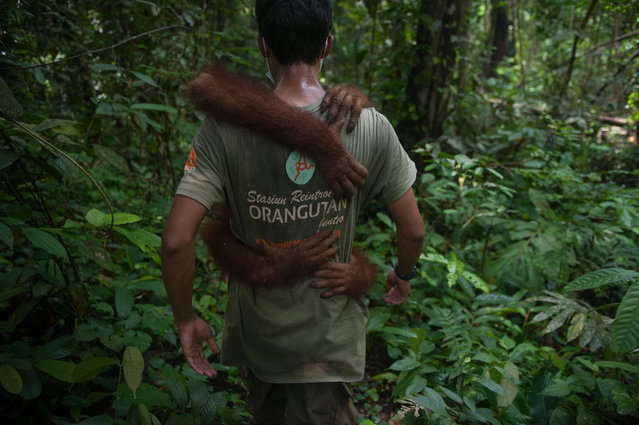
Leo, an orphaned Sumatran orangutan, is taken to the Sumatran Orangutan Conservation Programme rehabilitation centre. Leo will join other orangutans who have been reintroduced to the Pinus Jantho nature reserve. The SOCP has gradually formed a completely new wild population of species that have been threatened with extinction. (Photo by Sutanta Aditya/Barcroft Images)

Leo, an orphaned Sumatran orangutan, is taken to the Sumatran Orangutan Conservation Programme rehabilitation centre. Leo will join other orangutans who have been reintroduced to the Pinus Jantho nature reserve. The SOCP has gradually formed a completely new wild population of species that have been threatened with extinction. (Photo by Sutanta Aditya/Barcroft Images)
Details
10 Aug 2019 00:03:00
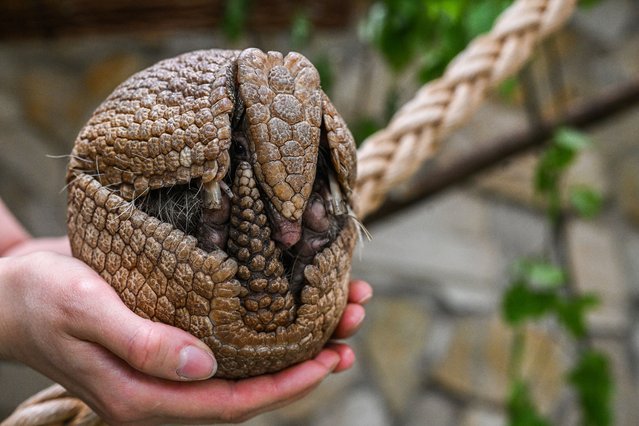
Zookeeper Agata holds a rare newborn Brazilian three-banded armadillo inside its enclosure at the Wroclaw Zoo in Wroclaw, Poland on May 11, 2023. The Tolypeutes matatus, or the southern armor also known as bolita or tatu-bola, is a fairly popular animal in South America but is increasingly rare. The new zoo child was born on March 23. The species is listed as vulnerable by the International Union for the Conservation of Nature (IUCN) and threatened by habitat loss and hunting. (Photo by Omar Marques/Anadolu Agency via Getty Images)

Zookeeper Agata holds a rare newborn Brazilian three-banded armadillo inside its enclosure at the Wroclaw Zoo in Wroclaw, Poland on May 11, 2023. The Tolypeutes matatus, or the southern armor also known as bolita or tatu-bola, is a fairly popular animal in South America but is increasingly rare. The new zoo child was born on March 23. The species is listed as vulnerable by the International Union for the Conservation of Nature (IUCN) and threatened by habitat loss and hunting. (Photo by Omar Marques/Anadolu Agency via Getty Images)
Details
28 May 2023 04:09:00