Loading...
Done
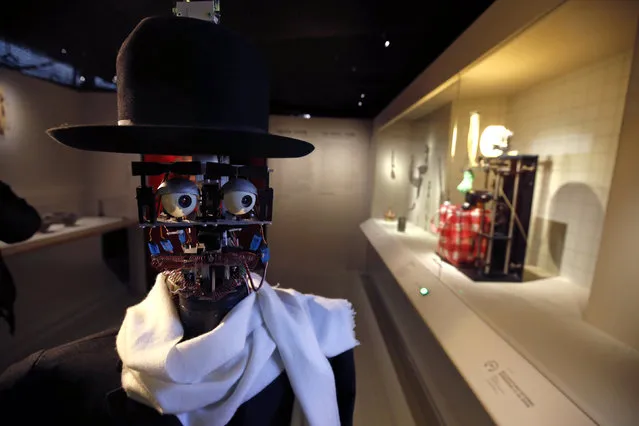
The Berenson robot strolls among visitors during the exhibition “Persona : Oddly Human” at the Quai Branly museum in Paris, France, February 23, 2016. The Berenson robot, developed in France in 2011, is the brainchild of anthropologist Denis Vidal and robotics engineer Philippe Gaussier. Its programming allows it to record reactions of museum visitors to certain pieces of art and then use the data to develop its own unique taste, which allows “Berenson” to judge whether or not it likes a certain work of art within an exhibition. (Photo by Philippe Wojazer/Reuters)

The Berenson robot strolls among visitors during the exhibition “Persona : Oddly Human” at the Quai Branly museum in Paris, France, February 23, 2016. The Berenson robot, developed in France in 2011, is the brainchild of anthropologist Denis Vidal and robotics engineer Philippe Gaussier. Its programming allows it to record reactions of museum visitors to certain pieces of art and then use the data to develop its own unique taste, which allows “Berenson” to judge whether or not it likes a certain work of art within an exhibition. (Photo by Philippe Wojazer/Reuters)
Details
25 Feb 2016 12:26:00
This August 15, 2016 photo shows two portraits Carolina, one of her holding a weapon while in her uniform for the Revolutionary Armed Forces of Colombia (FARC) 49th front, and in civilian clothing at a guerrilla camp in the southern jungle of Putumayo, Colombia. Carolina, 18, said she has spent three years in the FARC and would like to study engineering  after demobilizing as part of a peace deal with Colombia's government. (Photo by Fernando Vergara/AP Photo)

This August 15, 2016 photo shows two portraits Carolina, one of her holding a weapon while in her uniform for the Revolutionary Armed Forces of Colombia (FARC) 49th front, and in civilian clothing at a guerrilla camp in the southern jungle of Putumayo, Colombia. Carolina, 18, said she has spent three years in the FARC and would like to study engineering after demobilizing as part of a peace deal with Colombia's government. (Photo by Fernando Vergara/AP Photo)
Details
13 Sep 2016 09:50:00
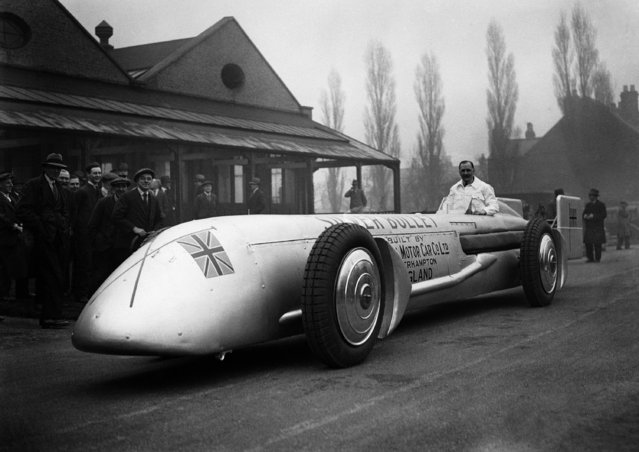
Kaye Don seated in the cockpit of his new racing car the “Silver Bullet” at Wolverhampton, England on February 21, 1930, in which he will attempt to beat world land speed record at Daytona. It has two 12-cylinder V shaped engines and each develops 2,000-h.p. The theoretical speed of the car is 275 m.p.h. but the designer estimated that will be able to reach 250 m.p.h. allowing for wind pressures. (Photo by AP Photo/Staff/Puttnam)

Kaye Don seated in the cockpit of his new racing car the “Silver Bullet” at Wolverhampton, England on February 21, 1930, in which he will attempt to beat world land speed record at Daytona. It has two 12-cylinder V shaped engines and each develops 2,000-h.p. The theoretical speed of the car is 275 m.p.h. but the designer estimated that will be able to reach 250 m.p.h. allowing for wind pressures. (Photo by AP Photo/Staff/Puttnam)
Details
03 Mar 2018 00:03:00
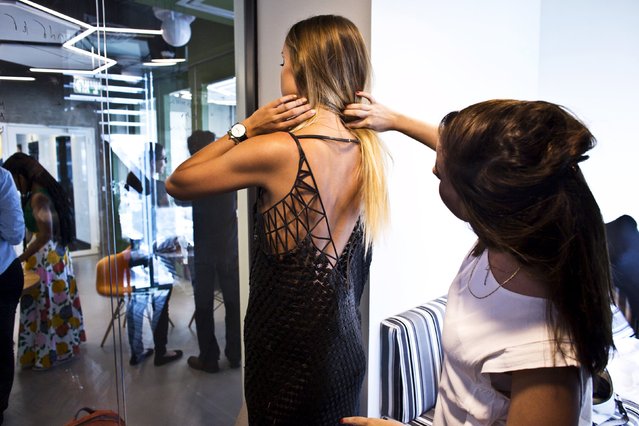
Israeli fashion design student from the Shenkar College of Engineering and Design Danit Peleg (R) assists a fashion blogger to wear an outfit from her graduate collection during a conference on 3-D printing in Tel Aviv, Israel September 3, 2015. (Photo by Nir Elias/Reuters)

Israeli fashion design student from the Shenkar College of Engineering and Design Danit Peleg (R) assists a fashion blogger to wear an outfit from her graduate collection during a conference on 3-D printing in Tel Aviv, Israel September 3, 2015. Peleg, 27, says she spent over 2000 hours to create her graduate collection which is made solely from home 3-D printers. International fashion bloggers, taking part in a project supported by “Stand With Us Israel fellowship”, a non-profit organisation, attended the conference and tried on Peleg's clothing before listening to her talk about her collection. (Photo by Nir Elias/Reuters)
Details
05 Sep 2015 12:08:00
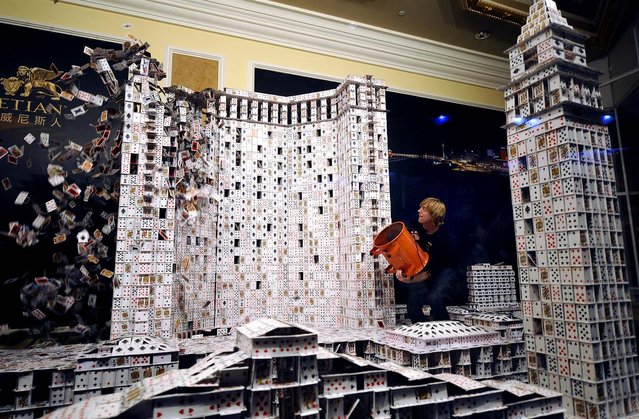
Cardstacker: Bryan Berg

Bryan Berg was introduced to card-stacking by his grandfather at the age of 8. He is a self-taught artist in all of the techniques he uses today. Berg's freestanding card structures are based on a grid-like arrangement, which Berg tested in a structural engineering lab to support 660 lbs per square foot―using no tape, no glue, no folding, and no tricks.
Details
05 Jun 2013 11:52:00
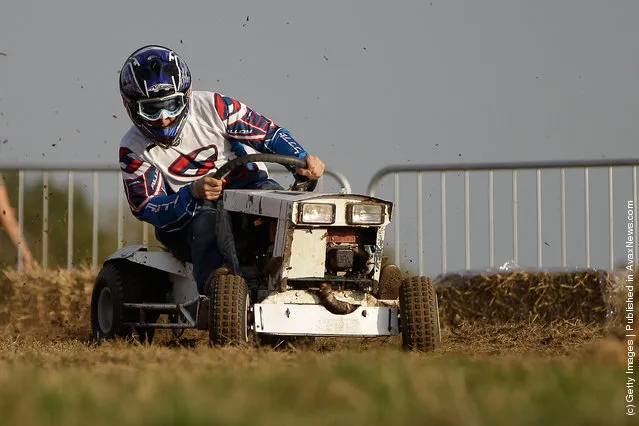
Lawn Mower Endurance Race

Competitors in action during a qualifying heat for the 12 hour Lawn Mower Endurance Race on September 24, 2011 in Billingshurst, England. First started in 1973 as a motorsport that would be accessible to as many as possible, there is little commercialism or sponsorship, no cash prizes and no modifying of engines. The trophies are donated from various sources with famous names such as Sir Stirling Moss found engraved on the plaques from previous races. (Photo by Matthew Lloyd/Getty Images)
Details
25 Sep 2011 11:45:00


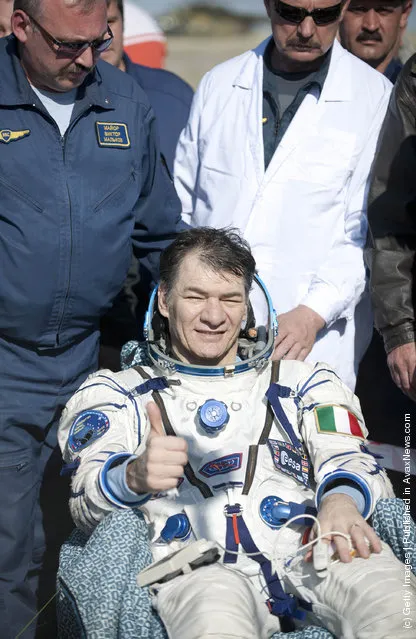
ESA astronaut Paolo Nespoli looks on after landing back on Earth from their Soyuz TMA-20 spacecraft on May 24, 2011 in Zhezkazgan, Kazakhstan. The mission of the Soyuz TMA-20 was launched last December to the International Space Station with the flight engineers Catherine Coleman from the United States, Russian cosmonaut Dmitry Kondratyev and Italian astronaut Paolo Nespoli. The next expedition is expected to launch this June. (Photo by Stephane Corvaja/ESA via Getty Images)
Details
24 May 2011 10:06:00


“Contrails (short for “condensation trails”) or vapour trails are artificial clouds that are the visible trails of condensed water vapour made by the exhaust of aircraft engines. As the hot exhaust gases cool in the surrounding air they may precipitate a cloud of microscopic water droplets or, if the air is cold enough, tiny ice crystals”. – Wikipedia

Photo: An airplane leaves a vapor trail as it flies in front of he moon on January 17, 2007 above Hanover, Germany. (Photo by Alexander Hassenstein/Getty Images)
Details
04 Jul 2011 10:39:00