A man dressed as Santa Claus arrives to distribute toys on children living in an impoverished neighbourhood in Iraq's southern city of Basra on December 26, 2020. (Photo by Hussein Faleh/AFP Photo)
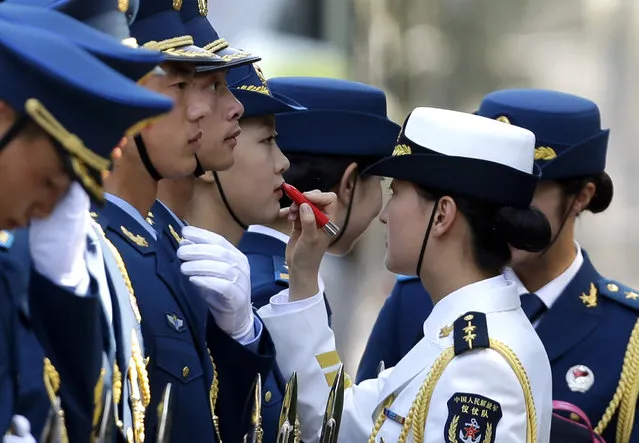
A female honor guard has lipstick applied as they prepare for an official welcoming ceremony outside the Great Hall of the People in Beijing, China on June 11, 2014. (Photo by Jason Lee/Reuters)
An army soldier takes a tree branch from an anti-government protester who is blocking a major highway that links the capital Beirut to northern Lebanon, in the town of Nahr el-Kalb, north of Beirut, Lebanon, Friday, January 3, 2020. Lebanon is facing its worst economic crisis in decades, while protests against corruption and mismanagement have gripped the country since October. (AP Photo/Hussein Malla)
U.S. Army soldiers with the 1st Battalion, 501st Infantry Regiment deployed to Combat Outpost Sabari, Afghanistan scan their area as they begin a multi-day air assault mission near the Pakistani border of eastern Afghanistan's Khost province May 2, 2012. (Photo by Staff Sgt. Joshua L. DeMotts/U.S. Air Force)
Protesters walk the runway at the COACH Spring 2024 Ready To Wear Fashion Show and dinner event at the New York Public Library (NYPL) on September 7, 2023 in New York, New York. (Photo by Giovanni Giannoni/WWD via Getty Images)
Two men look at the sea while taking part in the annual New Year's dive into the North Sea in Scheveningen, Netherlands on January 1, 2020. (Photo by Piroschka van de Wouw/Reuters)
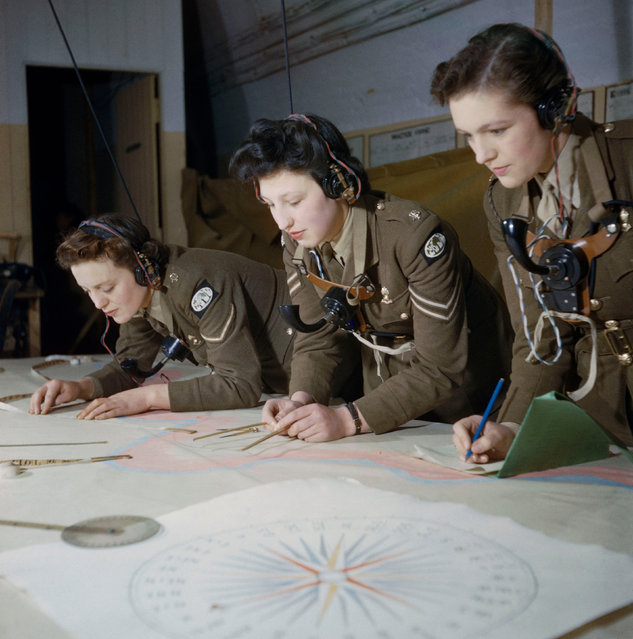
Auxiliary Territorial Service (ATS) plotters at work at Coastal Artillery Headquarters in Dover, December 1942. The Auxiliary Territorial Service was the women's branch of the British Army during the Second World War. It was formed on 9 September 1938, initially as a women's voluntary service, and existed until 1 February 1949, when it was merged into the Women's Royal Army Corps. The ATS had its roots in the Women's Auxiliary Army Corps (WAAC), which was formed in 1917 as a voluntary service. During the First World War its members served in a number of jobs including clerks, cooks, telephonists and waitresses. The WAAC was disbanded after four years in 1921. (Photo by Ted Dearberg/IWM/PA Wire)