Loading...
Done
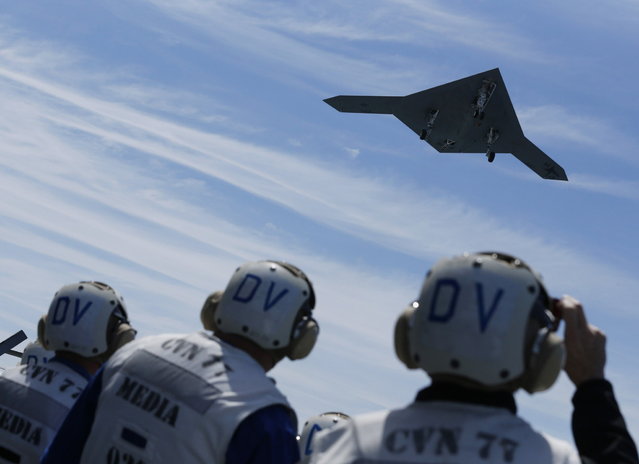
An X-47B pilot-less drone combat aircraft is launched for the first time off an aircraft carrier, the USS George H. W. Bush, in the Atlantic Ocean off the coast of Virginia, May 14, 2013. The U.S. Navy made aviation history on Tuesday by catapulting an unmanned jet off an aircraft carrier for the first time, testing a long-range, stealthy, bat-winged plane that represents a jump forward in drone technology. (Photo by Jason Reed/Reuters)

The X-47B prototype on Tuesday flew off an aircraft carrier and into the history books. Today's achievement, the first-ever catapult launch of an unmanned aircraft from the flight deck of a carrier, promises to open up a new chapter in the annals of naval aviation. Photo: An X-47B pilot-less drone combat aircraft is launched for the first time off an aircraft carrier, the USS George H. W. Bush, in the Atlantic Ocean off the coast of Virginia, May 14, 2013. The U.S. Navy made aviation history on Tuesday by catapulting an unmanned jet off an aircraft carrier for the first time, testing a long-range, stealthy, bat-winged plane that represents a jump forward in drone technology. (Photo by Jason Reed/Reuters)
Details
16 May 2013 12:39:00
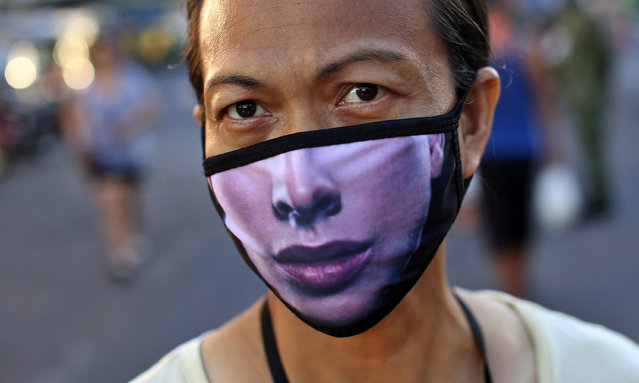
A Filipino woman wears a mask to try and protect against the spread of coronavirus in Malate district, Manila City on March 24, 2020. The Philippines has taken drastic measures to combat the spread of Covid-19. The entire country is under strict quarantine and the army is on the streets to monitor compliance. According to official figures, there are 462 positive cases and 33 dead in the Philippines, but it is thought that thousands of cases remain undetected due to lack of resources in a country where millions of people have no access to health care. In the poorest and most crowded areas, it’s almost impossible to adhere to the physical distancing required during quarantine. (Photo by Alejandro Ernesto/The Guardian)

A Filipino woman wears a mask to try and protect against the spread of coronavirus in Malate district, Manila City on March 24, 2020. The Philippines has taken drastic measures to combat the spread of Covid-19. The entire country is under strict quarantine and the army is on the streets to monitor compliance. According to official figures, there are 462 positive cases and 33 dead in the Philippines, but it is thought that thousands of cases remain undetected due to lack of resources in a country where millions of people have no access to health care. In the poorest and most crowded areas, it’s almost impossible to adhere to the physical distancing required during quarantine. (Photo by Alejandro Ernesto/The Guardian)
Details
08 Apr 2020 00:01:00
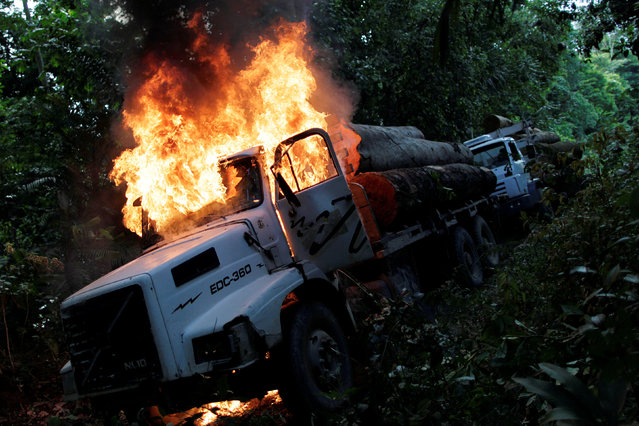
Trucks loaded with tree trunks are burned by agents of the Brazilian Institute for the Environment and Renewable Natural Resources, or Ibama, during an operation to combat illegal mining and logging, in the municipality of Novo Progresso, Para State, northern Brazil, November 11, 2016. When able to do their job, agents of the Brazilian Institute for the Environment and Renewable Natural Resources, or Ibama, are decisive, punishing illegal loggers on the spot. Nearly twice the size of India, the Amazon absorbs an estimated 2 billion tonnes of carbon dioxide per year, making its preservation vital in the fight to halt global warming. Ibama, responsible for preserving Brazil's 65 percent share of the world's largest rainforest, is one of the most important groups in that fight. But after years of surprising success, the rate of deforestation is on the rise again. Over the past four years it has risen 35 percent, as Ibama suffered from a lack of funding amid Brazil's worst recession in a century. (Photo by Ueslei Marcelino/Reuters)

Trucks loaded with tree trunks are burned by agents of the Brazilian Institute for the Environment and Renewable Natural Resources, or Ibama, during an operation to combat illegal mining and logging, in the municipality of Novo Progresso, Para State, northern Brazil, November 11, 2016. When able to do their job, agents of the Brazilian Institute for the Environment and Renewable Natural Resources, or Ibama, are decisive, punishing illegal loggers on the spot. Nearly twice the size of India, the Amazon absorbs an estimated 2 billion tonnes of carbon dioxide per year, making its preservation vital in the fight to halt global warming. (Photo by Ueslei Marcelino/Reuters)
Details
30 Nov 2016 12:36:00
Afghanistan: Dogs of War Part 2

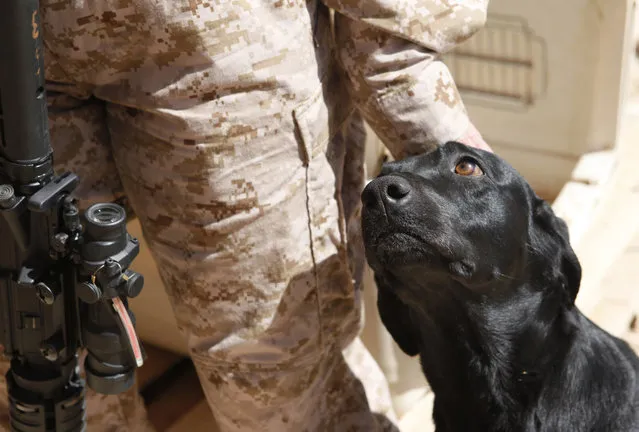
Throughout the course of the long war in Afghanistan, Coalition troops have relied on thousands of military working dogs to help keep them safe, and make their jobs easier. The dogs are trained to detect explosives, to find illegal drugs, to search for missing comrades, or target enemy combatants. Not only are they active on the front lines, but behind the lines they serve as therapy dogs, service dogs, and loyal companions. They also share the same risks as the ground troops, suffering injuries and sometimes death on the battlefields. Gathered here are images of these dogs and their handlers in Afghanistan and back home, from over the past several years, part of the ongoing series here on Afghanistan.
Details
05 Jun 2014 21:10:00
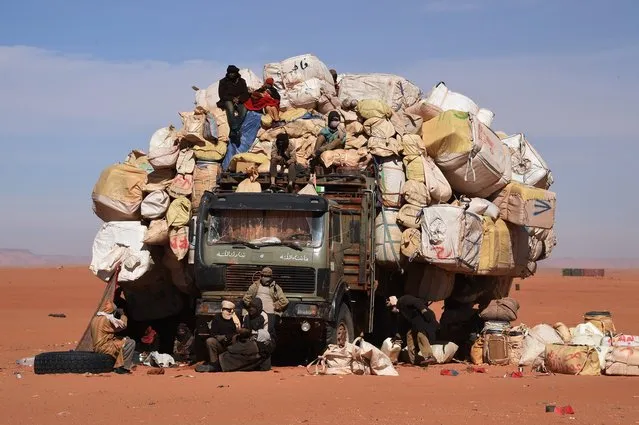
People sit near a fully loaded in Madama near the border with Lybia on January 1, 2015. French Defence Minister Jean-Yves Le Drian paid a surprise visit to northern Niger on January 1, to visit a base being built to combat the growing flow of weapons and jihadists from neighbouring Libya. Le Drian travelled from Chad to Madama, a desert outpost about 100 kilometres from Libya, where he saw in the New Year with troops at a French base. (Photo by Dominique Faget/AFP Photo)

People sit near a fully loaded in Madama near the border with Lybia on January 1, 2015. French Defence Minister Jean-Yves Le Drian paid a surprise visit to northern Niger on January 1, to visit a base being built to combat the growing flow of weapons and jihadists from neighbouring Libya. Le Drian travelled from Chad to Madama, a desert outpost about 100 kilometres from Libya, where he saw in the New Year with troops at a French base. Madama is situated on the route used by jihadists and arms smugglers in southern Libya to reach northern Mali and Niger. (Photo by Dominique Faget/AFP Photo)
Details
03 Jan 2015 13:27:00
Two women enjoy drinks outside a pub in the soho area of central London on November 4, 2020, on the eve of a second novel coronavirus COVID-19 lockdown in an effort to combat soaring infections. English pubs call last orders at the bar for a month on Wednesday evening, as the country effectively shuts down from November 5, for the second time this year to try to cut coronavirus cases. Prime Minister Boris Johnson insisted that the lockdown for England would end “automatically” in four weeks, as he tried to placate party critics over the spiralling economic fallout. (Photo by Stephen Lock/i-Images)

Two women enjoy drinks outside a pub in the soho area of central London on November 4, 2020, on the eve of a second novel coronavirus COVID-19 lockdown in an effort to combat soaring infections. English pubs call last orders at the bar for a month on Wednesday evening, as the country effectively shuts down from November 5, for the second time this year to try to cut coronavirus cases. Prime Minister Boris Johnson insisted that the lockdown for England would end “automatically” in four weeks, as he tried to placate party critics over the spiralling economic fallout. (Photo by Stephen Lock/i-Images)
Details
06 Nov 2020 00:07:00
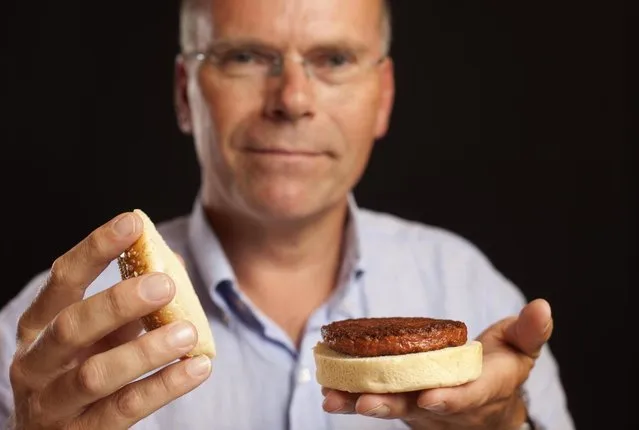
In this handout image provided by Ogilvy, a burger made from cultured beef, which has been developed by Professor Mark Post of Maastricht University in the Netherlands (pictured) is shown to the media during a press conference on August 5, 2013 in London, England. Cultured Beef could help solve the coming food crisis and combat climate change with commercial production of Cultured Beef beginning within ten to twenty years. (Photo by David Parry via Getty Images)

In this handout image provided by Ogilvy, a burger made from cultured beef, which has been developed by Professor Mark Post of Maastricht University in the Netherlands (pictured) is shown to the media during a press conference on August 5, 2013 in London, England. The in-vitro burger, cultured from cattle stem cells, the first example of what its creator says could provide an answer to global food shortages and help combat climate change, was fried in a pan and tasted by two volunteers. The burger is the result of years of research by Dutch scientist Mark Post, a vascular biologist at the University of Maastricht, who is working to show how meat grown in petri dishes might one day be a true alternative to meat from livestock.The meat in the burger has been made by knitting together around 20,000 strands of protein that has been cultured from cattle stem cells in Post's lab. (Photo by David Parry)
Details
06 Aug 2013 08:48:00
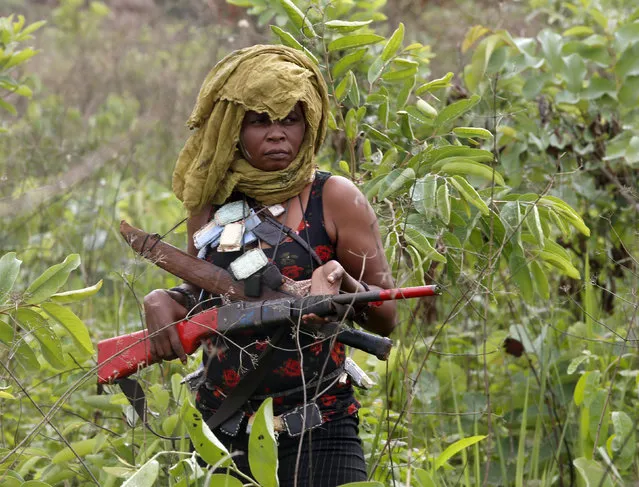
A female member of the anti-balaka, a Christian militia, patrols with other militiamen outside village of Zawa April 8, 2014. (Photo by Goran Tomasevic/Reuters)

Anti-balaka militia originally sprang up to protect the Christian population of the Central African Republic, but now stand accused of human rights abuses themselves. Last month, the African Union branded militia targeting Muslims in Central African Republic as “terrorists” and said they would be treated as enemy combatants, a day after killing a Congolese peacekeeper and amid deepening international frustration at continuing violence in the impoverished and landlocked country. Photo: A female member of the anti-balaka, a Christian militia, patrols with other militiamen outside village of Zawa April 8, 2014. (Photo by Goran Tomasevic/Reuters)
Details
10 Apr 2014 10:26:00