Loading...
Done
An inmate with a tattoo of Santa Muerte (The Saint of Death) reacts in the Topo Chico prison, during a media tour, in Monterrey, Mexico, February 17, 2016. (Photo by Daniel Becerril/Reuters)

An inmate with a tattoo of Santa Muerte (The Saint of Death) reacts in the Topo Chico prison, during a media tour, in Monterrey, Mexico, February 17, 2016. The director of a prison in northeast Mexico where 49 people died in a riot this week was accused of murder and detained, along with two others, a state prosecutor said on Saturday. (Photo by Daniel Becerril/Reuters)
Details
19 Feb 2016 12:20:00
Hundreds of houses painted in bright colors in what organizers claim is Mexico's largest mural, is part of a government-sponsored project is called Pachuca Paints Itself, in the Palmitas neighborhood, in Pachuca, Mexico, Thursday, July 30, 2015. German Crew is the artist collective responsible for painting the mural project. Director Enrique Gomez, who goes by MYBE, said the crew has painted 1,500 square meters with 20,000 liters of paint. (Photo by Sofia Jaramillo/AP Photo)

Hundreds of houses painted in bright colors in what organizers claim is Mexico's largest mural, is part of a government-sponsored project is called Pachuca Paints Itself, in the Palmitas neighborhood, in Pachuca, Mexico, Thursday, July 30, 2015. German Crew is the artist collective responsible for painting the mural project. Director Enrique Gomez, who goes by MYBE, said the crew has painted 1,500 square meters with 20,000 liters of paint. Working hand-in-hand with residents, muralists have painted the facades of 200 homes bright lavender, lime green, incandescent orange – hues more commonly found in a bag of Skittles than in the drab, cement-and-cinderblock neighborhoods where many of Mexico's poor live. The project aims to bring the community together and rehabilitate the area. (Photo by Sofia Jaramillo/AP Photo)
Details
03 Aug 2015 12:02:00
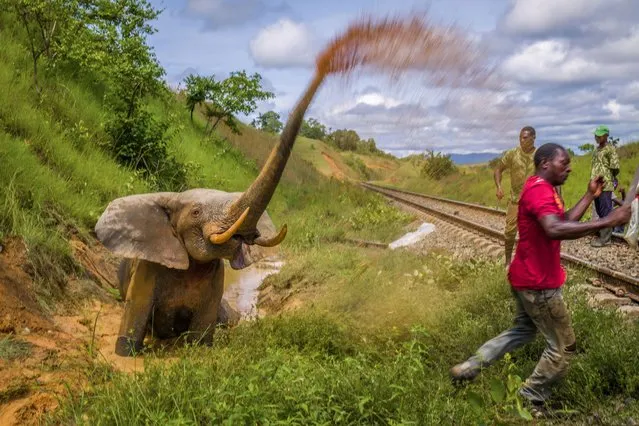
Grand prize winner: environmental photographer of the year 2023; also 1st place in the humanity v nature category; and winner of the 2023 public award. Lopé national park, Gabon, 2021. An angry elephant tries to defend itself after it was hit by a train that crosses paths the animals use within Lopé national park. Park officials decided the elephant was too severely injured to be saved. After it was killed, the park director distributed the meat to local people. As the forest loses its carrying capacity to sustain its megafauna, this kind of human-wildlife conflict is increasing. (Photo by Jasper Doest/Environmental Photography Award)

Grand prize winner: environmental photographer of the year 2023; also 1st place in the humanity v nature category; and winner of the 2023 public award. Lopé national park, Gabon, 2021. An angry elephant tries to defend itself after it was hit by a train that crosses paths the animals use within Lopé national park. Park officials decided the elephant was too severely injured to be saved. After it was killed, the park director distributed the meat to local people. As the forest loses its carrying capacity to sustain its megafauna, this kind of human-wildlife conflict is increasing. (Photo by Jasper Doest/Environmental Photography Award)
Details
09 Jul 2023 03:06:00
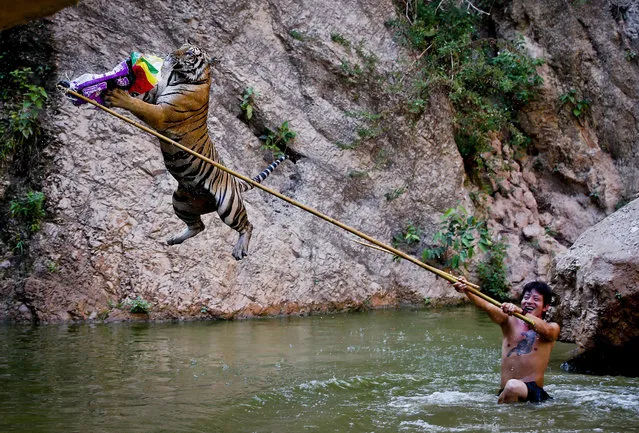
A picture made available 26 April 2016 shows a tiger playing in the water with a trainer nicknamed “Super Tiger Man” at the Tiger Temple in Kanchanaburi province, Thailand, 24 April 2016. The site known in Thai as “Wat Pa Luangta Maha Bua Yannasampanno” has been the focus of a dispute with the Department of National Parks, Wildlife and Plant Conservation (DNP) after the DNP asked in 2015 that the temple hands over its 147 tigers since it was not licensed to keep them. The temple has requested for a zoo license according to its managing director. (Photo by Diego Azubel/EPA)

A picture made available 26 April 2016 shows a tiger playing in the water with a trainer nicknamed “Super Tiger Man” at the Tiger Temple in Kanchanaburi province, Thailand, 24 April 2016. The site known in Thai as “Wat Pa Luangta Maha Bua Yannasampanno” has been the focus of a dispute with the Department of National Parks, Wildlife and Plant Conservation (DNP) after the DNP asked in 2015 that the temple hands over its 147 tigers since it was not licensed to keep them. The temple has requested for a zoo license according to its managing director. (Photo by Diego Azubel/EPA)
Details
01 Jun 2016 12:44:00
Eco-Friendly Coffins

Claire and Rupert Callender of the Green Funeral Company pose for a photograph with a environmentally friendly coffin in woodland close to their office at Dartington Hall Estate on February 4, 2011 near Torquay, England. The Devon-based company operates as funeral directors and undertakers throughout the South West, offers an ecological alternative to traditional funerals, with coffins made from ecologically friendly materials such as wicker and bamboo, and can arrange funerals that encompass diverse religious and spiritual beliefs everything from a Catholic Requiem Mass, to a Pagan ritual at a stone circle on Bodmin Moor. (Photo by Matt Cardy/Getty Images)
Details
16 Aug 2011 11:04:00
Architecture of Density #119, 2009. (Photo by Michael Wolf, courtesy of Flowers Gallery)

Hong Kong art gallery director Sarah Greene said that Wolf, known for his work depicting mega-cities, has died Tuesday, April 24, 2019 night at his home. She said he was 64. Wolf won first prize in the World Press Photo competition in 2005 and 2010. Here: Architecture of Density #119, 2009. (Photo by Michael Wolf, courtesy of Flowers Gallery)
Details
29 Apr 2019 00:03:00
Famous Guns By Federico Mauro

Award-winning director Federico Mauro continues his “Famous…” series with a piece on iconic guns and the characters who toted them. With everything from James Bond’s silenced Walther PPK and Dirty Harry’s legendary Smith & Wesson Model 29 to more obscure models like the Green Hornet’s green gun, this list covers a unique range of the more memorable guns in cinema and pop culture history.

See also:Famous Eyeglasses By Federico Mauro
Details
01 Sep 2013 13:20:00
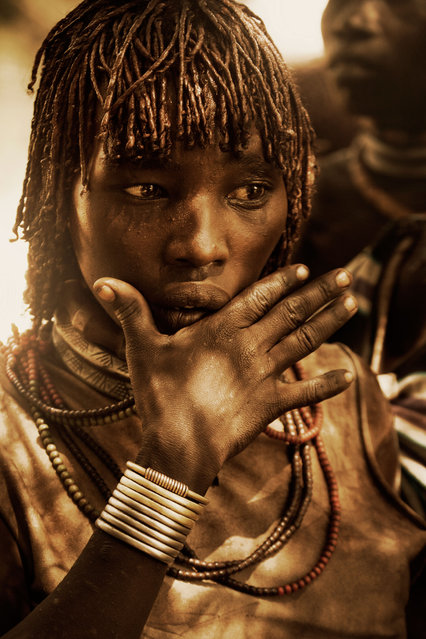
The Hamar people traditionally use red ocher clay to braid the hair of their women. (Photo by Diego Arroyo)

During his time in Ethiopia, New York-based art director and photographer Diego Arroyo spent time with the Hamar, Mursi, Dassanech, and Arbore Tribes. They, along with several others tribes, make up the 200,000 people situated in Africa’s Great Rift Valley. The people of the Omo Valley are still primarily herders and farmers, living an isolated and simple life. While they have yet to be truly touched by globalization, they could soon disappear. Their way of life is being threatened by a massive hydroelectric dam. (Photo by Diego Arroyo)
Details
13 Aug 2014 10:00:00