Loading...
Done
Women are covered in dust after making it out of a building that collapsed after an earthquake in the Roma neighborhood of Mexico City, Tuesday, September 19, 2017. (Photo by Rebecca Blackwell/AP Photo)

Women are covered in dust after making it out of a building that collapsed after an earthquake in the Roma neighborhood of Mexico City, Tuesday, September 19, 2017. A powerful earthquake shook Mexico City on Tuesday, causing panic among the megalopolis' 20 million inhabitants on the 32nd anniversary of a devastating 1985 quake. The US Geological Survey put the quake's magnitude at 7.1 while Mexico's Seismological Institute said it measured 6.8 on its scale. The institute said the quake's epicenter was seven kilometers west of Chiautla de Tapia, in the neighboring state of Puebla. (Photo by Rebecca Blackwell/AP Photo)
Details
20 Sep 2017 08:06:00
Grand banqueting halls, opulent lobbies and vast ballrooms; you could easily be forgiven for thinking this was a collection of photographs was documenting some of Europe’s grandest hotels. However, a closer look will reveal the majestic rooms to be engulfed in swathes of dust and moss; hotels that once hosted royals and high society abandoned to the elements. (Photo by Thomas Windisch/Caters News)

Grand banqueting halls, opulent lobbies and vast ballrooms; you could easily be forgiven for thinking this was a collection of photographs was documenting some of Europe’s grandest hotels. However, a closer look will reveal the majestic rooms to be engulfed in swathes of dust and moss; hotels that once hosted royals and high society abandoned to the elements. This is the latest result of urban exploration photography, going beyond “no entry” signs to capture images of dilapidated buildings across Europe. IT worker Thomas Windisch, from Graz in Austria, indulged his passion for photography by traveling across the continent, visiting over 100 abandoned hotels along the way. Here: inside a hotel in Austria. (Photo by Thomas Windisch/Caters News)
Details
24 Mar 2015 10:26:00
Students of Rabindrabharati University apply colour dust or Gulal on each other during a celebration the festival of colour Holi in Kolkata, Eastern India, 23 March 2024. Holi, also known as the Festival of Colors, is an ancient Hindu festival symbolizing the victory of good over evil and marking the arrival of spring. It is observed with joyful gatherings during which revelers cover each other in colored powders. (Photo by Piyal Adhikary/EPA/EFE)

Students of Rabindrabharati University apply colour dust or Gulal on each other during a celebration the festival of colour Holi in Kolkata, Eastern India, 23 March 2024. Holi, also known as the Festival of Colors, is an ancient Hindu festival symbolizing the victory of good over evil and marking the arrival of spring. It is observed with joyful gatherings during which revelers cover each other in colored powders. (Photo by Piyal Adhikary/EPA/EFE)
Details
05 Jul 2025 03:40:00
Airways hostess

British South American Airways hostess Mary Guthrie with a pair of pineapples, on the return of the Lancastrian airliner 'Star Dust' to Heathrow Airport after a test-flight to Buenos Aires, 15th January 1946
.
Details
10 Apr 2011 11:57:00
An infrared portrait from NASA's Spitzer Space Telescope which shows generations of stars is seen in this undated NASA handout image released February 14, 2013. In this wispy star-forming region, called W5, the oldest stars can be seen as blue dots in the centers of the two hollow cavities (other blue dots are background and foreground stars not associated with the region). Red shows heated dust that pervades the region's cavities, while green highlights dense clouds. (Photo by NASA/Reuters/JPL-Caltech/Harvard-Smithsonian/Handout)

An infrared portrait from NASA's Spitzer Space Telescope which shows generations of stars is seen in this undated NASA handout image released February 14, 2013. In this wispy star-forming region, called W5, the oldest stars can be seen as blue dots in the centers of the two hollow cavities (other blue dots are background and foreground stars not associated with the region). Red shows heated dust that pervades the region's cavities, while green highlights dense clouds. (Photo by NASA/Reuters/JPL-Caltech/Harvard-Smithsonian/Handout)
Details
03 Mar 2013 08:44:00
A shooting star (L, top) is seen on the night sky during the perseid meteor shower in Jankowo, near Poznan, 11 August 2016. The first half of August is traditionally the best time to look out for meteors called “shooting stars”, or perseids which are the leftover dust particles of a comet tail associated with comet Swift-Tuttle. (Photo by Lukasz Ogrodowczyk/EPA)

A shooting star (L, top) is seen on the night sky during the perseid meteor shower in Jankowo, near Poznan, 11 August 2016. The first half of August is traditionally the best time to look out for meteors called “shooting stars”, or perseids which are the leftover dust particles of a comet tail associated with comet Swift-Tuttle. (Photo by Lukasz Ogrodowczyk/EPA)
Details
12 Aug 2016 11:59:00
Five-year-old sniffing dog “Vine” wears protection goggles against the sun and dust as he poses together with Giulia Gausemann for photographers, at the sniffing dogs school of the German Army (Bundeswehr) in Daun, Germany, July 24, 2020. The Bundeswehr sniffing dogs school and the veterinarian university of Hanover are developing a training programme to sniff out the coronavirus disease (COVID-19) with dogs at airports, border crossings and other highly frequented places. (Photo by Wolfgang Rattay/Reuters)

Five-year-old sniffing dog “Vine” wears protection goggles against the sun and dust as he poses together with Giulia Gausemann for photographers, at the sniffing dogs school of the German Army (Bundeswehr) in Daun, Germany, July 24, 2020. The Bundeswehr sniffing dogs school and the veterinarian university of Hanover are developing a training programme to sniff out the coronavirus disease (COVID-19) with dogs at airports, border crossings and other highly frequented places. (Photo by Wolfgang Rattay/Reuters)
Details
26 Jul 2020 00:01:00
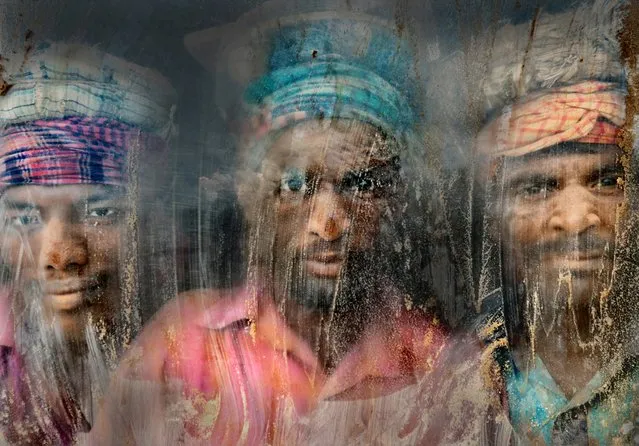
Gravel Workmen of Chittagong, Bangladesh, by Faisal Azim. Gravel workmen look through a glass window at a gravel-crushing yard in Chittagong. Full of dust and sand, it is an extremely unhealthy environment for working, but still hundreds of people work here for their livelihoods. (Photo by Faisal Azim/2016 Atkins CIWEM Environmental Photographer of the Year)

From Tibetan monks playing basket ball with ice thawing high up in the Himalayas, to the pollution that hides behind the Taj Mahal, here’s pick from 60 exceptional environmental photographs, by photographers and filmmakers from 70 countries, that will go on show at the Royal Geographical Society in London from 29 June to 21 August. The winners will be announced on 28 June. Here: Gravel Workmen of Chittagong, Bangladesh, by Faisal Azim. Gravel workmen look through a glass window at a gravel-crushing yard in Chittagong. Full of dust and sand, it is an extremely unhealthy environment for working, but still hundreds of people work here for their livelihoods. (Photo by Faisal Azim/2016 Atkins CIWEM Environmental Photographer of the Year)
Details
01 Jun 2016 12:25:00