Loading...
Done
Janus, a two-headed Greek turtle named after the Roman god with two heads is testing a kind of skateboard to rehabilitate one day ahead of her 25th birthday at the Natural History Museum in Geneva on September 2, 2022. (Photo by Pierre Albouy/Reuters)

Janus, a two-headed Greek turtle named after the Roman god with two heads is testing a kind of skateboard to rehabilitate one day ahead of her 25th birthday at the Natural History Museum in Geneva on September 2, 2022. (Photo by Pierre Albouy/Reuters)
Details
06 Dec 2023 04:53:00
A woman carries an idol of Hindu god Ganesh to her home on the first day of the ten-day-long Ganesh Chaturthi festival, amid the coronavirus disease (COVID-19) outbreak, in Mumbai, India on August 22, 2020. (Photo by Hemanshi Kamani/Reuters)

A woman carries an idol of Hindu god Ganesh to her home on the first day of the ten-day-long Ganesh Chaturthi festival, amid the coronavirus disease (COVID-19) outbreak, in Mumbai, India on August 22, 2020. (Photo by Hemanshi Kamani/Reuters)
Details
27 Aug 2020 00:05:00
Strange Children by John Seven

«My God! My Shoulder!», “Re-Gruntled”, 2011. (Photo by John Seven)
Details
07 Jul 2012 10:57:00
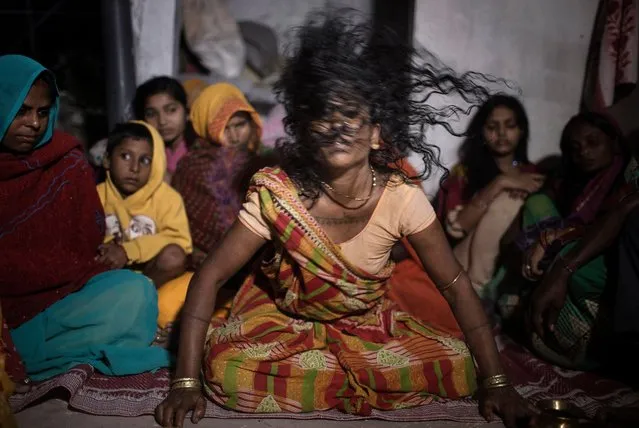
Marani Devi Chaudhary (C), aged 40, performs a ritual in front of shaman Paltan Yadav (unseen) at her home in Rajaur village in Dhanusha district, Nepal, 02 November 2017. The shaman identified Marani Devi to be possessed by their lineage god who was dissatisfied by their worship is thought by the family to have caused them misfortune and is even feared lead to their death. Therefore Marani Devi spent 1,500 USD to perform a healing ritual at the Ghost Festival held at the banks of Kamala River in Dhanusha district two days later. Every family or community has their own sacred god, called 'Kuldevta' in Nepali which means family deity or lineage god. Only family members or people within communities of the same caste can worship to the deity. They have their own rules and regulations of worship which varies from one family and community to another. Being unable to follow the rules and regulations or carry out worship is believed to cause misfortune. (Photo by Narendra Shrestha/EPA/EFE)

Marani Devi Chaudhary (C), aged 40, performs a ritual in front of shaman Paltan Yadav (unseen) at her home in Rajaur village in Dhanusha district, Nepal, 02 November 2017. The shaman identified Marani Devi to be possessed by their lineage god who was dissatisfied by their worship is thought by the family to have caused them misfortune and is even feared lead to their death. (Photo by Narendra Shrestha/EPA/EFE)
Details
17 Nov 2017 06:53:00
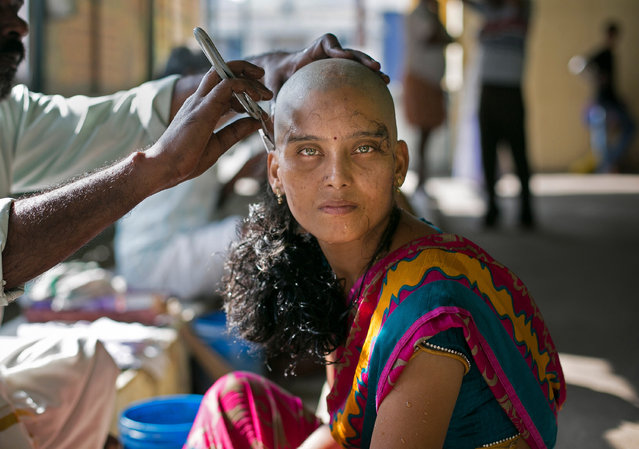
28 year old Rupa has her hair shaven to donate to the Gods at the Thiruthani Murugan Temple November 10, 2016 in Thiruttani, India. Rupa donated her hair with the wish that her daughter's illness is cured. The process of shaving ones hair and donating it to the Gods is known as tonsuring. It is common for Hindu believers to tonsure their hair at a temple as a young child, and also to celebrate a wish coming true, such as the birth of a baby or the curing of an illness. The “temple hair”, as it's known, is then auctioned off to a processing plant and then sold as pricey wigs and weaves in the US, Europe and Africa. (Photo by Allison Joyce/Getty Images)


28 year old Rupa has her hair shaven to donate to the Gods at the Thiruthani Murugan Temple November 10, 2016 in Thiruttani, India. Rupa donated her hair with the wish that her daughter's illness is cured. The process of shaving ones hair and donating it to the Gods is known as tonsuring. It is common for Hindu believers to tonsure their hair at a temple as a young child, and also to celebrate a wish coming true, such as the birth of a baby or the curing of an illness. The “temple hair”, as it's known, is then auctioned off to a processing plant and then sold as pricey wigs and weaves in the US, Europe and Africa. (Photo by Allison Joyce/Getty Images)
Details
21 Nov 2016 10:30:00
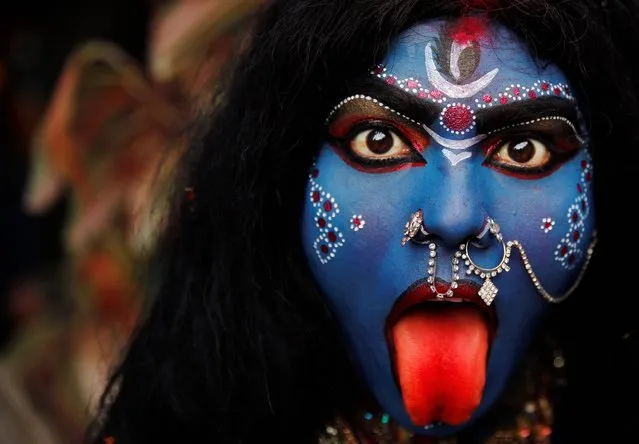
An Indian woman dressed as Hindu Goddess Kali participates in a “Shivratri” procession in Allahabad, India, Thursday, Feb. 27, 2014. “Shivaratri”, or the night of Shiva, is dedicated to the worship of Lord Shiva, the Hindu god of death and destruction. (Photo by Rajesh Kumar SinghAP Photo)

An Indian woman dressed as Hindu Goddess Kali participates in a “Shivratri” procession in Allahabad, India, Thursday, Feb. 27, 2014. “Shivaratri”, or the night of Shiva, is dedicated to the worship of Lord Shiva, the Hindu god of death and destruction. (Photo by Rajesh Kumar SinghAP Photo)
Details
01 Mar 2014 12:58:00
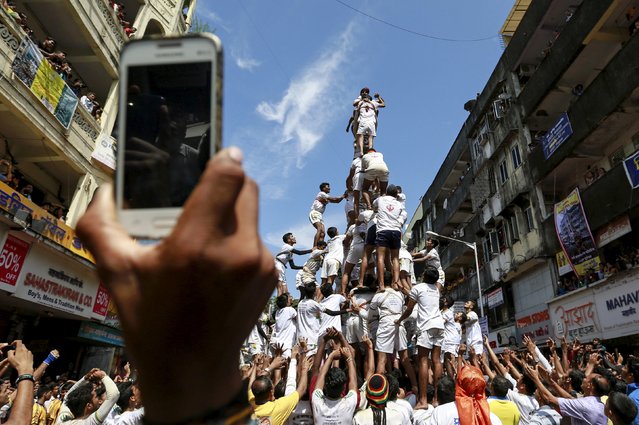
Devotees try to form a human pyramid to break a clay pot containing curd during celebrations to mark the Hindu festival of Janmashtami in Mumbai, India, September 6, 2015. Janmashtami, which marks the birthday of Hindu god Krishna, is being celebrated across the country today. (Photo by Danish Siddiqui/Reuters)

Devotees try to form a human pyramid to break a clay pot containing curd during celebrations to mark the Hindu festival of Janmashtami in Mumbai, India, September 6, 2015. Janmashtami, which marks the birthday of Hindu god Krishna, is being celebrated across the country today. (Photo by Danish Siddiqui/Reuters)
Details
07 Sep 2015 13:16:00
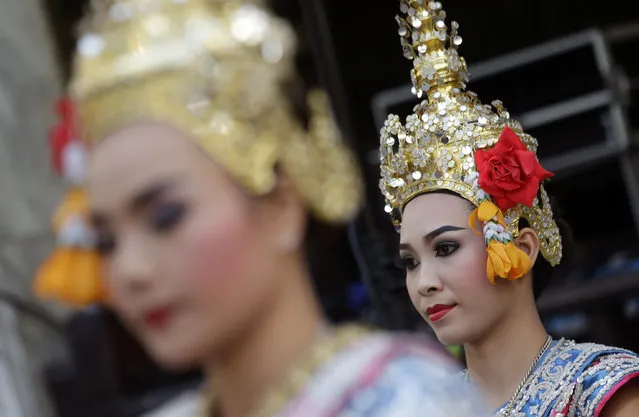
Thai classical dancers perform for Phra Phrom, the Thai interpretation of the Hindu god Brahma, at the Erawan Shrine in Bangkok, Thailand, Friday, September 4, 2015. (Photo by Sakchai Lalit/AP Photo)

Thai classical dancers perform for Phra Phrom, the Thai interpretation of the Hindu god Brahma, at the Erawan Shrine in Bangkok, Thailand, Friday, September 4, 2015. Thai authorities unveiled the restored centerpiece Friday of the Erawan Shrine, in the latest bid to restore confidence among Bangkok's tourism and business communities almost three weeks after a deadly bombing. (Photo by Sakchai Lalit/AP Photo)
Details
05 Sep 2015 12:27:00