Loading...
Done
A South Korean diver wearing a little mermaid costume performs in a tank ahead of the “Chuseok” national holiday, at the Coex Aquarium in Seoul, South Korea, 26 August 2022. Chuseok is the autumn harvest celebration of the Lunar Calendar and is one of Korea's biggest traditional holiday, which falls on 10 Setpember this year. (Photo by Jeon Heon-Kyun/EPA/EFE)

A South Korean diver wearing a little mermaid costume performs in a tank ahead of the “Chuseok” national holiday, at the Coex Aquarium in Seoul, South Korea, 26 August 2022. Chuseok is the autumn harvest celebration of the Lunar Calendar and is one of Korea's biggest traditional holiday, which falls on 10 Setpember this year. (Photo by Jeon Heon-Kyun/EPA/EFE)
Details
21 Sep 2022 04:50:00
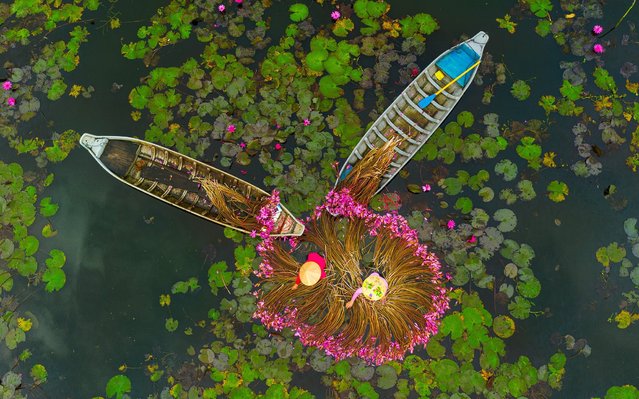
Incredible drone image capture colourful water lilies being harvested in An Giang Province, Vietnam, Southeast Asia on September 2020. Water lilies are an iconic symbol in the Mekong Delta and the flowers are immediately sent to market before landing on meal tables. Their stalks are edible and can be eaten raw with either fermented paste or braised sauce, or dunked into sour soup or hotpot. (Photo by Nguyen Sanh Quoc Huy/Triangle News)

Incredible drone image capture colourful water lilies being harvested in An Giang Province, Vietnam, Southeast Asia on September 2020. Water lilies are an iconic symbol in the Mekong Delta and the flowers are immediately sent to market before landing on meal tables. Their stalks are edible and can be eaten raw with either fermented paste or braised sauce, or dunked into sour soup or hotpot. (Photo by Nguyen Sanh Quoc Huy/Triangle News)
Details
25 Sep 2020 00:05:00
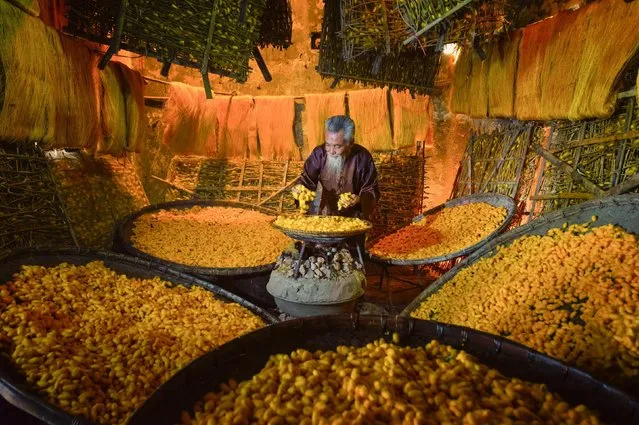
Thousands of bright yellow silkworm cocoons are dried in huge clay bowls in the village of Hong Ly, northern Vietnam in July 2022. Silk fibres are produced by silkworms when they spin themselves into a cocoon on their journey to becoming a silkmoth. The ultra-soft fibres are harvested from the cocoon in their raw state by being boiled in hot water. (Photo by Prabu Mohan/Solent News)

Thousands of bright yellow silkworm cocoons are dried in huge clay bowls in the village of Hong Ly, northern Vietnam in July 2022. Silk fibres are produced by silkworms when they spin themselves into a cocoon on their journey to becoming a silkmoth. The ultra-soft fibres are harvested from the cocoon in their raw state by being boiled in hot water. (Photo by Prabu Mohan/Solent News)
Details
31 Jul 2022 05:59:00
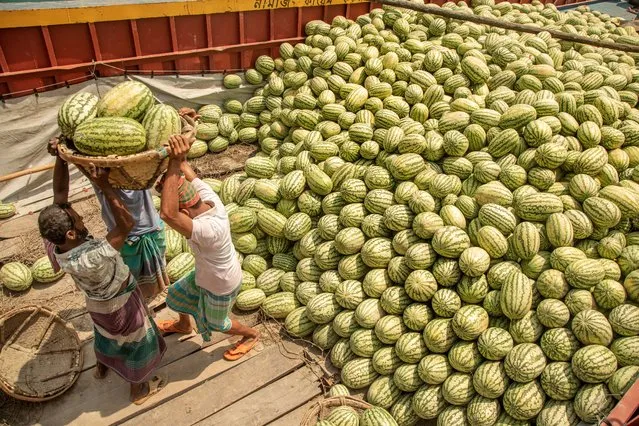
Bangladeshi laborers unload watermelons from a boat at the Buriganga River in Dhaka, Bangladesh, 03 April 2024. Watermelon is in harvesting season and is filling the city markets as it arrives from the southern part of Bangladesh. According to the Department of Agriculture Extension (DAE), Barishal has set an ambitious goal to expand watermelon cultivation to 54,002 hectares across six high-yielding districts in the division, which is 14 percent higher than last year. (Photo by Monirul Alam/EPA/EFE)

Bangladeshi laborers unload watermelons from a boat at the Buriganga River in Dhaka, Bangladesh, 03 April 2024. Watermelon is in harvesting season and is filling the city markets as it arrives from the southern part of Bangladesh. According to the Department of Agriculture Extension (DAE), Barishal has set an ambitious goal to expand watermelon cultivation to 54,002 hectares across six high-yielding districts in the division, which is 14 percent higher than last year. (Photo by Monirul Alam/EPA/EFE)
Details
19 Apr 2024 00:22:00
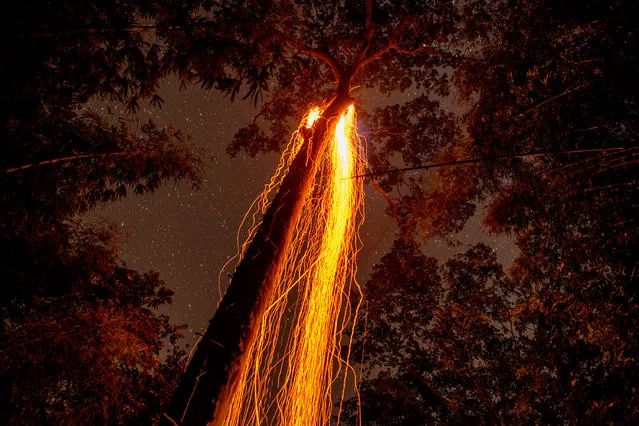
Bees are sensitive to light, which makes them follow the glowing embers down to the ground. (Photo by Hasnoor Hussain/The Guardian)

During the spring harvest season, a group of traditional Malaysian honey hunters travel to the rainforest near the Thai border to collect honeycombs from giant bees – and risk their lives climbing 200ft trees. Here: Bees are sensitive to light, which makes them follow the glowing embers down to the ground. (Photo by Hasnoor Hussain/The Guardian)
Details
22 Oct 2016 10:26:00
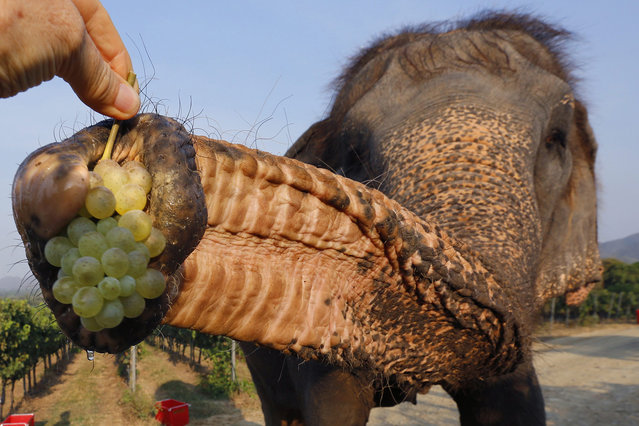
Tourists feed freshly picked grapes to 40-year-old elephant Boonruen, a long-term resident of the Hua Hin Hills vineyard, that used to be an elephant corral in Hua Hin, about 200km southwest of Bangkok, Thailand, 08 March 2016. The winery is among a handful of companies producing new latitude wines in non-traditional wine areas of the world near the equator. Harvest is only once a year in Thailand, this year in March. (Photo by Barbara Walton/EPA)

Tourists feed freshly picked grapes to 40-year-old elephant Boonruen, a long-term resident of the Hua Hin Hills vineyard, that used to be an elephant corral in Hua Hin, about 200km southwest of Bangkok, Thailand, 08 March 2016. The winery is among a handful of companies producing new latitude wines in non-traditional wine areas of the world near the equator. Harvest is only once a year in Thailand, this year in March. (Photo by Barbara Walton/EPA)
Details
20 Mar 2016 11:20:00
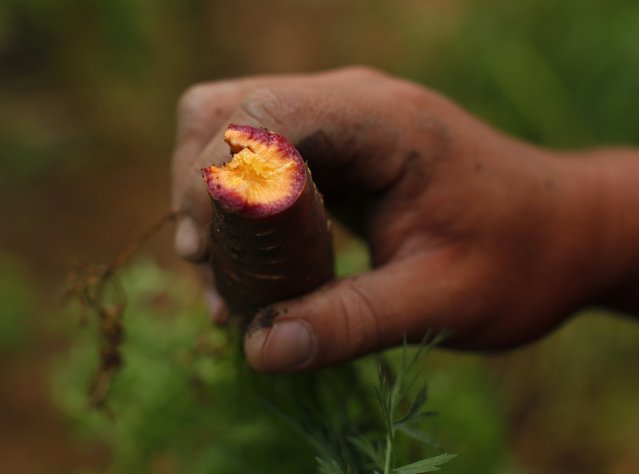
Makoto Chino eats a purple haze carrot as he works harvesting the morning's vegetables and fruit from his family's farm in Rancho Santa Fe, California August 12, 2014. (Photo by Mike Blake/Reuters)

Makoto Chino eats a purple haze carrot as he works harvesting the morning's vegetables and fruit from his family's farm in Rancho Santa Fe, California August 12, 2014. The gravitational pull of Chino Farm is legendary. Since they don't ship, everyone – whether a top chef or a traveling foodie or a local resident – comes to the farm stand, simply called “Vegetable Shop”, on a dusty corner of this affluent San Diego County town, hemmed in by sprawling housing estates. (Photo by Mike Blake/Reuters)
Details
26 Nov 2014 14:41:00
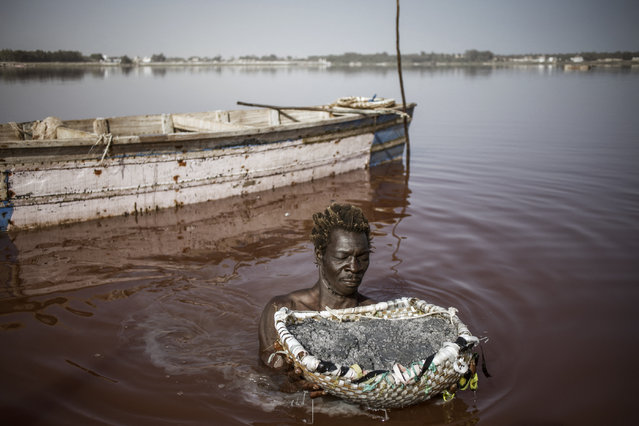
Toure, a Gambian salt harvester, holds a basket filled with  the salt collected from the crust of the bottom of the Lake Retba (Pink Lake) in Senegal on March 16, 2021. Lake Retba, divided from the Atlantic Ocean by a narrow corridor of dunes, owes its name to the pink waters caused by the Dunaliella salina algae and is known for its high salt content, up to 40% in some areas. (Photo by Marco Longari/AFP Photo)

Toure, a Gambian salt harvester, holds a basket filled with the salt collected from the crust of the bottom of the Lake Retba (Pink Lake) in Senegal on March 16, 2021. Lake Retba, divided from the Atlantic Ocean by a narrow corridor of dunes, owes its name to the pink waters caused by the Dunaliella salina algae and is known for its high salt content, up to 40% in some areas. (Photo by Marco Longari/AFP Photo)
Details
24 Mar 2021 10:29:00