Loading...
Done
A Filipino woman wears a mask to try and protect against the spread of coronavirus in Malate district, Manila City on March 24, 2020. The Philippines has taken drastic measures to combat the spread of Covid-19. The entire country is under strict quarantine and the army is on the streets to monitor compliance. According to official figures, there are 462 positive cases and 33 dead in the Philippines, but it is thought that thousands of cases remain undetected due to lack of resources in a country where millions of people have no access to health care. In the poorest and most crowded areas, it’s almost impossible to adhere to the physical distancing required during quarantine. (Photo by Alejandro Ernesto/The Guardian)

A Filipino woman wears a mask to try and protect against the spread of coronavirus in Malate district, Manila City on March 24, 2020. The Philippines has taken drastic measures to combat the spread of Covid-19. The entire country is under strict quarantine and the army is on the streets to monitor compliance. According to official figures, there are 462 positive cases and 33 dead in the Philippines, but it is thought that thousands of cases remain undetected due to lack of resources in a country where millions of people have no access to health care. In the poorest and most crowded areas, it’s almost impossible to adhere to the physical distancing required during quarantine. (Photo by Alejandro Ernesto/The Guardian)
Details
08 Apr 2020 00:01:00
A young Bengal tiger cub smuggled into the US and seized at the Mexico border is displayed for the media during Operation Jungle Book at the US Fish and Wildlife Service in Torrance, California on October 20, 2017. Operation Jungle Book, a law enforcement initiative led by the US Fish and Wildlife Service that targeted wildlife smuggling, resulting in federal criminal charges against defendants who allegedly participated in the illegal importation and/ or transportation of numerous animal species – including a tiger, monitor lizards, cobras, Asian “lucky” fish, exotic songbirds and several coral species. (Photo by Mark Ralston/AFP Photo)

A young Bengal tiger cub smuggled into the US and seized at the Mexico border is displayed for the media during Operation Jungle Book at the US Fish and Wildlife Service in Torrance, California on October 20, 2017. Operation Jungle Book, a law enforcement initiative led by the US Fish and Wildlife Service that targeted wildlife smuggling, resulting in federal criminal charges against defendants who allegedly participated in the illegal importation and/ or transportation of numerous animal species – including a tiger, monitor lizards, cobras, Asian “lucky” fish, exotic songbirds and several coral species. (Photo by Mark Ralston/AFP Photo)
Details
29 Oct 2017 08:30:00
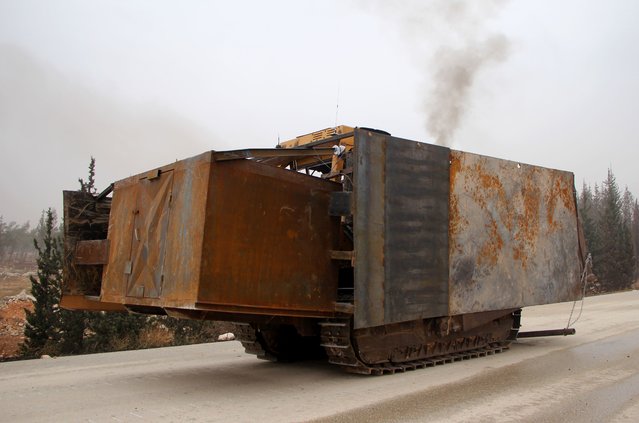
Rebel fighters from the Jaish al- Fatah (or Army of Conquest) brigades manoeuver an alleged explosive- rigged make- shift armoured vehicle during a major assault on Syrian government forces West of Aleppo city on October 28, 2016 Syrian opposition fighters launched a major assault on government forces to break a months- long siege of rebel- held neighbourhoods of the battered city of Aleppo. Rebel groups including the powerful Ahrar al- Sham faction and former Al- Qaeda affiliate Fateh al- Sham Front fired waves of rockets into government- held western Aleppo, killing at least 15 civilians, a monitor said. (Photo by Omar Haj Kadour/AFP Photo)

Rebel fighters from the Jaish al- Fatah (or Army of Conquest) brigades manoeuver an alleged explosive- rigged make- shift armoured vehicle during a major assault on Syrian government forces West of Aleppo city on October 28, 2016 Syrian opposition fighters launched a major assault on government forces to break a months- long siege of rebel- held neighbourhoods of the battered city of Aleppo. Rebel groups including the powerful Ahrar al- Sham faction and former Al- Qaeda affiliate Fateh al- Sham Front fired waves of rockets into government- held western Aleppo, killing at least 15 civilians, a monitor said. (Photo by Omar Haj Kadour/AFP Photo)
Details
29 Oct 2016 11:51:00
Two woman lie in a puddle of squashed tomatoes during the annual “Tomatina” tomato fight fiesta, in the village of Bunol, 50 kilometers outside Valencia, Spain, Wednesday, August 26, 2015. The streets of an eastern Spanish town are awash with red pulp as thousands of people pelt each other with tomatoes in the annual "Tomatina" battle that has become a major tourist attraction. (Photo by Alberto Saiz/AP Photo)

Two woman lie in a puddle of squashed tomatoes during the annual “Tomatina” tomato fight fiesta, in the village of Bunol, 50 kilometers outside Valencia, Spain, Wednesday, August 26, 2015. The streets of an eastern Spanish town are awash with red pulp as thousands of people pelt each other with tomatoes in the annual "Tomatina" battle that has become a major tourist attraction. At the annual fiesta in Bunol on Wednesday, trucks dumped 150 tons of ripe tomatoes for some 22,000 participants, many from abroad to throw during the hour-long morning festivities. (Photo by Alberto Saiz/AP Photo)
Details
27 Aug 2015 11:51:00
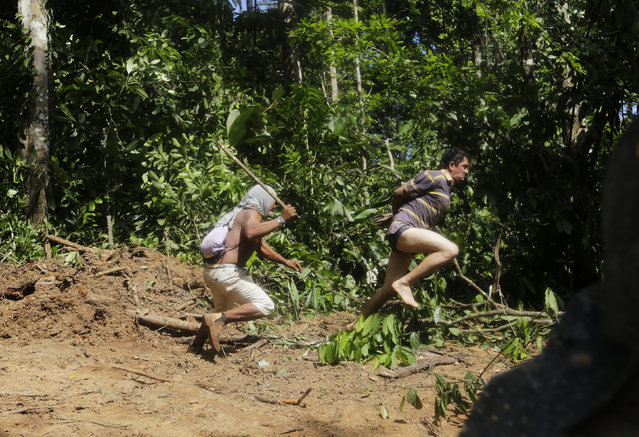
A Ka'apor Indian warrior (L) chases a logger who tried to escape after they captured him during a jungle expedition to search for and expel loggers from the Alto Turiacu Indian territory, near the Centro do Guilherme municipality in the northeast of Maranhao state in the Amazon basin, August 7, 2014. (Photo by Lunae Parracho/Reuters)

A Ka'apor Indian warrior (L) chases a logger who tried to escape after they captured him during a jungle expedition to search for and expel loggers from the Alto Turiacu Indian territory, near the Centro do Guilherme municipality in the northeast of Maranhao state in the Amazon basin, August 7, 2014. Tired of what they say is a lack of sufficient government assistance in keeping loggers off their land, the Ka'apor Indians, who along with four other tribes are the legal inhabitants and caretakers of the territory, have sent their warriors out to expel all loggers they find and set up monitoring camps in the areas that are being illegally exploited. (Photo by Lunae Parracho/Reuters)
Details
05 Sep 2014 11:41:00
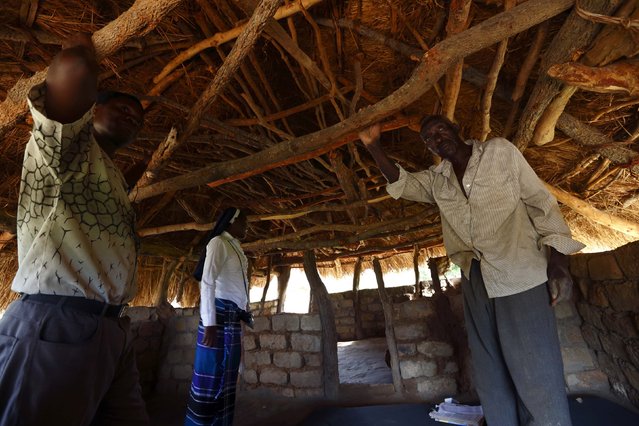
HIV-positive 71-year-old Sylverio Hachiploa (R) talks with caregivers Glandwel Muleya (L) and Sister Abigail Mwaka Mazuba (C) in his thatched hut during a visit by a home-based care team in the village of Nedwmba, south of the Chikuni Mission in the south of Zambia February 23, 2015. (Photo by Darrin Zammit Lupi/Reuters)

HIV-positive 71-year-old Sylverio Hachiploa (R) talks with caregivers Glandwel Muleya (L) and Sister Abigail Mwaka Mazuba (C) in his thatched hut during a visit by a home-based care team in the village of Nedwmba, south of the Chikuni Mission in the south of Zambia February 23, 2015. The caregivers in the Jesuit-run home-based care project at the Chikuni Mission run a capacity-building and empowerment project at the household level, offering training and assistance in crop-growing and animal rearing, as well as offering companionship, pastoral care and monitoring of the antiretroviral treatment compliance of HIV-AIDS patients. (Photo by Darrin Zammit Lupi/Reuters)
Details
25 Feb 2015 09:04:00
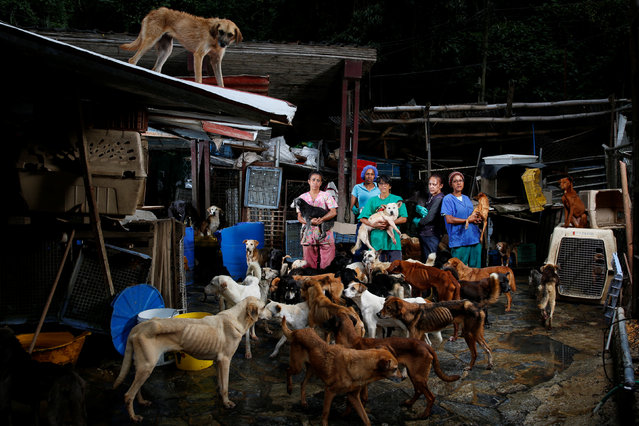
(L-R) Maria Silva, Milena Cortes, Maria Arteaga, Jackeline Bastidas and Gissy Abello pose for a picture at the Famproa dogs shelter where they work, in Los Teques, Venezuela, August 25, 2016. Venezuelans struggling to feed their families let alone their pets are dumping animals on the streets, in parks and at makeshift homes overrun with scrawny animals amid an economic crisis. An hour from Caracas in Los Teques, hundreds of dogs bark and run around the streets scavenging for food outside a makeshift shelter. People come by every few hours to hand over scrawny dogs which are fed by volunteers every day. Venezuela is undergoing a major economic and social crisis, with shortages of basic foods and medicines. Triple digit inflation is hitting everybody hard, including those who own pets. (Photo by Carlos Garcia Rawlins/Reuters)

(L-R) Maria Silva, Milena Cortes, Maria Arteaga, Jackeline Bastidas and Gissy Abello pose for a picture at the Famproa dogs shelter where they work, in Los Teques, Venezuela, August 25, 2016. Venezuelans struggling to feed their families let alone their pets are dumping animals on the streets, in parks and at makeshift homes overrun with scrawny animals amid an economic crisis. An hour from Caracas in Los Teques, hundreds of dogs bark and run around the streets scavenging for food outside a makeshift shelter. (Photo by Carlos Garcia Rawlins/Reuters)
Details
08 Sep 2016 10:01:00
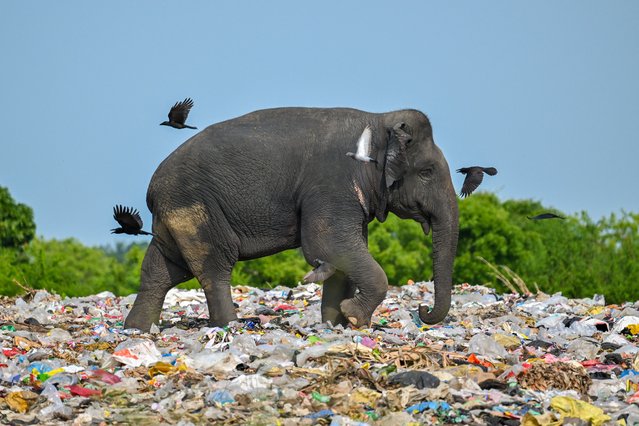
A wild elephant eats garbage containing plastic waste at a dump in Sri Lanka's eastern district of Ampara on June 3, 2023. Sri Lanka is set to launch a nation-wide clean up of plastic waste ahead of new laws banning the sale of single use plastics, the Environmental ministry said, after a spate of deaths of elephants and deer in the island's northeast after foraging at open garbage tips filled with plastic waste, whilst shrinking habitat has led to jumbos raiding villages looking for food. (Photo by Ishara S. Kodikara/AFP Photo)

A wild elephant eats garbage containing plastic waste at a dump in Sri Lanka's eastern district of Ampara on June 3, 2023. Sri Lanka is set to launch a nation-wide clean up of plastic waste ahead of new laws banning the sale of single use plastics, the Environmental ministry said, after a spate of deaths of elephants and deer in the island's northeast after foraging at open garbage tips filled with plastic waste, whilst shrinking habitat has led to jumbos raiding villages looking for food. (Photo by Ishara S. Kodikara/AFP Photo)
Details
30 Sep 2024 04:49:00