Loading...
Done
On August 31, 2012, a long filament of solar material that had been hovering in the sun's atmosphere, the corona, erupted out into space at 4:36 p.m. EDT. The coronal mass ejection, or CME, traveled at over 900 miles per second. The CME did not travel directly toward Earth, but did connect with Earth's magnetic environment, or magnetosphere, causing aurora to appear on the night of Monday, September 3. (Photo by NASA/GSFC/SDO)

On August 31, 2012, a long filament of solar material that had been hovering in the sun's atmosphere, the corona, erupted out into space at 4:36 p.m. EDT. The coronal mass ejection, or CME, traveled at over 900 miles per second. The CME did not travel directly toward Earth, but did connect with Earth's magnetic environment, or magnetosphere, causing aurora to appear on the night of Monday, September 3. (Photo by NASA/GSFC/SDO via The Atlantic)
Details
14 Sep 2012 09:01:00
Riot police hold their weapons during a protest by supporters of Kenyan opposition National Super Alliance (NASA) coalition, along a street in Nairobi, Kenya on October 11, 2017. (Photo by Thomas Mukoya/Reuters)

Riot police hold their weapons during a protest by supporters of Kenyan opposition National Super Alliance (NASA) coalition, along a street in Nairobi, Kenya on October 11, 2017. Opposition leader Raila Odinga, has called for protests this week, reiterated that he would not take part in a re- run of the presidential election on October 26, 2017 if his demands are not met, as Kenya' s Supreme Court last month overturned the August election of President Uhuru Kenyatta citing “irregularities” in the counting of results. (Photo by Thomas Mukoya/Reuters)
Details
12 Oct 2017 08:49:00
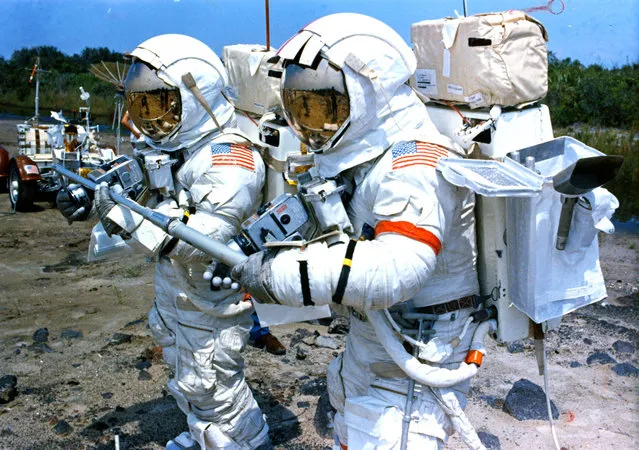
Astronauts Harrison Schmitt (left) and Eugene Andrew Cernan practice taking geological samples at the Kennedy Space Center in Florida, in preparation for NASA's scheduled Apollo 17 lunar landing mission, on August 28, 1972. Schmitt is the Lunar Module Pilot and Cernan is the mission's Commander. They are training for their period of EVA (extravehicular activity) on the Moon. (Photo by Space Frontiers/Getty Images)

Astronauts Harrison Schmitt (left) and Eugene Andrew Cernan practice taking geological samples at the Kennedy Space Center in Florida, in preparation for NASA's scheduled Apollo 17 lunar landing mission, on August 28, 1972. Schmitt is the Lunar Module Pilot and Cernan is the mission's Commander. They are training for their period of EVA (extravehicular activity) on the Moon. (Photo by Space Frontiers/Getty Images)
Details
24 Dec 2022 04:10:00
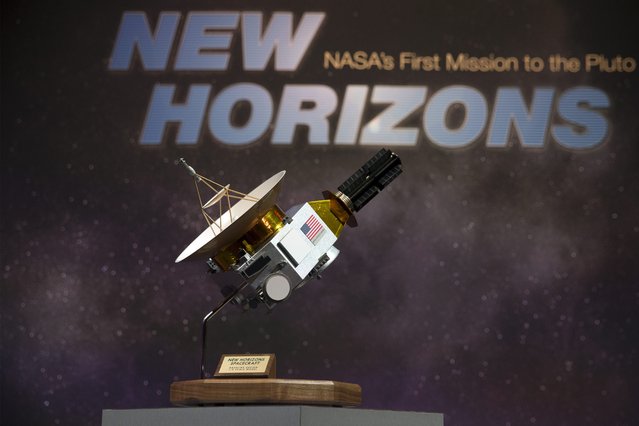
A model of the New Horizons spacecraft is seen at a live television program on NASA television celebrating the spacecraft's closest proximity to Pluto, at Johns Hopkins University Applied Physics Laboratory, site of the mission operations center, in Laurel, Maryland, USA, 14 July 2015. (Photo by Michael Reynolds/EPA)

A model of the New Horizons spacecraft is seen at a live television program on NASA television celebrating the spacecraft's closest proximity to Pluto, at Johns Hopkins University Applied Physics Laboratory, site of the mission operations center, in Laurel, Maryland, USA, 14 July 2015. At approximately 7:49 am ET (11:49 am GMT), 14 July, New Horizons was scheduled to be as close to Pluto as the spacecraft will get; about 7,800 miles (12,500 kilometers) above the surface, following a journey of more than nine years and three billion miles. This is the first mission to the Pluto System and the Kuiper Belt. (Photo by Michael Reynolds/EPA)
Details
15 Jul 2015 10:08:00
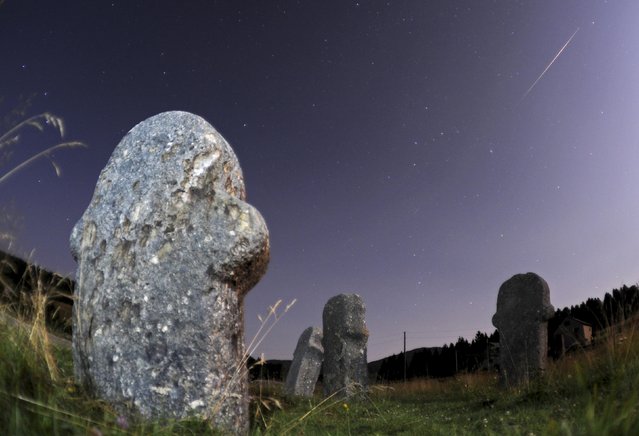
A meteor streaks over the sky during the Perseid meteor shower at the Maculje archaeological site near Novi Travnik August 12, 2014. According to NASA, the annual Perseid meteor shower reaches its peak on August 12 and 13 in Europe. The fireballs from the meteorites are fast and plentiful, although a nearly full moon (Supermoon) makes it difficult to view them this year, the agency adds. (Photo by Dado Ruvic/Reuters)

A meteor streaks over the sky during the Perseid meteor shower at the Maculje archaeological site near Novi Travnik August 12, 2014. According to NASA, the annual Perseid meteor shower reaches its peak on August 12 and 13 in Europe. The fireballs from the meteorites are fast and plentiful, although a nearly full moon (Supermoon) makes it difficult to view them this year, the agency adds. (Photo by Dado Ruvic/Reuters)
Details
14 Aug 2014 10:45:00
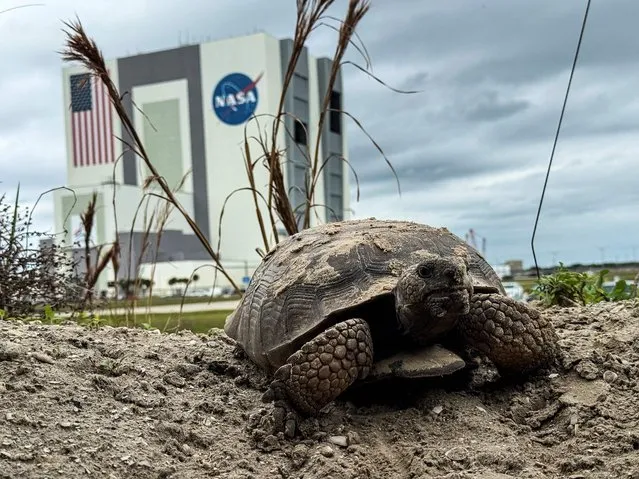
A gopher tortoise walks the grounds of NASA's Kennedy Space Center in Florida, near the Vehicle Assembly Building on January 18, 2024. An all-European crew including Turkey's first astronaut are poised to blast off to the International Space Station in a mission with Axiom Space, as countries hungry for a taste of space turn increasingly to the private sector. (Photo by Chandan Khanna/AFP Photo)

A gopher tortoise walks the grounds of NASA's Kennedy Space Center in Florida, near the Vehicle Assembly Building on January 18, 2024. An all-European crew including Turkey's first astronaut are poised to blast off to the International Space Station in a mission with Axiom Space, as countries hungry for a taste of space turn increasingly to the private sector. (Photo by Chandan Khanna/AFP Photo)
Details
26 Jan 2024 09:15:00
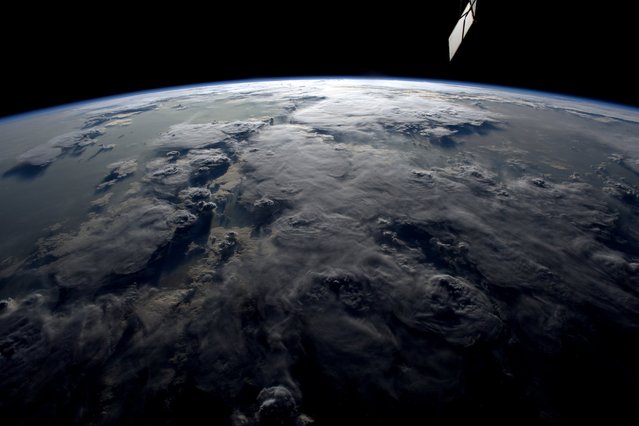
European Space Agency astronaut Tim Peake will return home after a six-month long mission on the International Space Station,on June 18, 2016. Peake was the first British ESA astronaut to visit the ISS and captured hundreds of photographs of the Earth during his mission. Here: “Lots of sun-glint right now during our whole orbit – we haven't seen a sunset for over 3 days”, he wrote. (Photo by Tim Peake/ESA/NASA)

European Space Agency astronaut Tim Peake will return home after a six-month long mission on the International Space Station,on June 18, 2016. Peake was the first British ESA astronaut to visit the ISS and captured hundreds of photographs of the Earth during his mission. Here: “Lots of sun-glint right now during our whole orbit – we haven't seen a sunset for over 3 days”, he wrote. (Photo by Tim Peake/ESA/NASA)
Details
18 Jun 2016 13:08:00
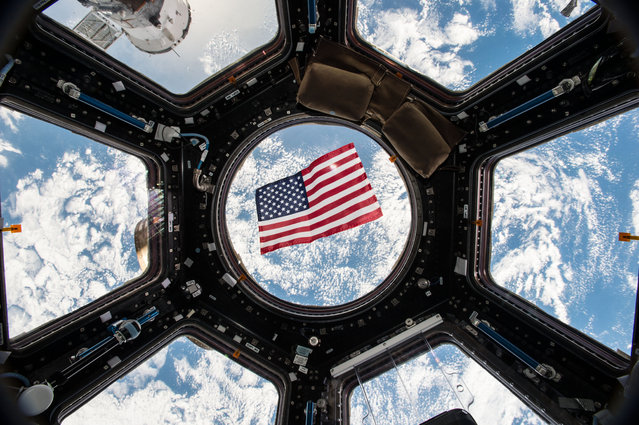
An American flag is visible in the windows of the cupola aboard the International Space Station. Thanks to a bill passed by Texas legislators in 1997 that put in place technical voting procedure for astronauts – nearly all of whom live in Texas – they have the ability to vote from space through specially designed absentee ballots. To preserve the integrity of the secret vote, the ballot is encrypted and only accessible by the astronaut and the county clerk responsible for casting the ballot. (Photo by NASA)

An American flag is visible in the windows of the cupola aboard the International Space Station. Thanks to a bill passed by Texas legislators in 1997 that put in place technical voting procedure for astronauts – nearly all of whom live in Texas – they have the ability to vote from space through specially designed absentee ballots. To preserve the integrity of the secret vote, the ballot is encrypted and only accessible by the astronaut and the county clerk responsible for casting the ballot. (Photo by NASA)
Details
10 Nov 2016 12:35:00