Loading...
Done
Shamila, 15, from an internally displaced family, adjusts her wedding dress in an old mud house yard, on her wedding day, on the outskirts of Kabul, Afghanistan, Friday, May 19, 2023. “I have no choice. If I don’t accept, my family will be hurt”, she says. Due to poverty and debt, her father had to marry her to a boy at a young age. Her father said that if I did not do this, I might have to give my daughter to someone that I owe. Now, with the money I received from the boy's family, I can pay my debt and treat my son. (Photo by Ebrahim Noroozi/AP Photo)

Shamila, 15, from an internally displaced family, adjusts her wedding dress in an old mud house yard, on her wedding day, on the outskirts of Kabul, Afghanistan, Friday, May 19, 2023. “I have no choice. If I don’t accept, my family will be hurt”, she says. Due to poverty and debt, her father had to marry her to a boy at a young age. Her father said that if I did not do this, I might have to give my daughter to someone that I owe. Now, with the money I received from the boy's family, I can pay my debt and treat my son. (Photo by Ebrahim Noroozi/AP Photo)
Details
12 Jan 2024 18:46:00
Part Time Job By Chow Hon Lam

What would superheroes do if they had a part time job? Well… besides fighting crime, the powers of most superheroes aren’t exactly very useful. Sure, Flash would make a great delivery boy, delivering the freshest pizza in the world, while Thor might turn out to be a great smith (though judging by the way he handles his mallet, it is very unlikely), but in the end of the day, all these things are pretty useless. It sure is hard being a superhero when you have no villains to catch; especially if the only superpower that you have is lighting yourself on fire. Reducing you to a mere job of being used as fuel for cooking grilled chicken. Besides, it’s not exactly useful for catching villains either, if you don't plan on burning them alive… (Photo by Chow Hon Lam)
Details
08 Dec 2014 11:44:00
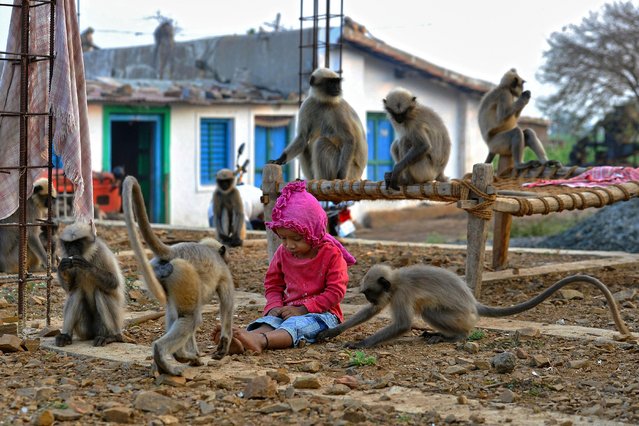
In this photograph taken on December 8, 2017, Indian child Samarth Bangari, 2, plays with langur monkeys at his home in Allapur in India' s southwest Karnataka state. (Photo by Manjunath Kiran/AFP Photo)

In this photograph taken on December 8, 2017, Indian child Samarth Bangari, 2, plays with langur monkeys at his home in Allapur in India' s southwest Karnataka state, 250 miles from Bangalore. He is still too young to talk, but a 2- year- old Indian boy has become a subject of local intrigue after befriending a gang of langur monkeys. (Photo by Manjunath Kiran/AFP Photo)
Details
25 Dec 2017 06:03:00
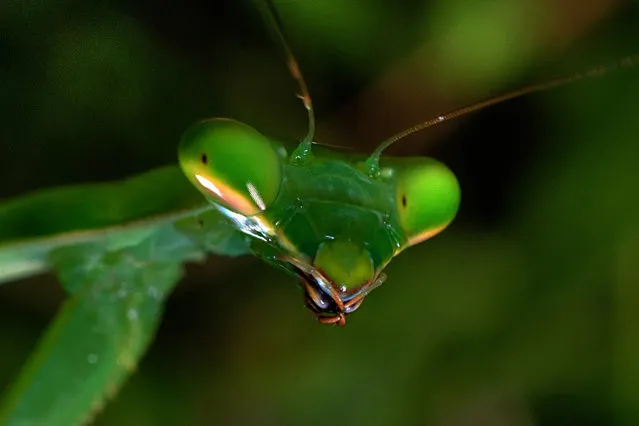
Close Encounter of the Insect Kind: Check out the awesome face on this praying mantis. I can't get over the mouth, it's like something from a science fiction movie. Of all photographic styles macro is definitely my favorite. I am constantly amazed, in every photo that I take, by the intricate level of detail that exists on even the smallest of creatures. It's a stark reminder that a very complex and infinitely beautiful world exists just beyond our human-sized level of perception. Photo taken in Donnybrook, Queensland, Australia. (Photo by Andrew Young/National Geographic Photo Contest

Close Encounter of the Insect Kind: “Check out the awesome face on this praying mantis. I can't get over the mouth, it's like something from a science fiction movie. Of all photographic styles macro is definitely my favorite. I am constantly amazed, in every photo that I take, by the intricate level of detail that exists on even the smallest of creatures. It's a stark reminder that a very complex and infinitely beautiful world exists just beyond our human-sized level of perception. Photo taken in Donnybrook, Queensland, Australia” – Andrew Young. (Photo by Andrew Young/National Geographic Photo Contest via The Atlantic)
Details
24 Sep 2012 09:18:00
A baby wallaby

“Very small forest-dwelling wallabies are known as pademelons (genus Thylogale) and dorcopsises (genera Dorcopsis and Dorcopsulus). The name wallaby comes from the Eora Aboriginal tribe who were the original inhabitants of the Sydney area. Wallabies are herbivores whose diet consists of a wide range of grasses, vegetables, leaves, and other types of foliage”. – Wikipedia

Photo: A baby wallaby sits in a zoo attendant's lap at Edogawa Natural Zoo on August 4, 2009 in Tokyo, Japan. The staff of the zoo have raised the young wallaby after her mother neglected her. (Photo by Junko Kimura/Getty Images)
Details
07 Sep 2011 13:33:00
Micro or Macro? It's micro: this is an electron microscope image of the wing of a Green Darner dragonfly. (Photo by P. Kelly)

Macro or Micro? Scientists’ pictures baffle our sense of scale. It began when Stephen Young, a geography professor at Salem State University in Massachusetts, tricked his biologist colleague Paul Kelly into thinking a satellite image was one of his electron microscope scans. Can you guess whether they are close-up or very far away? (Photo by Paul Kelly)
Details
21 Apr 2014 10:24:00


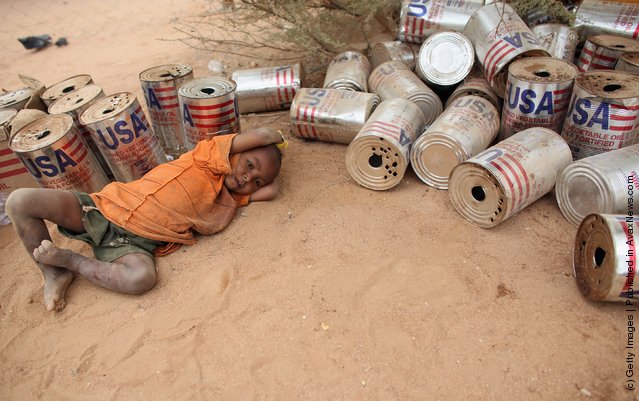
A young boy rests by empty USAID vegetable oil tins in the Dagahaley refugee camp which makes up part of the giant Dadaab refugee settlement on July 19, 2011 in Dadaab, Kenya. The refugee camp at Dadaab, located close to the Kenyan border with Somalia, was originally designed in the early 1990s to accommodate 90,000 people but the UN estimates over 4 times as many reside there. The ongoing civil war in Somalia and the worst drought to affect the Horn of Africa in six decades has resulted in an estimated 12 million people whose lives are threatened. (Photo by Oli Scarff/Getty Images)
Details
20 Jul 2011 12:08:00
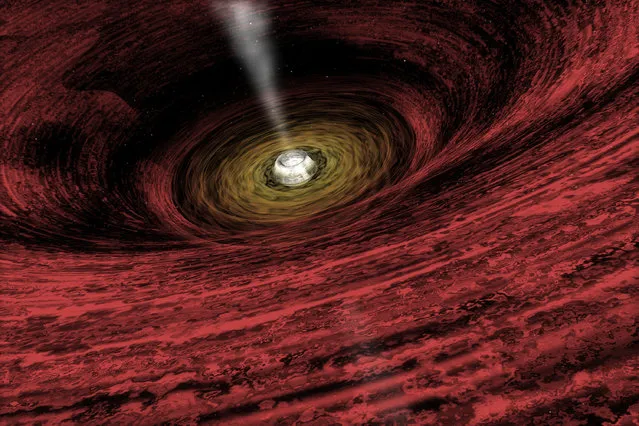
An artist's impression of a growing supermassive black hole located in the early Universe is seen in this NASA handout illustration released on June 15, 2011. Using the deepest X-ray image ever taken, astronomers found the first direct evidence that massive black holes were common in the early universe. This discovery from NASA's Chandra X-Ray Observatory shows that very young black holes grew more aggressively than previously thought, in tandem with the growth of their host galaxies. (Photo by Reuters/NASA/Chandra X-Ray Observatory/A.Hobart)

An artist's impression of a growing supermassive black hole located in the early Universe is seen in this NASA handout illustration released on June 15, 2011. Using the deepest X-ray image ever taken, astronomers found the first direct evidence that massive black holes were common in the early universe. This discovery from NASA's Chandra X-Ray Observatory shows that very young black holes grew more aggressively than previously thought, in tandem with the growth of their host galaxies. (Photo by Reuters/NASA/Chandra X-Ray Observatory/A.Hobart)
Details
11 Feb 2016 12:57:00