Loading...
Done
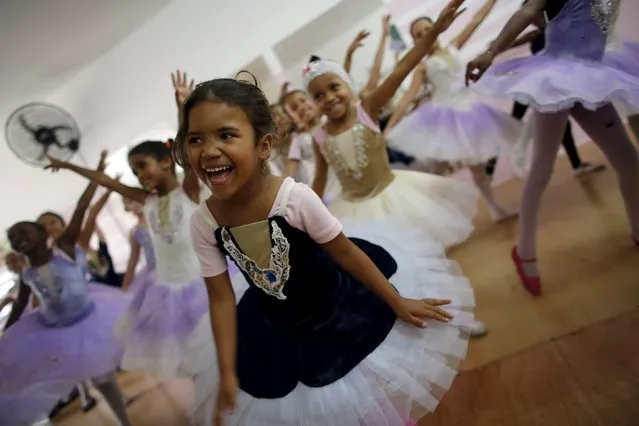
Young girls take ballet lessons at the New Dreams dance studio in the Luz neighborhood known to locals as Cracolandia (Crackland) in Sao Paulo, Brazil, August 14, 2015. (Photo by Nacho Doce/Reuters)

Young girls take ballet lessons at the New Dreams dance studio in the Luz neighborhood known to locals as Cracolandia (Crackland) in Sao Paulo, Brazil, August 14, 2015. For the young girls learning to jump and plie, the dance studio provides a way forward and out of the difficult environment they have grown up in. Brazil is one of the world's highest consuming countries of crack cocaine, and Cracolandia, or “Crack Land”, located in the outskirts of Sao Paulo, is one of the most intense and brutal hubs. (Photo by Nacho Doce/Reuters)
Details
18 Aug 2015 13:59:00
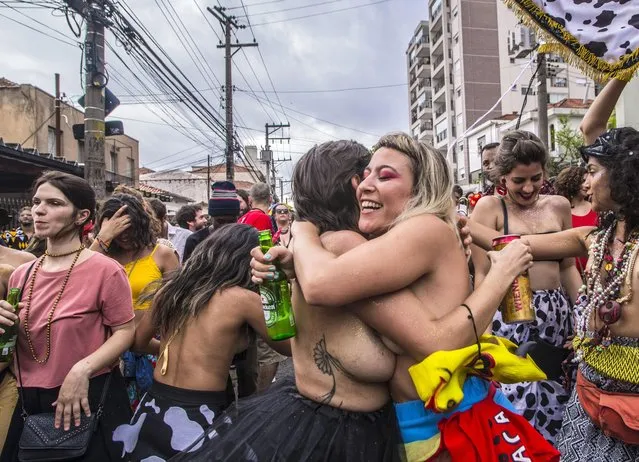
People enjoy carnival while shouting slogans of female empowerment and anti harrassment in Sao Paulo, Brazil on January 28, 2018. The carnival is marked by a lot of fun, but also has space to talk about more serious things – without losing the good mood. Parading for the first time in São Paulo, the Vaca Profana block proposed a reflection on sieges and machismo. With the breasts on display singing not only frevos but, mainly, shouting words of disorder, in order to stimulate female empowerment and against harassment. Our body is our struggle. The preservation of our physical integrity, our freedom of choice. Nude or clothed, we demand respect. (Photo by Cris Faga/Rex Features/Shutterstock)

People enjoy carnival while shouting slogans of female empowerment and anti harrassment in Sao Paulo, Brazil on January 28, 2018. The carnival is marked by a lot of fun, but also has space to talk about more serious things – without losing the good mood. Parading for the first time in São Paulo, the Vaca Profana block proposed a reflection on sieges and machismo. (Photo by Cris Faga/Rex Features/Shutterstock)
Details
29 Jan 2018 08:29:00
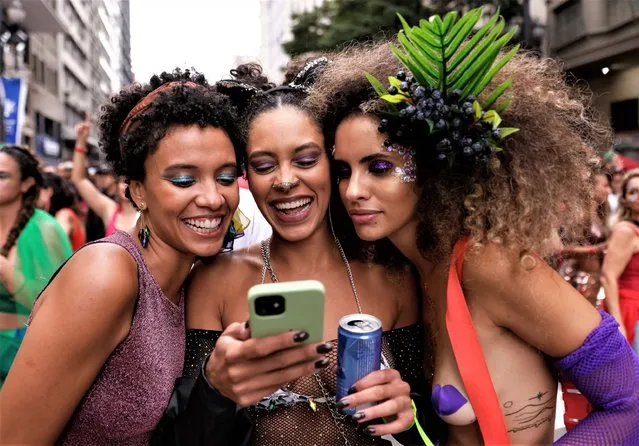
Revelers look at a cellphone during the annual street block party know as “Explode Coracao” on the third day of Carnival on February 19, 2023 in Sao Paulo, Brazil. According to the São Paulo City Council, during Carnival week more than 500 street blocks (blocos de rua) are held and more than 15 million people are expected to participate in them. Created in 2017, Explode Coracao is one of the most popular street blocks and attracted 150,000 revelers in its last edition, before the pandemic, in 2020. (Photo by Alexandre Schneider/Getty Images)

Revelers look at a cellphone during the annual street block party know as “Explode Coracao” on the third day of Carnival on February 19, 2023 in Sao Paulo, Brazil. According to the São Paulo City Council, during Carnival week more than 500 street blocks (blocos de rua) are held and more than 15 million people are expected to participate in them. Created in 2017, Explode Coracao is one of the most popular street blocks and attracted 150,000 revelers in its last edition, before the pandemic, in 2020. (Photo by Alexandre Schneider/Getty Images)
Details
22 Feb 2023 04:58:00
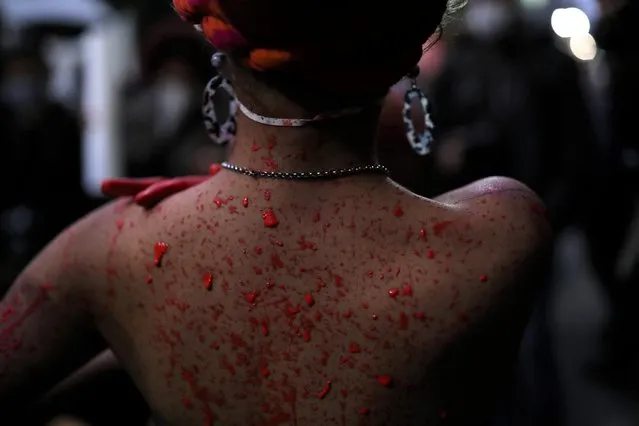
A Black movement activist covered by red paint attends a protest against racism and police violence, and against a police operation that took place at Jacarezinho slum in Rio de Janeiro, on the day that marks 133 years since the abolition of Slavery in the country, in Sao Paulo, Brazil, on May 13, 2021. (Photo by Amanda Perobelli/Reuters)

A Black movement activist covered by red paint attends a protest against racism and police violence, and against a police operation that took place at Jacarezinho slum in Rio de Janeiro, on the day that marks 133 years since the abolition of Slavery in the country, in Sao Paulo, Brazil, on May 13, 2021. (Photo by Amanda Perobelli/Reuters)
Details
12 Feb 2022 06:15:00
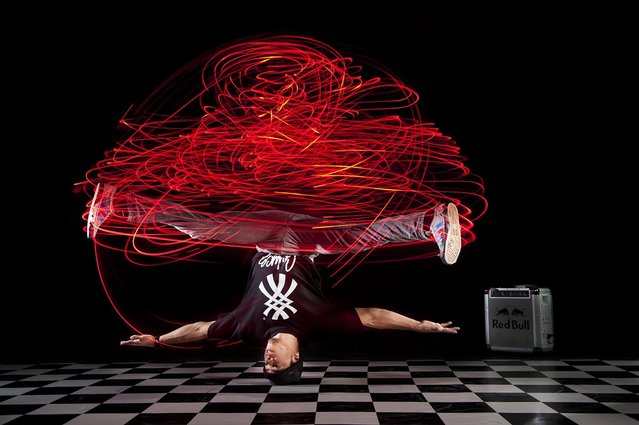
Multiple Exposures By Marcelo Maragni

Marcelo Maragni was born in Sao Paulo, Brazil. According to his mother’s idea, he was ment to be an architect in a quest of changing the world. Instead, he preferred to take possession of his father’s camera and learn another craft on his own.
Details
20 Jun 2015 17:35:00
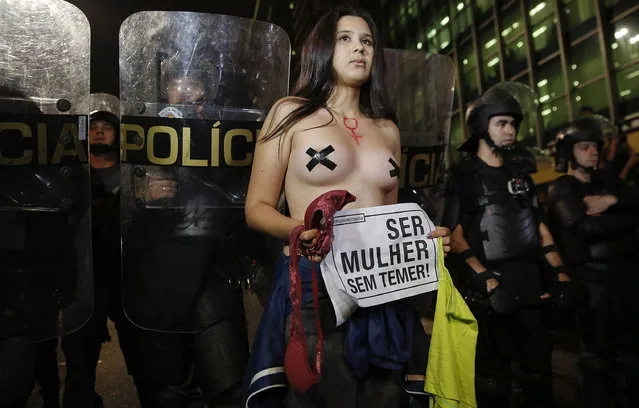
A woman with a sign that reads in Portuguese “Being woman without Temer”, stands next to a police barricade during a protest against the gang rape of a 16-year-old girl in Sao Paulo, Brazil, Wednesday, June 1, 2016. In response to the assault, Brazil's interim President Michel Temer said that the country will set up a specialized group to fight violence against women. (Photo by Andre Penner/AP Photo)

A woman with a sign that reads in Portuguese “Being woman without Temer”, stands next to a police barricade during a protest against the gang rape of a 16-year-old girl in Sao Paulo, Brazil, Wednesday, June 1, 2016. In response to the assault, Brazil's interim President Michel Temer said that the country will set up a specialized group to fight violence against women. (Photo by Andre Penner/AP Photo)
Details
03 Jun 2016 13:05:00
An athletes competes in a log carrying relay race event at Peruibe beach during the Indigenous Games, near the Tapirema community of Peruibe, Brazil, Sunday, April 23, 2023. Hundreds of Indigenous athletes gather this weekend in the south of Sao Paulo state to hold their version of the Olympic Games. They will compete for medals in archery, tug of war, athletics, Indigenous wrestling and other sports. (Photo by Andre Penner/AP Photo)

An athletes competes in a log carrying relay race event at Peruibe beach during the Indigenous Games, near the Tapirema community of Peruibe, Brazil, Sunday, April 23, 2023. Hundreds of Indigenous athletes gather this weekend in the south of Sao Paulo state to hold their version of the Olympic Games. They will compete for medals in archery, tug of war, athletics, Indigenous wrestling and other sports. (Photo by Andre Penner/AP Photo)
Details
19 Aug 2024 04:04:00
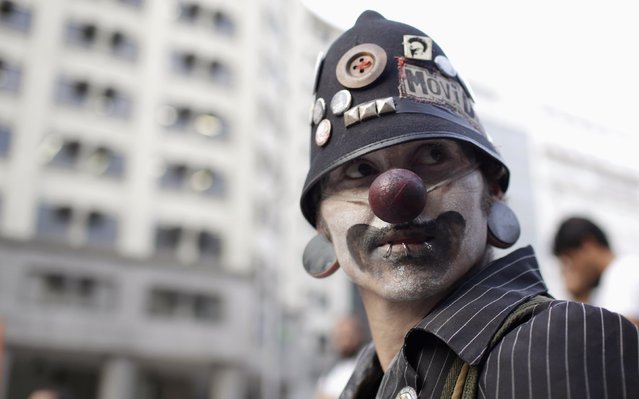
A demonstrator attends a protest against fare hikes for city buses in Rio de Janeiro January 16, 2015. Amid a marked economic downturn and high inflation, bus fares went up in Sao Paulo, Brazil's largest city, from 3 to 3.50 reais, and in Rio, the former capital, from 3.0 to 3.40 reais. (Photo by Mauro Pimentel/Reuters)

A demonstrator attends a protest against fare hikes for city buses in Rio de Janeiro January 16, 2015. Amid a marked economic downturn and high inflation, bus fares went up in Sao Paulo, Brazil's largest city, from 3 to 3.50 reais, and in Rio, the former capital, from 3.0 to 3.40 reais. (Photo by Mauro Pimentel/Reuters)
Details
18 Jan 2015 13:42:00