Loading...
Done
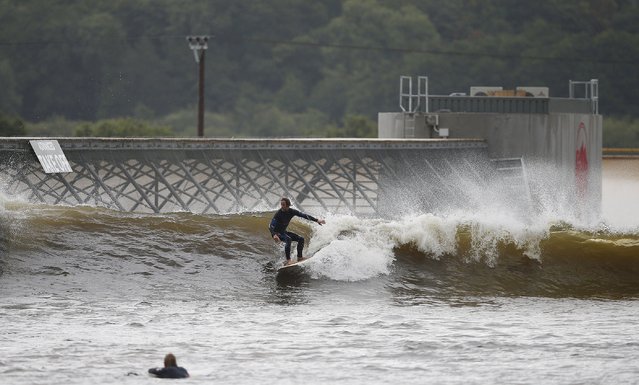
Surfers surf at Surf Snowdonia in Conwy, North Wales, September 3, 2015. (Photo by Andrew Yates/Reuters)

Surfers surf at Surf Snowdonia in Conwy, North Wales, September 3, 2015. The surf park, which cost $22.8 million, opened on August 1 and is the world's first commercial artificial surfing lake, according to the company.The pool is 300 metres (980 ft) long and 110 metres (360 ft) wide, containing a total of six million gallons of water. A bi-directional snowplough-shaped wave-generation mechanism, towed on a cable between the two central towers, moves up and down the pool on a three-rail track, generating the waves. (Photo by Andrew Yates/Reuters)
Details
04 Sep 2015 12:26:00
An aerial view shows a sinkhole 3.5 km (2 miles) to the east of Solikamsk-2 mine in Perm region, November 20, 2014. Shares in Russia's Uralkali, the world's top potash producer, fell sharply for a second day on Wednesday after a mine accident that could reduce global supplies and push up prices of the crop nutrient worldwide. (Photo by Reuters/Press service of Uralkali company)

An aerial view shows a sinkhole 3.5 km (2 miles) to the east of Solikamsk-2 mine in Perm region, November 20, 2014. Shares in Russia's Uralkali, the world's top potash producer, fell sharply for a second day on Wednesday after a mine accident that could reduce global supplies and push up prices of the crop nutrient worldwide. Uralkali shares have fallen 28 percent since Tuesday when it suspended work at its Solikamsk-2 mine, which accounts for a fifth of the company's output and 3.5 percent of global capacity, following an inflow of water. A sinkhole, stretching 30 by 40 metres (yards), found at an abandoned mine 3.5 km (2 miles) to the east, increased concern about the future of the mine because an inflow of water and the resulting sinkhole in 2006 forced another Uralkali operation to shut permanently. (Photo by Reuters/Press service of Uralkali company)
Details
22 Nov 2014 13:51:00
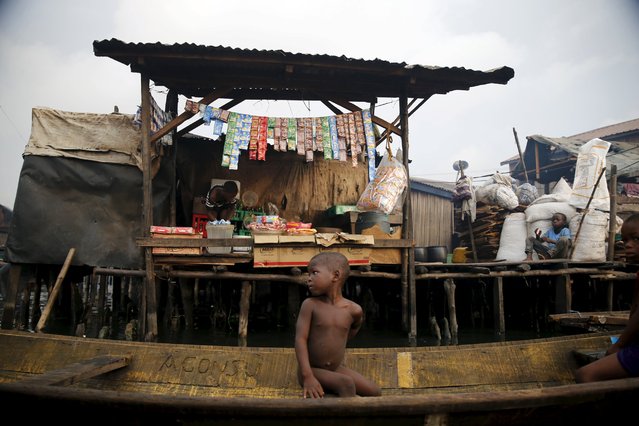
A boy sits in a canoe in front of a shed built on a raft in the Makoko fishing community on the Lagos Lagoon, Nigeria February 29, 2016. Makoko, a vast slum of houses on stilts in a Lagos lagoon, now boasts a new school – pyramid-shaped, floating and capable of withstanding the waterways' extreme weather, it is a beacon of hope for the nearly 100,000 Nigerians who live there.  (Photo by Akintunde Akinleye/Reuters)

A boy sits in a canoe in front of a shed built on a raft in the Makoko fishing community on the Lagos Lagoon, Nigeria February 29, 2016. In Makoko, a sprawling slum of Nigeria's megacity Lagos, a floating school capable of holding up to a hundred pupils has since November brought free education to the waterways known as the Venice of Lagos. It offers the chance of social mobility for youngsters who, like most of the city's 21 million inhabitants, lack a reliable electricity and water supply and whose water-based way of life is threatened by climate change as well as rapid urbanisation. (Photo by Akintunde Akinleye/Reuters)
Details
05 Mar 2016 12:01:00
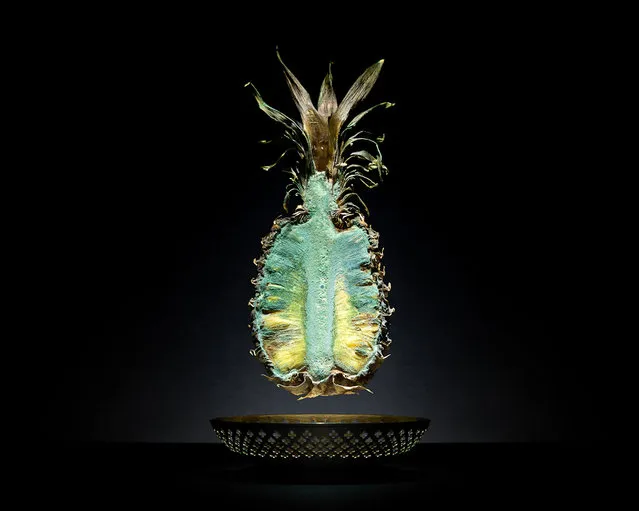
Pineapple

“One Third” – a project on food waste by an Austrian photography Klaus Pichler. According to a UN study one third of the world's food goes to waste – the largest part thereof in the industrialized nations of the global north. Equally, 925 million people around the world are threatened by starvation. The series “One Third” describes the connection between individual wastage of food and globalized food production.

Photo: Pineapple. Place of production: Guayaquil, Ecuador. Cultivation method: Outdoor plantation • Time of harvest: All- season. Transporting distance: 10.666 km (linear distance) • Means of transportation: Aircraft, truck. Carbon footprint (total) per kg: 11,94 kg • Water requirement (total) per kg: 360 l. Price: 2,10 € / kg. (Photo by Klaus Picher)
Details
02 May 2012 11:01:00
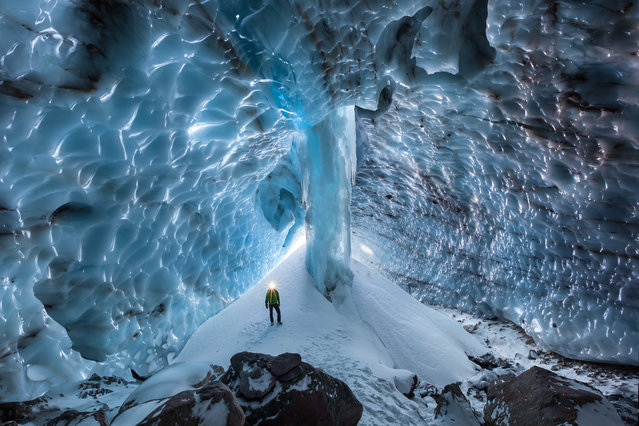
On the western side of Mount Hood lies the longest glacier cave system in the contiguous United States. In 2012, these caves were mapped to a combined length of 7,166.8 feet by cave explorers Brent McGregor and Eddy Cartaya. Currently, the total passage length is hundreds of feet less. Glaciers are frozen rivers; they are always moving and changing. In the past five years, we have seen the caves melt, shrink and collapse in a dramatic way. The caves are formed by water carving away at the ice. (Photo and caption by Josh Hydeman)

On the western side of Mount Hood lies the longest glacier cave system in the contiguous United States. In 2012, these caves were mapped to a combined length of 7,166.8 feet by cave explorers Brent McGregor and Eddy Cartaya. Currently, the total passage length is hundreds of feet less. Glaciers are frozen rivers; they are always moving and changing... (Photo and caption by Josh Hydeman)
Details
22 Mar 2015 11:05:00
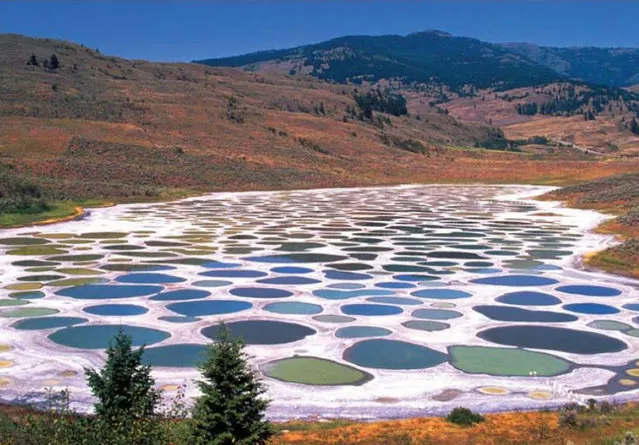
Kliluk, the Spotted Lake, Canada

Originally known to the First Nations of the Okanagan Valley as Khiluk, which was- and remains today revered as a sacred site producing therapeutic waters. During World War I the minerals of Spotted Lake were used in manufacturing ammunition. Later the area came under the control of the Ernest Smith Family, for a term of about 40 years. In 1979 Smith attempted to create interest in a spa at the lake. The First Nations responded with an effort to buy the lake; in October 2001 they finally struck a deal. First Nations arranged the purchase of 22 hectares of land for a total of $720,000, and contributed about 20% of the cost. The Indian Affairs Department paid the remainder.
Details
06 Mar 2015 12:59:00

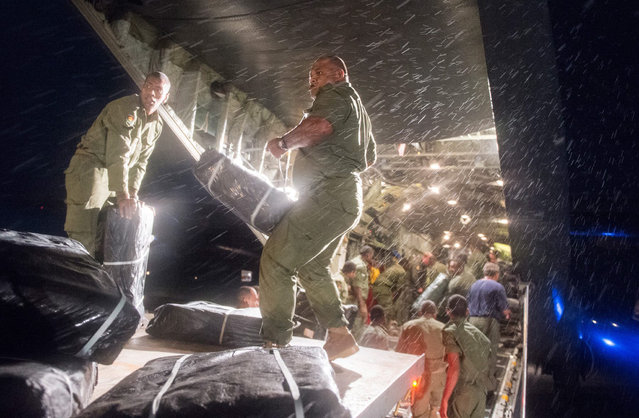
A handout image provided by the New Zealand Defence Force shows aid supplies being unloaded by Fijian soldiers from an Royal New Zealand Airforce C-130 Hercules plane in Suva, Fiji, 23 February 2016. Tool kits, generators, ration packs, water containers and chainsaws make up part of the New Zealand relief following Tropical Cyclone Winston. The death toll from the cyclone that hit Fiji over the weekend climbed to 29, local media reported ON 23 February. (Photo by Sam Shepherd/EPA/NZ Defence Force)

A handout image provided by the New Zealand Defence Force shows aid supplies being unloaded by Fijian soldiers from an Royal New Zealand Airforce C-130 Hercules plane in Suva, Fiji, 23 February 2016. Tool kits, generators, ration packs, water containers and chainsaws make up part of the New Zealand relief following Tropical Cyclone Winston. The death toll from the cyclone that hit Fiji over the weekend climbed to 29, local media reported ON 23 February. Cyclone Winston, the most powerful storm in Fiji's history, battered the country's main island of Viti Levu and other smaller surrounding islands on Saturday, the Fiji Broadcasting Corporation reported. (Photo by Sam Shepherd/EPA/NZ Defence Force)
Details
24 Feb 2016 12:56:00


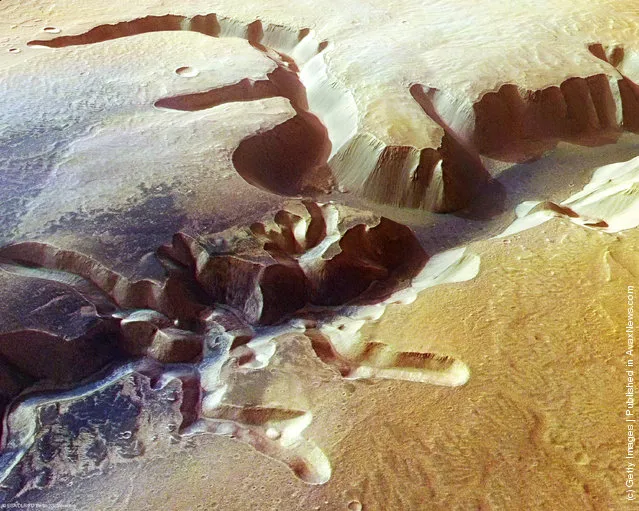
“Echus Chasma is a chasma in the Lunae Planum high plateau north of the Valles Marineris canyon system of Mars. Clay has been found in Echus Chasma that means that water once sat there for a time. Echus Chasma is approximately 100 km long and 10 km wide, with valleys ranging in depth from around 1 km to 4 km”. – Wikipedia

Photo: In this handout image supplied by the European Space Agency (ESA) on July 16, 2008, The Echus Chasma, one of the largest water source regions on Mars, is pictured from ESA's Mars Express. The data was acquired on September 25, 2005. The dark material shows a network of light-coloured, incised valleys that look similar to drainage networks known on Earth. It is still debated whether the valleys originate from precipitation, groundwater springs or liquid or magma flows on the surface. (Photo by ESA via Getty Images)
Details
18 Jul 2011 11:47:00