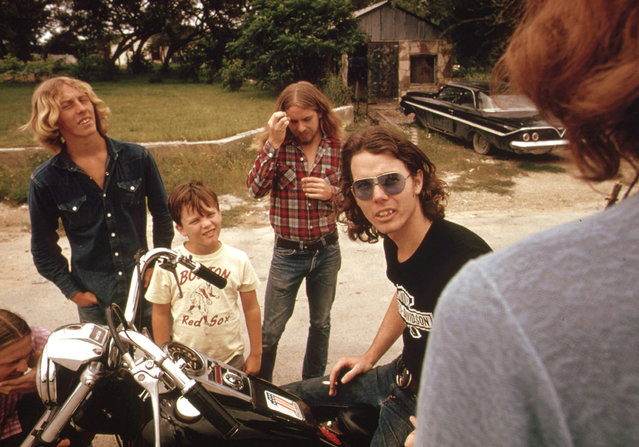
America in the 1970s: Texas. Motorcyclist loading his possessions onto a truck with the help of his friends in Leakey, May 1973. (Photo by Marc St. Gil/NARA via The Atlantic)
Chris “Birdman” Andersen poses for Getty Images photographer Mike Ehrmann during the Miami Heat's Media Day at AmericanAirlines Arena, on September 30, 2013. (Photo by Gary Coronado/The Palm Beach Post)
P.S. All pictures are presented in high resolution. To see Hi-Res images – just TWICE click on any picture. In other words, click small picture – opens the BIG picture. Click BIG picture – opens VERY BIG picture (if available; this principle works anywhere on the site AvaxNews)
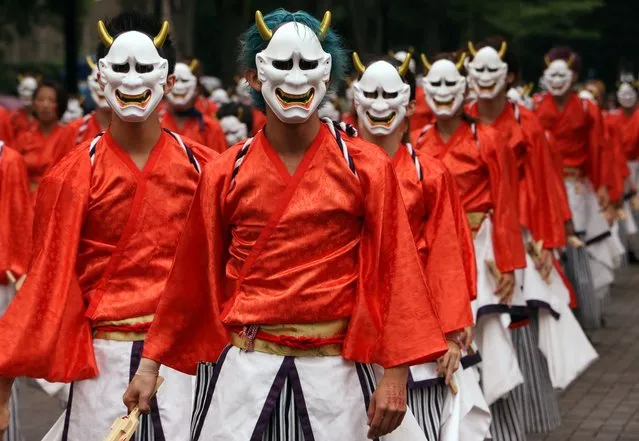
Dancers wearing masks and kimonos perform in the streets at the “Super Yosakoi 2015” dance festival in Tokyo on August 30, 2015. One hundred dance teams with some 5,500 people participated in the two-day summer festival event. (Photo by Yoshikazu Tsuno/AFP Photo)
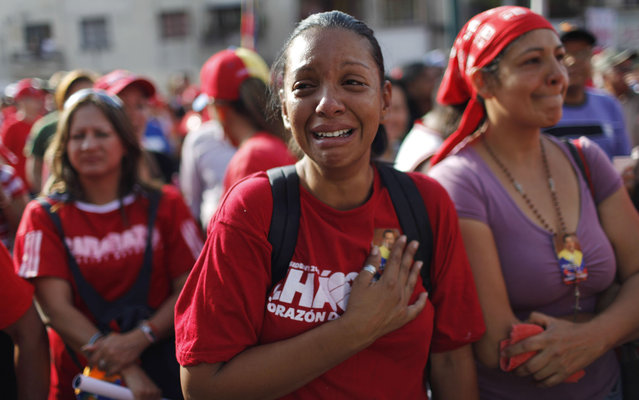
A woman cries as she watches the coffin containing the body of Venezuela's late President Hugo Chavez be taken from the hospital, where he died on Tuesday, to a military academy in Caracas, Venezuela, Wednesday, March 6, 2013. Seven days of mourning were declared, all schools were suspended for the week and friendly heads of state were expected for an elaborate funeral on Friday. (Photo by Rodrigo Abd/AP Photo)
This undated handout picture made available on February 3, 2016 and provided by Russia's punk band Рussy Riot shows Рussy Riot frontwoman Nadezhda Tolokonnikova performing in the band's new music video titled “Chaika” in Moscow. Russian punk band Рussy Riot, which became a symbol of resistance for a church performance slamming President Vladimir Putin, released a new protest song on February 3 mocking a senior official for alleged corruption. Titled “Chaika”, the satirical song and accompanying video take aim at prosecutor general Yury Chaika, whose two sons have been accused of using their father's position to accrue large fortunes. (Photo by Andrey Noskov/AFP Photo/Russian Punk Band Рussy Riot)
Photo: Vladimir Ilyich Lenin (1870 – 1924) lying in state in the Kremlin. (Photo by Hulton Archive/Getty Images). 1924
Important! For the same article in Russian language click here.
Something quite intriguing is happening within Russian-speaking internet during the last few – should you type a fully academic inquiry (at least, according to Russian academic requirements) in national search engines for "Lenin's mausoleum" – the first thing you get (even in top 10 searches) is website pages talking about black magic and occult. Website authors view this construction differently, but unconditionally agree on one thing: the mausoleum of the "leader of the world proletariat” – the essence of a magical artifact, a sort of “energy vampire”. It was built with a certain purpose: to drain the energy out of miserable Soviet citizens on one hand; and to poison the anthroposphere of one-sixth part of the earth with its vibes (the exact territory that was occupied by the former Soviet Union), depriving the Russian people of will to resist on the other hand. Complete nonsense? No doubt. Nevertheless, an intriguing one. Well, probably because some oddities do exist in mausoleum's history. These oddities are the thing we are going to discuss this time. First, let me refresh you memory on the subject.
Armed man stand at entrance of the naval headquarters in Sevastopol, March 19, 2014. Around a dozen Ukrainian servicemen, unarmed and in civilian clothes, walked out of the Ukrainian naval headquarters in the Crimean port of Sevastopol on Wednesday after it was taken over by pro-Russian forces, a Reuters witness said. (Photo by Baz Ratner/Reuters)