Loading...
Done
Singapore Hindus Celebrate Thaipusam Festival

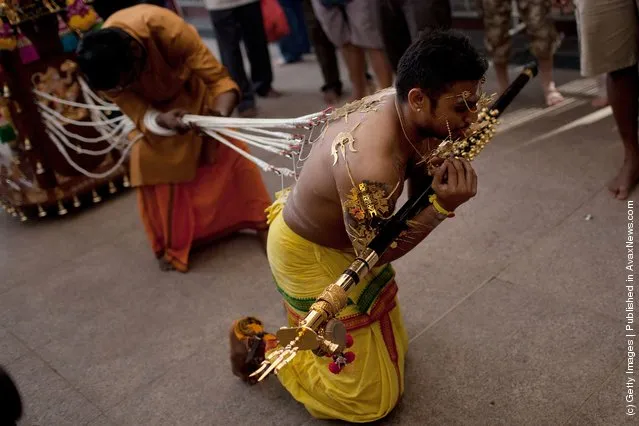
“Kavadi Attam is a dance performed by the devotees during the ceremonial worship of Murugan, the Tamil God of War. It is often performed during the festival of Thaipusam and emphasizes debt bondage. The Kavadi itself is a physical burden through which the devotees implore for help from the God Murugan”. – Wikipedia

Photo: A devotee pulls his procession burden connected by hooks pierced in his back during the Thaipusam procession at Sri Srinivasa Perumal Temple on February 7, 2012 in Singapore. (Photo by Chris McGrath/Getty Images)
Details
07 Feb 2012 10:22:00
Belarusians wearing national costumes celebrate a Pull the Kolyada Up the Oak rite in the village of Martsiyanauka, some 77 km (48 miles) east of capital Minsk, Belarus, Thursday, January 21, 2016. (Photo by Sergei Grits/AP Photo)

Belarusians wearing national costumes celebrate a Pull the Kolyada Up the Oak rite in the village of Martsiyanauka, some 77 km (48 miles) east of capital Minsk, Belarus, Thursday, January 21, 2016. The merry ancient rite Pull the Kolyada Up the Oak marks the end of Orthodox Christmas celebrations in Belarus. On Jan. 21 a wheel, the so-called Kolyada, would be pulled up an oak or any old tree. The Belarusians believed that the ritual heralds a good harvest, luck and happiness for the entire year. (Photo by Sergei Grits/AP Photo)
Details
22 Jan 2016 10:13:00
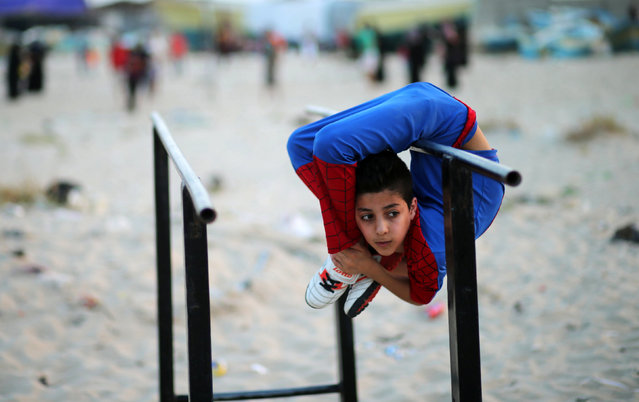
Palestinian boy Mohamad al-Sheikh, 12, who is nicknamed “Spiderman” and hopes to break the Guinness world records with his bizarre feats of contortion, demonstrates acrobatics skills on a beach in Gaza City June 2, 2016. (Photo by Mohammed Salem/Reuters)

Palestinian boy Mohamad al-Sheikh, 12, who is nicknamed “Spiderman” and hopes to break the Guinness world records with his bizarre feats of contortion, demonstrates acrobatics skills on a beach in Gaza City June 2, 2016. (Photo by Mohammed Salem/Reuters)
Details
03 Jun 2016 12:52:00
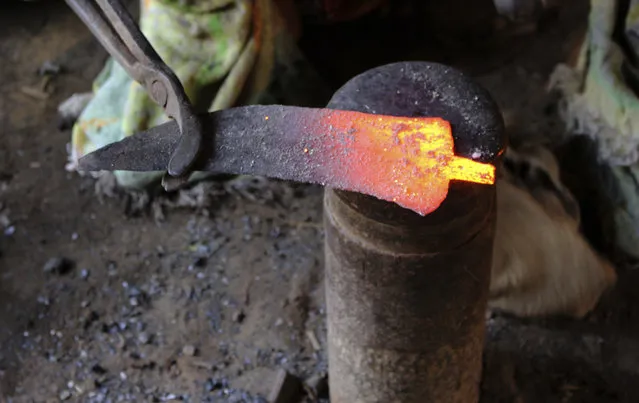
In this October 6, 2018, photo, a craftsman makes daggers or “Jambiyya” in Yemeni Arabic, made out of remains of missiles, at his workshop, in Hajjah, Yemen. (Photo by Hammadi Issa/AP Photo)

In this October 6, 2018, photo, a craftsman makes daggers or “Jambiyya” in Yemeni Arabic, made out of remains of missiles, at his workshop, in Hajjah, Yemen. Missiles raining on Yemen from the jets of the Saudi-led coalition fighting Houthi rebels are killing thousands of civilians and militiamen alike, but amid crashing economy, some Yemenis see the bright side of it: they make daggers out of the fragments of the missiles for ordinary men traditionally wear for prestige and a show of courage. (Photo by Hammadi Issa/AP Photo)
Details
10 Oct 2018 00:01:00
An employee walks past a rotary dredge working at an open-cast iron ore mine of the Stoilensky mining and concentration plant (GOK), owned by the Novolipetsk (NLMK) steel mill, in the city of Stary Oskol in Belgorod region, Russia, August 4, 2015. (Photo by Maxim Shemetov/Reuters)

An employee walks past a rotary dredge working at an open-cast iron ore mine of the Stoilensky mining and concentration plant (GOK), owned by the Novolipetsk (NLMK) steel mill, in the city of Stary Oskol in Belgorod region, Russia, August 4, 2015. (Photo by Maxim Shemetov/Reuters)
Details
06 Aug 2015 11:23:00
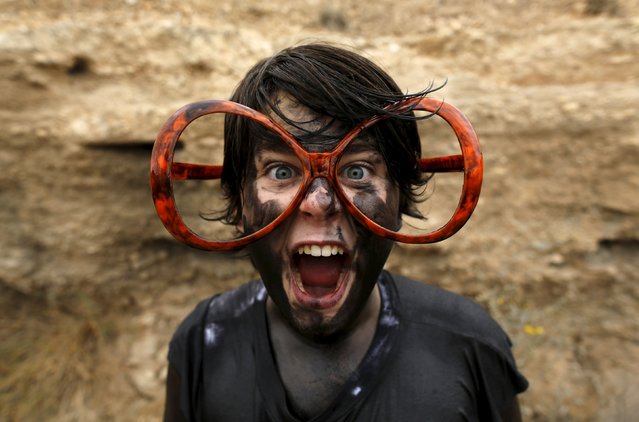
Jose, a reveller covered in grease, poses for a photo as he takes part in the annual Cascamorras festival in Baza, southern Spain September 6, 2015. The festival was inspired by a dispute between the town of Baza and Guadix over the possession of an icon of the Virgin of Piedad. The Cascamorras refers to representatives from Guadix, who were sent to Baza to recover the statue. As the Cascamorras had to stay perfectly clean to gain possession of the statue, Baza residents attempt to make them as “dirty” as possible. (Photo by Marcelo del Pozo/Reuters)

Jose, a reveller covered in grease, poses for a photo as he takes part in the annual Cascamorras festival in Baza, southern Spain September 6, 2015. The festival was inspired by a dispute between the town of Baza and Guadix over the possession of an icon of the Virgin of Piedad. The Cascamorras refers to representatives from Guadix, who were sent to Baza to recover the statue. As the Cascamorras had to stay perfectly clean to gain possession of the statue, Baza residents attempt to make them as “dirty” as possible. (Photo by Marcelo del Pozo/Reuters)
Details
07 Sep 2015 14:11:00
1941 Chevrolet 1.5 tonnes are left to rot in a field. (Photo by Robert Kahl/Mediadrumworld)

Feast your eyes on Europe’s most spectacular car graveyards as discovered by one auto-obsessed explorer who has dedicated over ten years to finding the best cars left to rot in the European wilderness. The beautiful set of images were taken in Germany, Sweden and Belgium by German Civil Servant Robert Kahl (30) using a Nikon D7100. He describes his photographs as showcasing “the beauty of transience and decayed charm”. Here: 1941 Chevrolet 1.5 tonnes are left to rot in a field. (Photo by Robert Kahl/Mediadrumworld)
Details
01 Mar 2017 00:04:00
The Nasir al-mulk or “Pink” mosque in Shiraz, Iran. (Photo by Mohammad Reza Domiri Ganj)

Amateur Iranian photographer Mohammad Reza Domiri Ganji, 23 likes to learn as much as he can about a site before he photographs it. Then he utilizes a variety of wide-angle and fisheye lenses, as well as occasional panoramic techniques to create beautiful new, often mind-bending images. He usually shoots the architectural wonders of Iran, and hopes that the Iranian government will allow him to travel further from home in pursuit of other iconic architectural treasures. Photo: The Nasir al-mulk or “Pink” mosque in Shiraz, Iran. (Photo by Mohammad Reza Domiri Ganj)
Details
17 Aug 2014 08:58:00