Loading...
Done
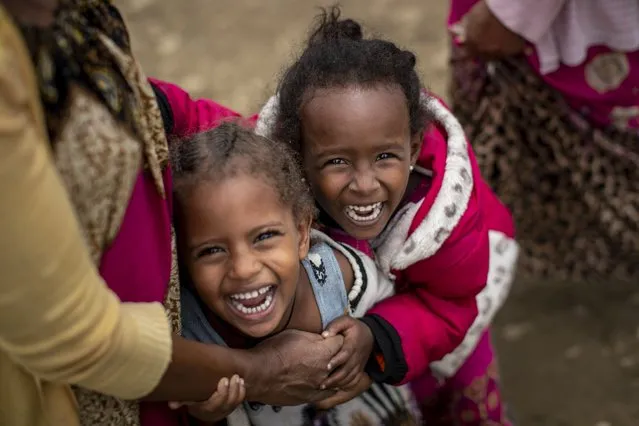
Two displaced Tigrayan girls giggle next to their mother, left, as their photograph is taken outside the Hadnet General Secondary School which has become a makeshift home to thousands displaced by the conflict, in Mekele, in the Tigray region of northern Ethiopia Wednesday, May 5, 2021. The Tigray conflict has displaced more than 1 million people, the International Organization for Migration reported in April, and the numbers continue to rise. (Photo by Ben Curtis/AP Photo)

Two displaced Tigrayan girls giggle next to their mother, left, as their photograph is taken outside the Hadnet General Secondary School which has become a makeshift home to thousands displaced by the conflict, in Mekele, in the Tigray region of northern Ethiopia Wednesday, May 5, 2021. The Tigray conflict has displaced more than 1 million people, the International Organization for Migration reported in April, and the numbers continue to rise. (Photo by Ben Curtis/AP Photo)
Details
15 May 2021 08:13:00
A Tibetan man stands nearby as a young tourist poses for photos on a white yak at the shore of the lake in Namtso in western China’s Tibet Autonomous Region, as seen during a government organized visit for foreign journalists, Wednesday, June 2, 2021. (Photo by Mark Schiefelbein/AP Photo)

A Tibetan man stands nearby as a young tourist poses for photos on a white yak at the shore of the lake in Namtso in western China’s Tibet Autonomous Region, as seen during a government organized visit for foreign journalists, Wednesday, June 2, 2021. (Photo by Mark Schiefelbein/AP Photo)
Details
16 Jun 2021 10:25:00
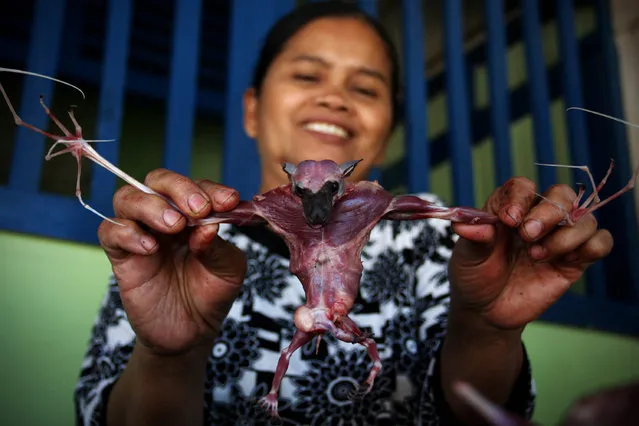
Bat seller Sukarwati shows a skinned bat on July 30, 2009 in Yogyakarta, Indonesia. Sukarwati and her family have hunted bats in the Imogiri region for generations, capturing more than 800 bats per month. The Sukarwati family believe that the meat from the bat heals asthma and respiratory problems and it is a great honour for them knowing that the meat that they provide will help ease people's health ailments

Bat seller Sukarwati shows a skinned bat on July 30, 2009 in Yogyakarta, Indonesia. Sukarwati and her family have hunted bats in the Imogiri region for generations, capturing more than 800 bats per month. The Sukarwati family believe that the meat from the bat heals asthma and respiratory problems and it is a great honour for them knowing that the meat that they provide will help ease people's health ailments. (Photo by Ulet Ifansasti)
Details
20 Sep 2012 08:57:00
A chevrotain or mouse deer feeds in its enclosure at Zurich Zoo, Zurich, Switzerland, October 17, 2012. (Photo by Patrick B. Kraemer/AP)

A chevrotain or mouse deer feeds in its enclosure at Zurich Zoo, Zurich, Switzerland, October 17, 2012. (Photo by Patrick B. Kraemer/AP)
Details
27 Oct 2012 12:21:00
Buddhist pilgrim family from Sichuan. (Photo by Tom Carter/The Atlantic)

Nine years ago, Tom Carter traveled from San Francisco to China, responding to a job posting that turned out to be a scam. He managed to find another job as a teacher, and saved enough money to embark on a 56,000 km trip through all of China's 33 provinces that lasted two years. Carrying a camera – just a a 4-megapixel point-and-shoot – Carter captured some amazing images of the widely varying landscape, people, and architecture across the nation. Photo: Buddhist pilgrim family from Sichuan. (Photo by Tom Carter via The Atlantic)
Details
12 Mar 2013 14:19:00
Workers lay railway track in a tunnel of the Crossrail project in Stepney, east London, Britain, November 16, 2016. (Photo by Stefan Wermuth/Reuters)

Workers lay railway track in a tunnel of the Crossrail project in Stepney, east London, Britain, November 16, 2016. Crossrail, which is Europe's largest construction project, is a railway link which will connect outlying areas to the east and west of London with tunnels under the centre of the capital. (Photo by Stefan Wermuth/Reuters)
Details
17 Nov 2016 11:14:00
Cloud inversion taken at Sunrise in Mam Tor, Derbyshire, UK on August 30, 2016. (Photo by David Zdanowicz/REX Shutterstock)

Cloud inversion taken at Sunrise in Mam Tor, Derbyshire, UK on August 30, 2016. (Photo by David Zdanowicz/Rex Features/Shutterstock)
Details
21 Nov 2016 10:47:00
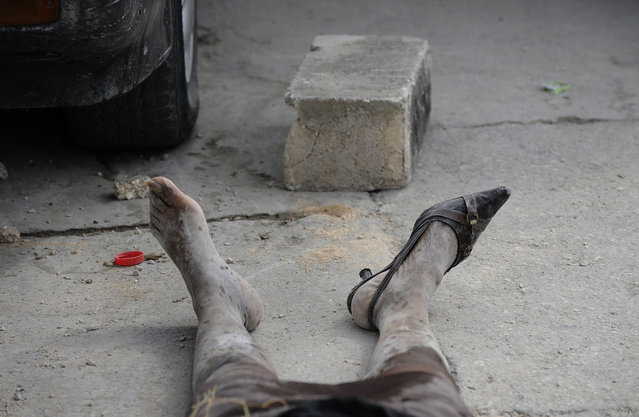
In this photo submitted by the Washington Post tilted “The Moment Time Stopped”, survivors piled bodies of the dead outside for weeks after earthquake on January 14, 2010 in Port-au-Prince, Haiti. The Washington Post has won a Pulitzer Prize for breaking news photography on Monday, April 18, 2011 for images taken in Haiti following the earthquake there.(Photo by Carol Guzy/AP Photo/The Washington Post)

In this photo submitted by the Washington Post tilted “The Moment Time Stopped”, survivors piled bodies of the dead outside for weeks after earthquake on January 14, 2010 in Port-au-Prince, Haiti. The 7.0 magnitude earthquake struck in 2010, and the Haitian government has said more than 300,000 people were killed. The exact toll is unknown because there was no systematic effort to count bodies among the chaos and destruction. (Photo by Carol Guzy/AP Photo/The Washington Post)
Details
13 Jan 2015 14:17:00