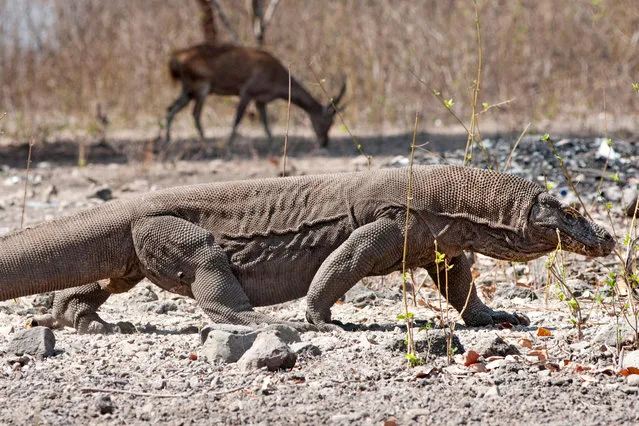
The Komodo dragon (Varanus komodoensis) was the most popular species overall based on English language Wikipedia page views. It is the world’s largest lizard, living on the islands of Komodo, Rinca and other smaller islands, and on Flores island in Indonesia. (Photo by Eric Nathan/Alamy)
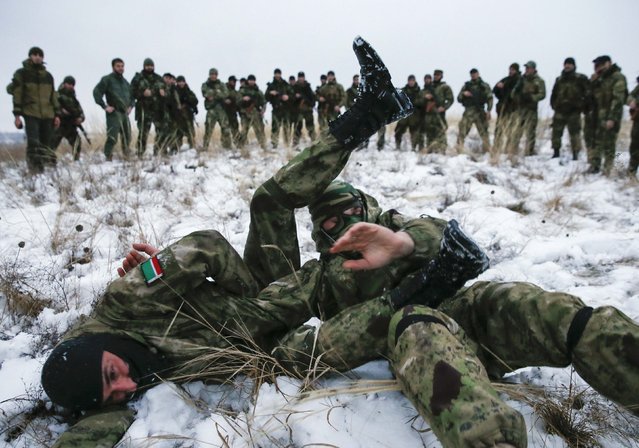
Pro-Russian separatists from the Chechen “Death” battalion take part in a training exercise in the territory controlled by the self-proclaimed Donetsk People's Republic, eastern Ukraine, December 8, 2014. Chanting “Allahu Akbar” (God is greatest), dozens of armed men in camouflage uniforms from Russia's republic of Chechnya train in snow in a camp in the rebel-held east Ukraine. They say their “Death” unit fighting Ukrainian forces has 300 people, mostly former state security troops in the mainly-Muslim region where Moscow waged two wars against Islamic insurgents and which is now run by a Kremlin-backed strongman. (Photo by Maxim Shemetov/Reuters)
Giant panda Mei Xiang discovers a birthday cake meant for her cub Bei Bei (NP) who turns one at the Smithsonian National Zoo in Washington, DC on August 20, 2016. (Photo by Linda Davidson/The Washington Post)
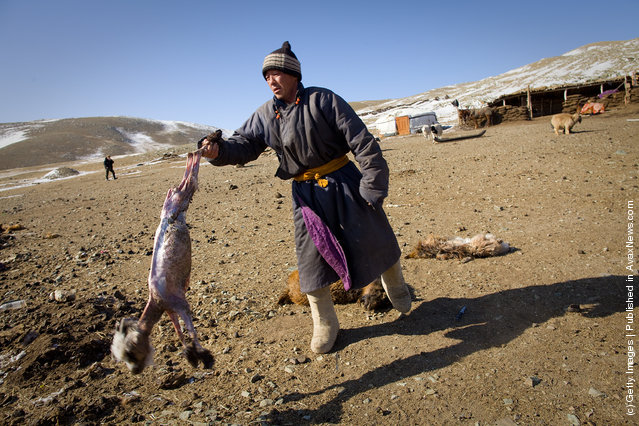
Mongolian herder, Khurelsukh, throws the carcass of a goat onto a heap as he struggles to deal with losing a quarter of his herd, on March 8, 2010 in Bayantsogt, Tuv province, Mongolia. (Photo by Paula Bronstein /Getty Images)
South Korean police officers show their martial arts' skills during the official launch ceremony of the 2012 Seoul Nuclear Security Summit on February 15, 2012 in Seoul, South Korea. The Korean National Police Agency launched a security squad, exclusively established for the successful hosting of the 2012 Seoul Nuclear Security Summit. The 2012 Seoul Nuclear Security Summit will be held in Seoul from March 26-27, 2012. (Photo by Chung Sung-Jun/Getty Images)
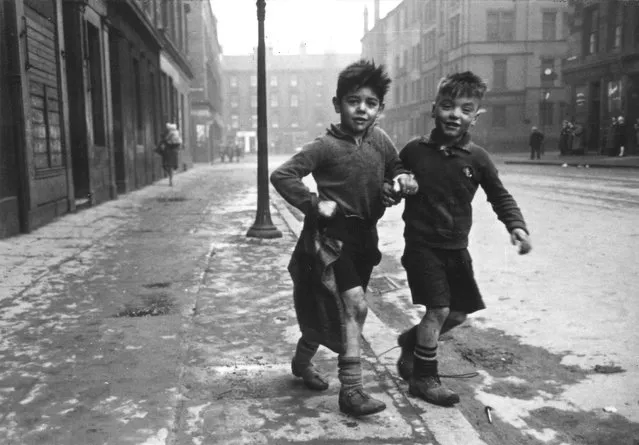
Two boys in the Gorbals area of Glasgow, UK on January 31, 1948. The Gorbals tenements were built quickly and cheaply in the 1840s, providing housing for Glasgow's burgeoning population of industrial workers. Conditions were appalling; overcrowding was standard and sewage and water facilities inadequate. The tenements housed about 40,000 people with up to eight family members sharing a single room, 30 residents sharing a toilet and 40 sharing a tap. By the time this photograph was taken 850 tenements had been demolished since 1920. Redevelopment of the area began in the late 1950s and the tenements were replaced with a modern tower block complex in the sixties. (Photo by Bert Hardy/Getty Images)