Loading...
Done
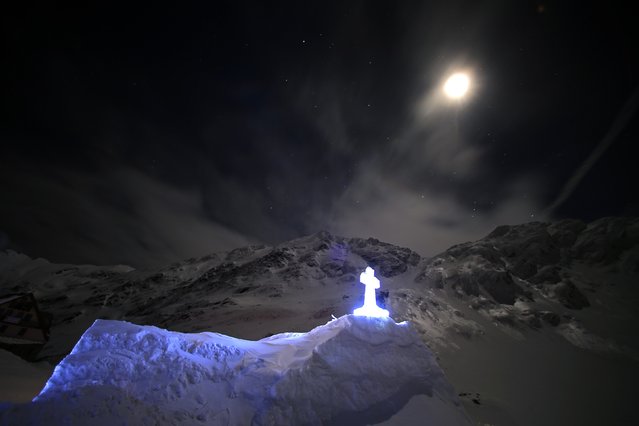
A church made entirely from ice is seen during the night at Balea Lac resort in the Fagaras mountains January 29, 2015. (Photo by Radu Sigheti/Reuters)

A church made entirely from ice is seen during the night at Balea Lac resort in the Fagaras mountains January 29, 2015. (Photo by Radu Sigheti/Reuters)
Details
30 Jan 2015 11:05:00
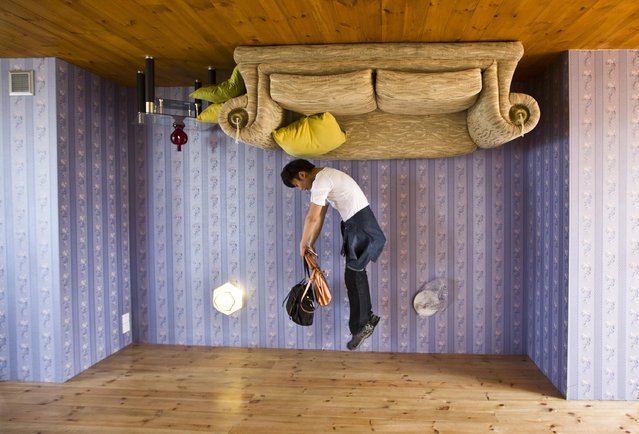
A tourist jumps inside an upside-down house at Fengjing Ancient Town, Jinshan District, south of Shanghai, May 1, 2014. The upside-down house was built as a tourist attraction using everyday household items and furniture. (Photo by Aly Song/Reuters)

A tourist jumps inside an upside-down house at Fengjing Ancient Town, Jinshan District, south of Shanghai, May 1, 2014. The upside-down house was built as a tourist attraction using everyday household items and furniture. (Photo by Aly Song/Reuters)
Details
02 May 2014 11:46:00
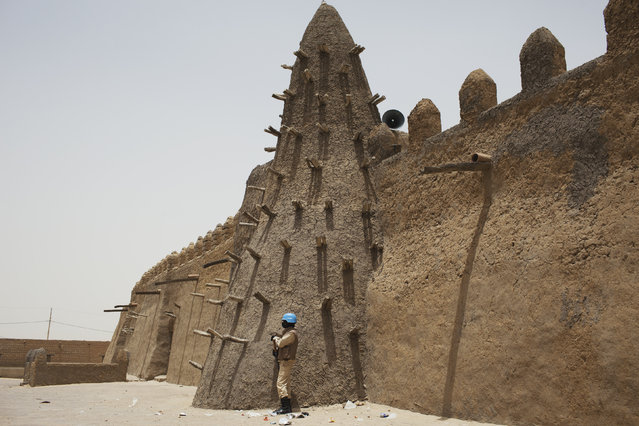
Timbuktu: A UN peacekeeper from Burkina Faso stands guard at the Djinguereber mosque, built in the 14th century, during a visit by a UN delegation on election day in Timbuktu, Mali, July 28, 2013. (Photo by Joe Penney/Reuters)

Timbuktu: A UN peacekeeper from Burkina Faso stands guard at the Djinguereber mosque, built in the 14th century, during a visit by a UN delegation on election day in Timbuktu, Mali, July 28, 2013. (Photo by Joe Penney/Reuters)
Details
08 Jul 2015 12:33:00
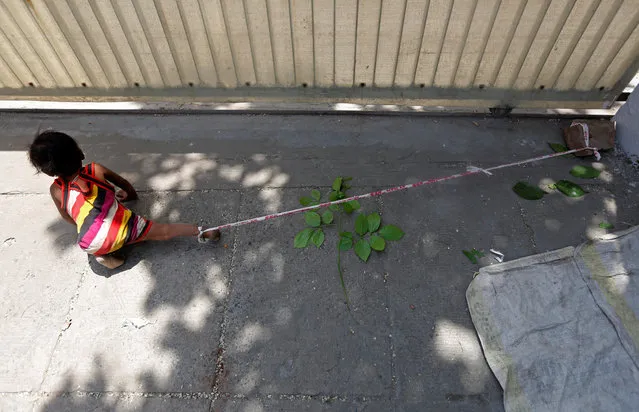
Barrier tape is tied around 15-month-old Shivani's ankle to prevent her from running away, while her mother Sarta Kalara works at a construction site nearby, in Ahmedabad, India, April 19, 2016. Kalara says she has no option but to tether her daughter Shivani to a stone despite her crying, while she and her husband work for 250 rupees ($3.8) each a shift digging holes for electricity cables in the city of Ahmedabad. There are about 40 million construction workers in India, at least one in five of them women, and the majority poor migrants who shift from site to site, building infrastructure for India's booming cities. Across the country it is not uncommon to see young children rolling in the sand and mud as their parents carry bricks or dig for new roads or luxury houses. (Photo by Amit Dave/Reuters)

Barrier tape is tied around 15-month-old Shivani's ankle to prevent her from running away, while her mother Sarta Kalara works at a construction site nearby, in Ahmedabad, India, April 19, 2016. Kalara says she has no option but to tether her daughter Shivani to a stone despite her crying, while she and her husband work for 250 rupees ($3.8) each a shift digging holes for electricity cables in the city of Ahmedabad. There are about 40 million construction workers in India, at least one in five of them women, and the majority poor migrants who shift from site to site, building infrastructure for India's booming cities. Across the country it is not uncommon to see young children rolling in the sand and mud as their parents carry bricks or dig for new roads or luxury houses. (Photo by Amit Dave/Reuters)
Details
14 Dec 2016 07:39:00
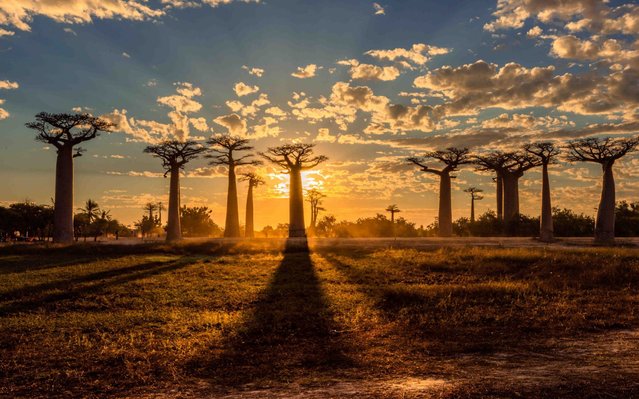
Madagascan sunset setting over the 98-foot-tall baobab trees of the Avenue of the Baobabs located in Menabe, Madagascar on August 2020. (Photo by Kim Paffen/MediaDrumImages)

Madagascan sunset setting over the 98-foot-tall baobab trees of the Avenue of the Baobabs located in Menabe, Madagascar on August 2020. (Photo by Kim Paffen/MediaDrumImages)
Details
23 Sep 2020 00:03:00
A model composes herself during the Ukrainian Fashion Week 2020-2021 at the Mystetskyi Arsenal National Art and Culture Museum Complex on February 4, 2020. (Photo by Irynka Hromotska/Radio Free Europe/Radio Liberty)

A model composes herself during the Ukrainian Fashion Week 2020-2021 at the Mystetskyi Arsenal National Art and Culture Museum Complex on February 4, 2020. (Photo by Irynka Hromotska/Radio Free Europe/Radio Liberty)
Details
05 Feb 2020 00:07:00
Carolaine Reis and her son Miguel Alves, residents of the Aglomerado da Serra favela, wear a protective mask against the spread of the new Coronavirus (COVID-19) made by the seamstresses of the Remexe Favelinha studio, in the Aglomerado da Serra favela, on April 13, 2020 in Belo Horizonte, Brazil. Facial masks follow the protocol and guidelines defined by the Ministry of Health. Around 6,000 masks have already been produced. The masks are being distributed to a part of the population and sold throughout the country, in the amount of 5 reais per unit. (Photo by Pedro Vilela/Getty Images)

Carolaine Reis and her son Miguel Alves, residents of the Aglomerado da Serra favela, wear a protective mask against the spread of the new Coronavirus (COVID-19) made by the seamstresses of the Remexe Favelinha studio, in the Aglomerado da Serra favela, on April 13, 2020 in Belo Horizonte, Brazil. Facial masks follow the protocol and guidelines defined by the Ministry of Health. Around 6,000 masks have already been produced. The masks are being distributed to a part of the population and sold throughout the country, in the amount of 5 reais per unit. (Photo by Pedro Vilela/Getty Images)
Details
16 Apr 2020 00:03:00
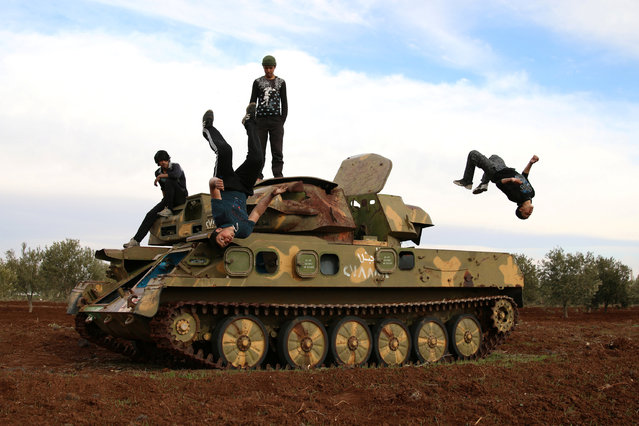
Muhannad al-Kadiri (R),18, and Ibrahim Eid, 16, demonstrate their Parkour skills over a military vehicle in the rebel-held city of Inkhil, west of Deraa, Syria, February 4, 2017. (Photo by Alaa Al-Faqir/Reuters)

Muhannad al-Kadiri (R),18, and Ibrahim Eid, 16, demonstrate their Parkour skills over a military vehicle in the rebel-held city of Inkhil, west of Deraa, Syria, February 4, 2017. (Photo by Alaa Al-Faqir/Reuters)
Details
05 May 2017 07:26:00