Loading...
Done
A Vietnamese woman, wearing the traditional “ao dai” long dress, poses for photos along peach blossom flowers ahead of the Vietnamese “Tet” (Lunar New Year festival), in a field in Hanoi, Vietnam, February 2, 2016. (Photo by Reuters/Kham)

A Vietnamese woman, wearing the traditional “ao dai” long dress, poses for photos along peach blossom flowers ahead of the Vietnamese “Tet” (Lunar New Year festival), in a field in Hanoi, Vietnam, February 2, 2016. (Photo by Reuters/Kham)
Details
03 Feb 2016 13:43:00
A pro-Russian rebel shows his t-shirt depicting Russian President Vladimir Putin at a checkpoint in the village of Chornukhyne near the town of Debaltseve, north-east from Donetsk, March 12, 2015. (Photo by Marko Djurica/Reuters)

A pro-Russian rebel shows his t-shirt depicting Russian President Vladimir Putin at a checkpoint in the village of Chornukhyne near the town of Debaltseve, north-east from Donetsk, March 12, 2015. (Photo by Marko Djurica/Reuters)
Details
30 Mar 2015 13:26:00
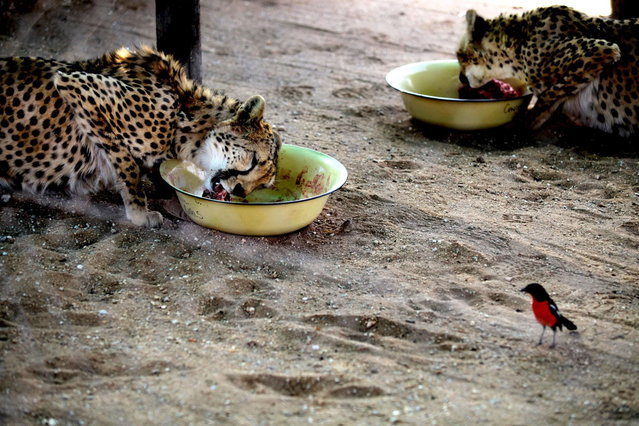
Young cheetahs eat meat at The Cheetah Conservation Fund (CCF) center in Otjiwarongo, Namibia, on August 13, 2013. The CCF started breeding Anatolian livestock dogs to promote cheetah-friendly farming after some 10,000 big cats – the current total worldwide population – were killed or moved off farms in the 1980s.  Up to 1,000 cheetahs were being killed a year, mostly by farmers who saw them as livestock killers. But the use of dogs has slashed losses for sheep and goat farmers and led to less retaliation against the vulnerable cheetah. (Photo by Jennifer Bruce/AFP Photo)

Young cheetahs eat meat at The Cheetah Conservation Fund (CCF) center in Otjiwarongo, Namibia, on August 13, 2013. The CCF started breeding Anatolian livestock dogs to promote cheetah-friendly farming after some 10,000 big cats – the current total worldwide population – were killed or moved off farms in the 1980s. Up to 1,000 cheetahs were being killed a year, mostly by farmers who saw them as livestock killers. But the use of dogs has slashed losses for sheep and goat farmers and led to less retaliation against the vulnerable cheetah. (Photo by Jennifer Bruce/AFP Photo)
Details
29 Aug 2013 10:56:00
Skiers and snow boarders descend from a slope as they attempt to break the record for mass skiing in swimming suits at Rosa Khutor resort near Sochi, Russia, April 9, 2016. (Photo by Kazbek Basayev/Reuters)

Skiers and snow boarders descend from a slope as they attempt to break the record for mass skiing in swimming suits at Rosa Khutor resort near Sochi, Russia, April 9, 2016. (Photo by Kazbek Basayev/Reuters)
Details
10 Apr 2016 12:04:00
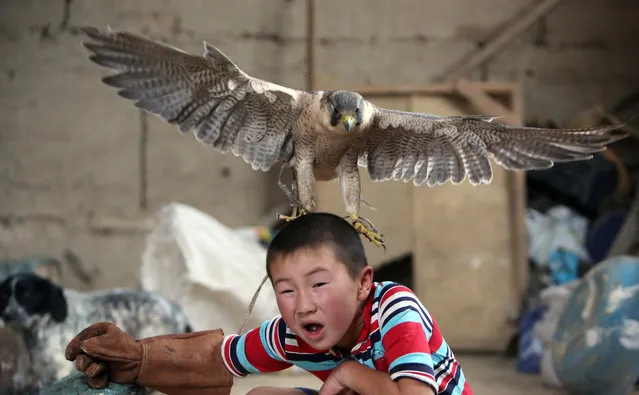
Azat Shajbyrov reacts with a baby falcon on his head in a village of Bokonbaevo, Issyk-Kul area (270 km from Bishkek), Kyrgyzstan, 22 June 2016, as he dreams of continuing a family tradition of golden eagle hunting. Eagle and falcon hunting is an old Kyrgyz tradition. With their birds, Kyrgyz berkutchy hunt in the mountains and participate in the hunting festival “Salburun”. (Photo by Igor Kovalenko/EPA)

Azat Shajbyrov reacts with a baby falcon on his head in a village of Bokonbaevo, Issyk-Kul area (270 km from Bishkek), Kyrgyzstan, 22 June 2016, as he dreams of continuing a family tradition of golden eagle hunting. Eagle and falcon hunting is an old Kyrgyz tradition. With their birds, Kyrgyz berkutchy hunt in the mountains and participate in the hunting festival “Salburun”. (Photo by Igor Kovalenko/EPA)
Details
23 Jun 2016 13:17:00
Braless festival style of a music fan during the third day of Lollapalooza Brazil Festival at Interlagos Racetrack on March 25, 2018 in Sao Paulo, Brazil. (Photo by Mauricio Santana/Getty Images)

Braless festival style of a music fan during the third day of Lollapalooza Brazil Festival at Interlagos Racetrack on March 25, 2018 in Sao Paulo, Brazil. (Photo by Mauricio Santana/Getty Images)
Details
27 Mar 2018 08:16:00
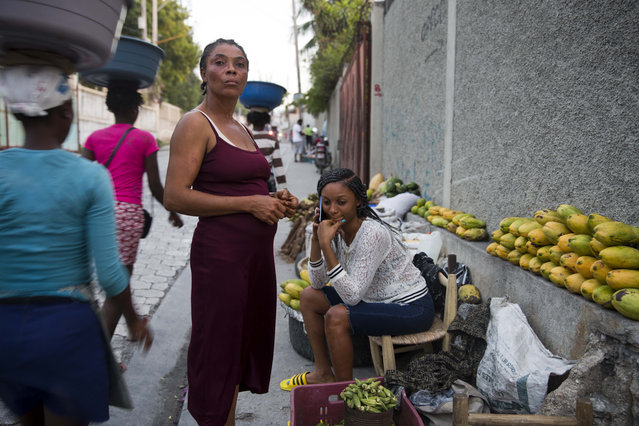
In this November 27, 2019 photo, Wadlande Pierre, right, talks on her mobile phone as she helps her mother, Vanlancia Julien, center, at their fruit and vegetable stand on a sidewalk in Delmas, a district of in Port-au-Prince, Haiti. Pierre, 23, said she temporarily moved in with her aunt in the southwest town of Les Cayes to escape the violent protests in Port-au-Prince. However, she had to move back to the capital because there was no gas, power or water in Les Cayes, and food was becoming scarce. (Photo by Dieu Nalio Chery/AP Photo)

In this November 27, 2019 photo, Wadlande Pierre, right, talks on her mobile phone as she helps her mother, Vanlancia Julien, center, at their fruit and vegetable stand on a sidewalk in Delmas, a district of in Port-au-Prince, Haiti. Pierre, 23, said she temporarily moved in with her aunt in the southwest town of Les Cayes to escape the violent protests in Port-au-Prince. However, she had to move back to the capital because there was no gas, power or water in Les Cayes, and food was becoming scarce. (Photo by Dieu Nalio Chery/AP Photo)
Details
01 Feb 2020 00:05:00
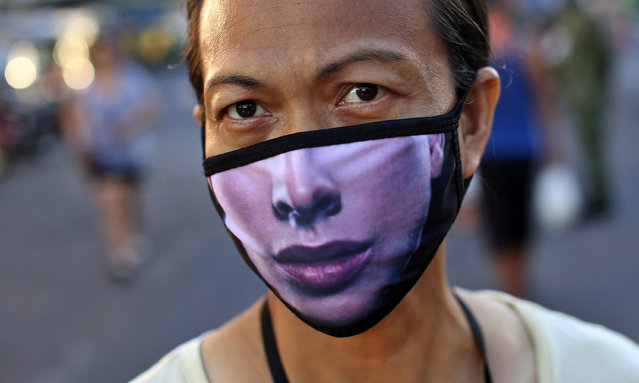
A Filipino woman wears a mask to try and protect against the spread of coronavirus in Malate district, Manila City on March 24, 2020. The Philippines has taken drastic measures to combat the spread of Covid-19. The entire country is under strict quarantine and the army is on the streets to monitor compliance. According to official figures, there are 462 positive cases and 33 dead in the Philippines, but it is thought that thousands of cases remain undetected due to lack of resources in a country where millions of people have no access to health care. In the poorest and most crowded areas, it’s almost impossible to adhere to the physical distancing required during quarantine. (Photo by Alejandro Ernesto/The Guardian)

A Filipino woman wears a mask to try and protect against the spread of coronavirus in Malate district, Manila City on March 24, 2020. The Philippines has taken drastic measures to combat the spread of Covid-19. The entire country is under strict quarantine and the army is on the streets to monitor compliance. According to official figures, there are 462 positive cases and 33 dead in the Philippines, but it is thought that thousands of cases remain undetected due to lack of resources in a country where millions of people have no access to health care. In the poorest and most crowded areas, it’s almost impossible to adhere to the physical distancing required during quarantine. (Photo by Alejandro Ernesto/The Guardian)
Details
08 Apr 2020 00:01:00