Loading...
Done
Inmates are seen at the transgender gallery in La Joya prison on the outskirts of Panama City, Panama February 3, 2016. (Photo by Carlos Jasso/Reuters)

Inmates are seen at the transgender gallery in La Joya prison on the outskirts of Panama City, Panama February 3, 2016. Inmates of La Joya prison on the outskirts of Panama City are housed in makeshift cells amid heavy overcrowding, living in grimy conditions and with limited medical attention. Many prisoners in the Central American nation languish for years without being sentenced. (Photo by Carlos Jasso/Reuters)
Details
14 Apr 2016 11:51:00
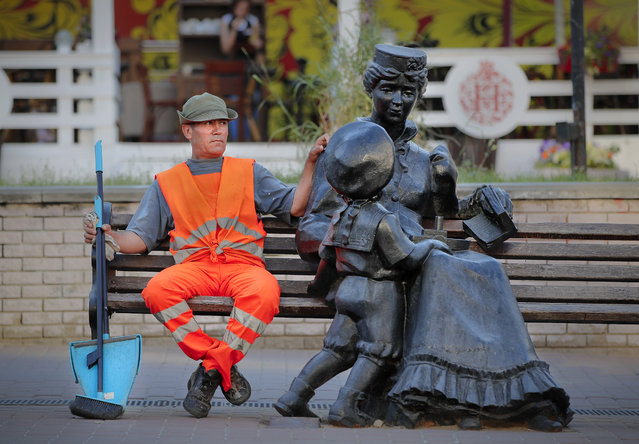
A municipal worker sits on a bench, next to a statue, in Nizhny Novgorod, Russia, during the 2018 soccer World Cup, Thursday, June 28, 2018. (Photo by Vadim Ghirda/AP Photo)

A municipal worker sits on a bench, next to a statue, in Nizhny Novgorod, Russia, during the 2018 soccer World Cup, Thursday, June 28, 2018. Nizhny Novgorod was a “closed city” during the Soviet era. It was known as Gorky until 1990 and it was here that dissident scientist Andrei Sakharov was held under house arrest. Now the city hosts six World Cup matches and is teeming with tourists. That was unthinkable in the Soviet era and even rare now in a city that is seldom visited by outsiders. (Photo by Vadim Ghirda/AP Photo)
Details
03 Jul 2018 00:03:00
A newly wed couple jumps to pose for their wedding photographs after their group wedding ceremony which was held as part of the Harbin International Ice and Snow Festival in the northern city of Harbin, Heilongjiang province January 6, 2015. The wedding ceremony was organised by the city government and 11 couples from China, Russia and Egypt participated in the ceremony. (Photo by Kim Kyung-Hoon/Reuters)

A newly wed couple jumps to pose for their wedding photographs after their group wedding ceremony which was held as part of the Harbin International Ice and Snow Festival in the northern city of Harbin, Heilongjiang province January 6, 2015. The wedding ceremony was organised by the city government and 11 couples from China, Russia and Egypt participated in the ceremony. (Photo by Kim Kyung-Hoon/Reuters)
Details
07 Jan 2015 13:57:00
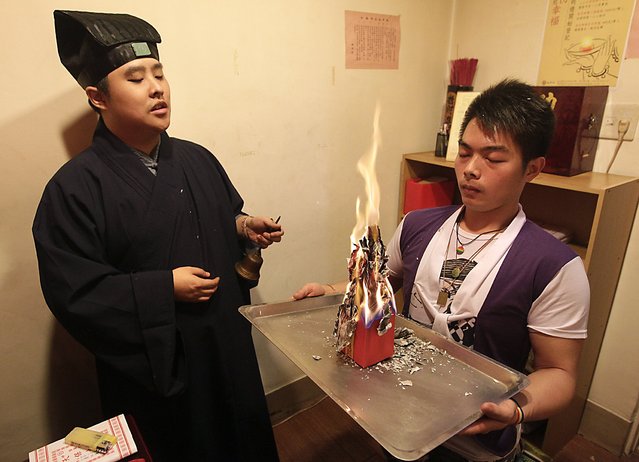
Lu Wei-ming (L), priest of the Wei-ming temple, and a worshipper burn a Taoist paper amulet during a prayer ritual at the temple in New Taipei city January 8, 2015. The shrine, down a narrow alleyway in a bustling district of the city, is dedicated to a deity who has watched over homosexuals for four centuries. (Photo by Pichi Chuang/Reuters)

Lu Wei-ming (L), priest of the Wei-ming temple, and a worshipper burn a Taoist paper amulet during a prayer ritual at the temple in New Taipei city January 8, 2015. The shrine, down a narrow alleyway in a bustling district of the city, is dedicated to a deity who has watched over homosexuals for four centuries. Priest Lu founded the temple in 2006, at a time gays were excluded from most religious ceremonies. (Photo by Pichi Chuang/Reuters)
Details
21 Jan 2015 13:06:00
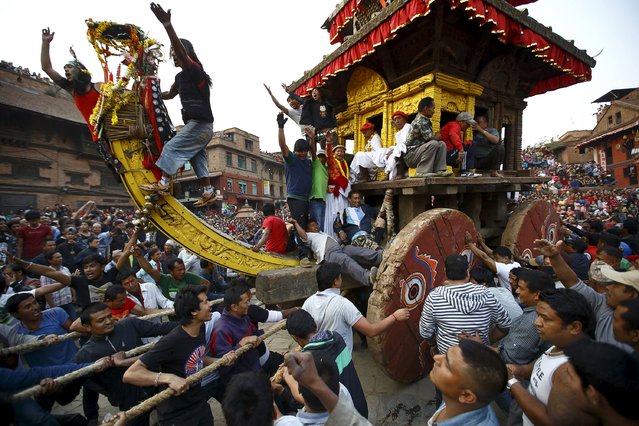
The chariot of God Bhairab is pulled through the city centre of Bhaktapur near Kathmandu during the Bisket festival April 10, 2015. The festival, which runs for more than a week and coincides with the Nepalese New Year, involves devotees offering prayers and the pulling of two chariots, one carrying the idol of God Bhairab and the other with the idol of Goddess Bhadrakali, around the ancient city of Bhaktapur. (Photo by Navesh Chitrakar/Reuters)

The chariot of God Bhairab is pulled through the city centre of Bhaktapur near Kathmandu during the Bisket festival April 10, 2015. The festival, which runs for more than a week and coincides with the Nepalese New Year, involves devotees offering prayers and the pulling of two chariots, one carrying the idol of God Bhairab and the other with the idol of Goddess Bhadrakali, around the ancient city of Bhaktapur. Devotees participate in the festival with the belief that they will be blessed with good health, fortune and harvest for the coming year. (Photo by Navesh Chitrakar/Reuters)
Details
12 Apr 2015 07:52:00
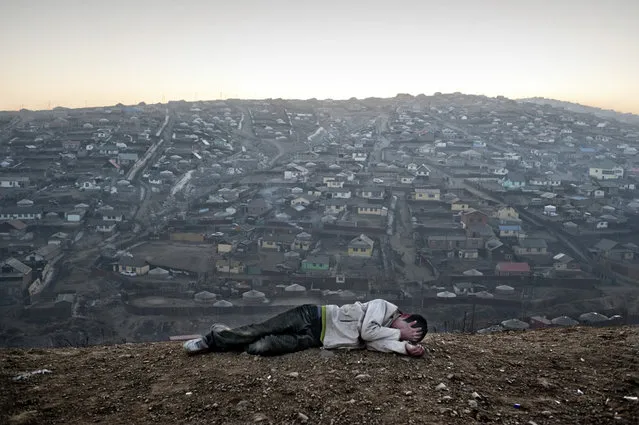
Asia, Mongolia, March 27, 2011. A view of Ulaan Baator over the shoulder of a slumbering drunk. Alcoholism is a huge problem in the city, home to almost half of Mongolia's people. The capital's population has doubled in the past two years, expanding outward in a haphazard sprawl, and many inhabitants live in slums known as the “Gher District”. (Photo by Alessandro Grassani)

“Environmental Migrants: The Last Illusion” by photographer Alessandro Grassani, documents the life of people in Kenya, Mongolia and Bangladesh who migrate to escape environmental stresses to the city of their own countries in hopes for a better life. Here: Asia, Mongolia, March 27, 2011. A view of Ulaan Baator over the shoulder of a slumbering drunk. Alcoholism is a huge problem in the city, home to almost half of Mongolia's people. The capital's population has doubled in the past two years. High levels of unemployment and poverty await herders who abandon rural areas and arrive in the city, illiterate and untrained in any skills necessary for urban jobs. (Photo by Alessandro Grassani)
Details
21 Jul 2015 10:10:00
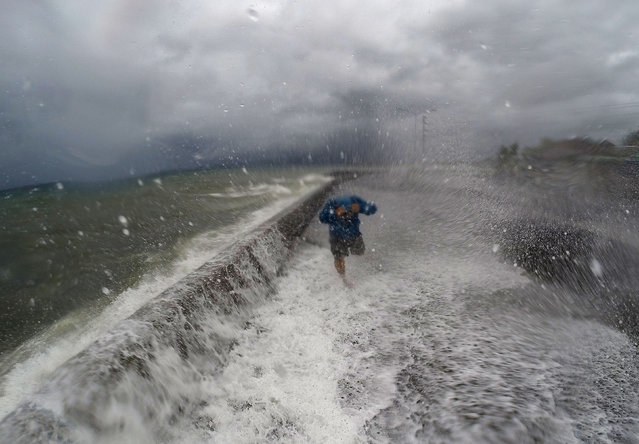
A resident walks past big waves spilling over a wall onto a coastal road in the city of Legaspi in Albay province, south of Manila on December 14, 2015, as typhoon Melor approaches the city. More than 700,000 people fled the central Philippines amid threats of giant waves, floods and landslides as powerful Typhoon Melor approached the archipelago nation, officials said December 14. (Photo by Charism Sayat/AFP Photo)

A resident walks past big waves spilling over a wall onto a coastal road in the city of Legaspi in Albay province, south of Manila on December 14, 2015, as typhoon Melor approaches the city. More than 700,000 people fled the central Philippines amid threats of giant waves, floods and landslides as powerful Typhoon Melor approached the archipelago nation, officials said December 14. (Photo by Charism Sayat/AFP Photo)
Details
15 Dec 2015 11:34:00
An employee of Paris city Hall removes padlocks clipped by lovers on the fence of the Pont des Arts over the River Seine in Paris, December 9, 2014. For years, visiting couples have hung brass padlocks on the iron grills lining the city's bridges to symbolise their undying love – they write their names on the locks, then toss the key into the Seine below. (Photo by Philippe Wojazer/Reuters)

An employee of Paris city Hall removes padlocks clipped by lovers on the fence of the Pont des Arts over the River Seine in Paris, December 9, 2014. For years, visiting couples have hung brass padlocks on the iron grills lining the city's bridges to symbolise their undying love – they write their names on the locks, then toss the key into the Seine below. About 700,000 love locks are added every few months and Paris officials say they are damaging the bridges and threatening safety because of the added weight. (Photo by Philippe Wojazer/Reuters)
Details
10 Dec 2014 12:24:00