Loading...
Done
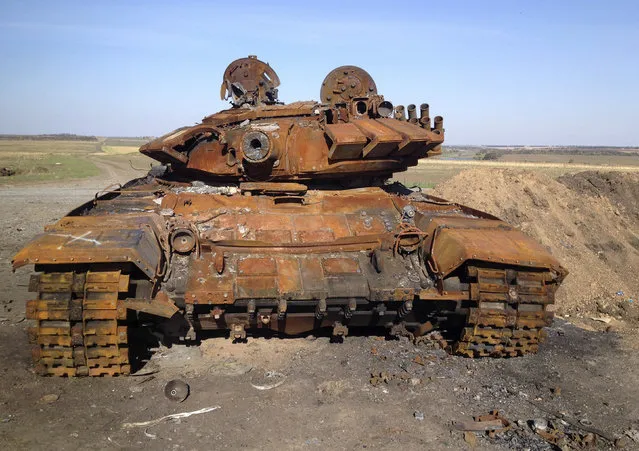
A destroyed T-72 tank, which presumably came from Russia, is seen on a battlefield near separatist-controlled Starobesheve, eastern Ukraine, October 2, 2014.(Photo by Maria Tsvetkova/Reuters)

A destroyed T-72 tank, which presumably came from Russia, is seen on a battlefield near separatist-controlled Starobesheve, eastern Ukraine, October 2, 2014. The burnt-out remains of dozens of tanks and armoured vehicles in fields near the small village of Horbatenko bear witness to the ferocity of a battle that turned the tide of the conflict in eastern Ukraine. Among the debris, Reuters found the blackened carcasses of what military experts have since identified as two Russian army tanks, supporting statements by Kiev and the West that the rebels were backed by troops and equipment sent by Moscow. (Photo by Maria Tsvetkova/Reuters)
Details
24 Oct 2014 12:14:00
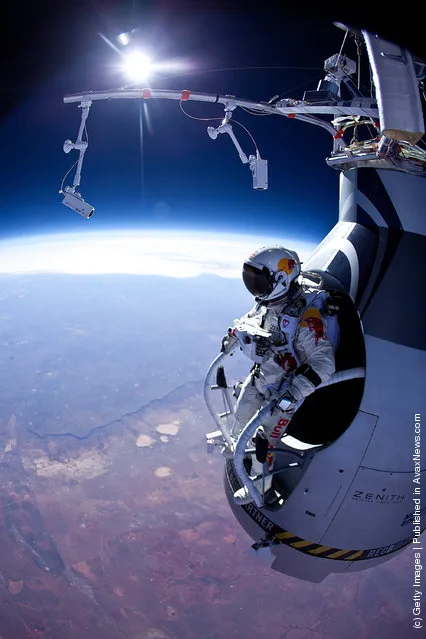
Pilot Felix Baumgartner of Austria is seen before his jump during the first manned test flight for Red Bull Stratos

“Felix Baumgartner (born 20 April 1969 in Salzburg, Austria) is a skydiver and a BASE jumper. He is renowned for the particularly dangerous nature of the stunts he has performed during his career. Baumgartner spent time in the Austrian military where he practiced parachute jumping, including training to land on small target zones”. – Wikipedia

Photo: Pilot Felix Baumgartner of Austria is seen before his jump during the first manned test flight for Red Bull Stratos on March 15, 2012 in Roswell, New Mexico. In this test he reach the altitude 21800 meters (71500 ft) and landed safely near Roswell. Red Bull Stratos is a mission to the edge of the earths atmosphere, where upon reaching altitude of 120,000 feet by helium baloon, pilot and basejumper Felix Baumgartner will then freefall to the ground in an attempt to break the speed of sound. (Photo by Jay Nemeth/Red Bull via Getty Images)
Details
17 Mar 2012 13:11:00
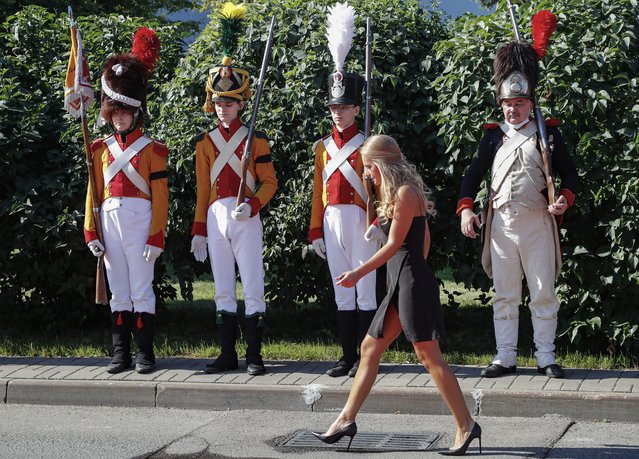
A woman passes Members of historical clubs dressed in the uniform of French soldiers during ceremony of repatriation of the remains of French General Charles-Etienne Gudin de la Sablonniere, participant in the French Revolutionary wars and Napoleonic wars, to France in Moscow airport Vnukovo-3, Russia, 13 July 2021. One of Napoleon Bonaparte's favourite military commanders died in the Battle of Smolensk during the Russian campaign of 1812. The search for his remains was one of the main goals of the joint archaeological expedition, which the historians of the two countries, led by Pierre Malinowski, President of the Foundation for the Development of Russian- French Historical Initiatives, began in the summer of 2019. A significant find was made during excavations at the Royal Bastion in the Lopatinsky Garden of Smolensk. (Photo by Sergei Ilnitsky/EPA/EFE)

A woman passes Members of historical clubs dressed in the uniform of French soldiers during ceremony of repatriation of the remains of French General Charles-Etienne Gudin de la Sablonniere, participant in the French Revolutionary wars and Napoleonic wars, to France in Moscow airport Vnukovo-3, Russia, 13 July 2021. (Photo by Sergei Ilnitsky/EPA/EFE)
Details
23 Jul 2021 09:07:00
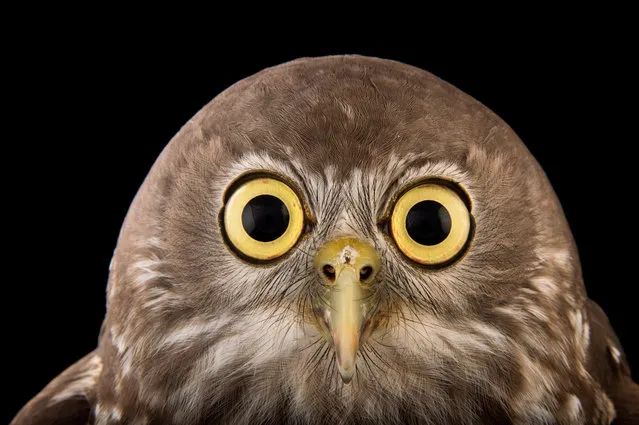
The National Geographic Photo Ark is a travelling exhibition of photographer Joel Sartore’s quest to create a photo archive of biodiversity around the world. So far, Sartore has captured studio portraits of more than 6,000 species – a number that he hopes to double. On 1 July, the ark will open at Melbourne zoo – the first time it has been exhibited in the southern hemisphere. More than 50 portraits will be on display, including many of Australian endangered animals being protected by programs at the zoo itself. These captions have been edited from text supplied by Melbourne zoo. Here: Barking owl. So-named because its call sounds like a barking dog, these birds are native to Australia, Indonesia and Papua New Guinea. In Victoria they are listed as an endangered species, and in 2003 there were estimated to be fewer than 50 breeding pairs. The main threat to the species in Victoria is loss of habitat, especially large trees with hollows in which they can nest and on which many of their prey depend. Apart from a bark, they may utter a chilling scream when they feel threatened. (Photo by Joel Sartore/National Geographic Photo Ark/The Guardian)

The National Geographic Photo Ark is a travelling exhibition of photographer Joel Sartore’s quest to create a photo archive of biodiversity around the world. So far, Sartore has captured studio portraits of more than 6,000 species – a number that he hopes to double. On 1 July, the ark will open at Melbourne zoo – the first time it has been exhibited in the southern hemisphere. More than 50 portraits will be on display, including many of Australian endangered animals being protected by programs at the zoo itself. These captions have been edited from text supplied by Melbourne zoo. Here: Barking owl. (Photo by Joel Sartore/National Geographic Photo Ark/The Guardian)
Details
01 Jul 2017 07:45:00
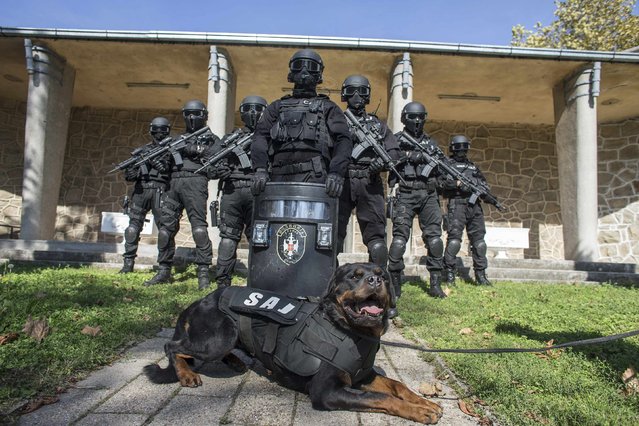
Serbian police officers of the Special Anti-Terrorist Unit pose for a picture in their base outside Belgrade October 8, 2014. (Photo by Marko Djurica/Reuters)

Serbian police officers of the Special Anti-Terrorist Unit pose for a picture in their base outside Belgrade October 8, 2014. When the killing of an unarmed black teenager by a white policeman in Ferguson, Missouri, in August sparked sometimes violent protests, the response of police in camouflage gear and armoured vehicles wielding stun grenades and assault rifles seemed more like a combat operation than a public order measure. Some U.S. police departments have recently acquired U.S. military-surplus hardware from wars abroad, but there are many law enforcers around the world whose rules of engagement also allow the use of lethal force with relatively few restrictions. But for every regulation that gives police wide scope to use firearms, there is another code that sharply limits their use. In Serbia, police may use measures ranging from batons to special vehicles, water cannon and tear gas on groups of people who have gathered illegally and are behaving in a way that is violent or could cause violence, but they may use firearms only when life is endangered. (Photo by Marko Djurica/Reuters)
Details
27 Nov 2014 14:53:00


“The Trabant is a car that was produced by former East German auto maker VEB Sachsenring Automobilwerke Zwickau in Zwickau, Sachsen. It was the most common vehicle in East Germany, and was also exported to countries both inside and outside the communist bloc. The main selling points was that it had room for four adults and luggage in a compact, light and durable shell and that it was fast (when introduced) and durable. With its mediocre performance, smoky two-stroke engine, and production shortages, the Trabant is often cited as an example of the disadvantages of centralized planning; on the other hand, it is regarded with derisive affection as a symbol of the failed former East Germany and of the fall of communism (in former West Germany, as many East Germans streamed into West Berlin and West Germany in their Trabants after the opening of the Berlin Wall in 1989). It was in production without any significant changes for nearly 30 years with 3,096,099 Trabants produced in total”. – Wikipedia

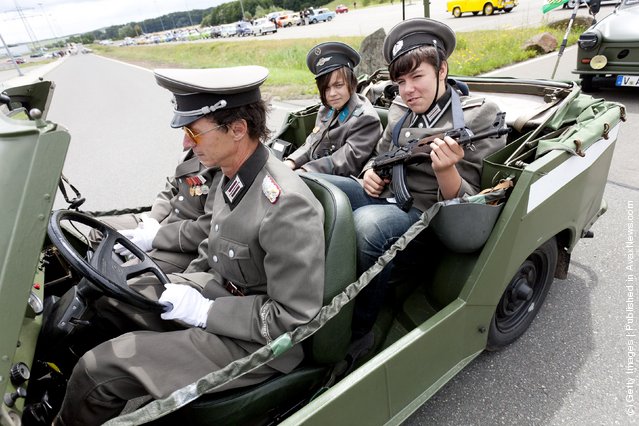
Photo: Enthusiasts weared in uniforms of the former eastern german army trive in a military Trabant car as fans and owners of East German-era Trabant cars gather at the 2011 International Trabantfahrer Treffen (International Trabant Drivers Meeting) on June 26, 2011 in Zwickau, Germany. The Trabant, also known as the Trabi, was among the main cars produced in communist East Germany and built by VEB Sachsenring Automobilwerke in Zwickau for 30 years until 1989. Today the car has cult status for many followers and one company, IndiKar, is even seeking to revive the brand in a modern, electric version. (Photo by Carsten Koall/Getty Images)

Details
27 Jun 2011 12:21:00
Devotees of the small farming village of Bibiclat celebrate the Feast of Saint John the Baptist while covered in banana leaves and mud on June 24, 2025 in Aliaga, Philippines. Known as the “Taong Putik” (mud people), the ritual happens yearly in this small farming village as their own version of expressing their faith and celebrating the feast of Saint John the Baptist whom the survivors of the Japanese occupation in 1944 in their area prayed to for rain to save their fellow villagers. A marker near the church entrance of the village tells a story of a heavy torrential rain that happened that day that forced the Japanese military to call off the execution of 14 villagers. The Philippines is the only predominantly Catholic country in Southeast Asia after more than 300 years of Spanish rule. (Photo by Ezra Acayan/Getty Images)

Devotees of the small farming village of Bibiclat celebrate the Feast of Saint John the Baptist while covered in banana leaves and mud on June 24, 2025 in Aliaga, Philippines. Known as the “Taong Putik” (mud people), the ritual happens yearly in this small farming village as their own version of expressing their faith and celebrating the feast of Saint John the Baptist whom the survivors of the Japanese occupation in 1944 in their area prayed to for rain to save their fellow villagers. (Photo by Ezra Acayan/Getty Images)
Details
29 Aug 2025 03:18:00
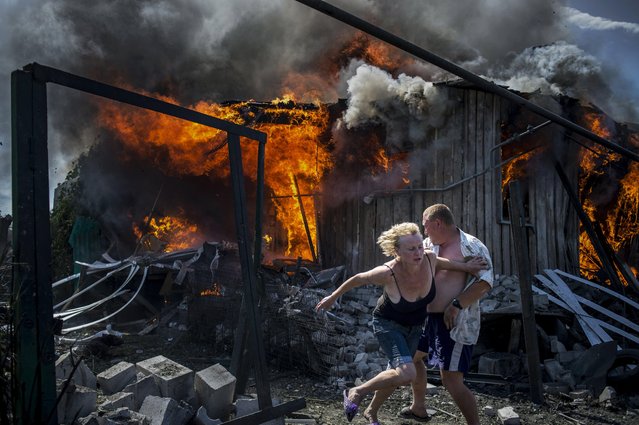
A handout photo made available by the World Press Photo (WPP) organization on 13 February 2017 shows a picture by Rossiya Segodnya photographer Valery Melnikov that won the Long-Term Projects – First Prize award of the 60th annual World Press Photo Contest, it was announced by the WPP Foundation in Amsterdam, The Netherlands on 13 February 2017. Caption: Civilians escape from a fire at a house destroyed by an air attack in the Luhanskaya village. Story: Ordinary people became victims of the conflict between self-proclaimed republics and the official Ukrainian authorities from 2014 onwards in the region of Donbass. Disaster came into their lives unexpectedly. These people were involved in the military confrontation against their will. They experienced the most terrible things: the death of their friends and relatives, destroyed homes and the ruined lives of thousands of people. (Photo by Valery Melnikov/EPA/Rossiya Segodnya/World Press Photo)

A handout photo made available by the World Press Photo (WPP) organization on 13 February 2017 shows a picture by Rossiya Segodnya photographer Valery Melnikov that won the Long-Term Projects – First Prize award of the 60th annual World Press Photo Contest, it was announced by the WPP Foundation in Amsterdam, The Netherlands on 13 February 2017. Caption: Civilians escape from a fire at a house destroyed by an air attack in the Luhanskaya village. (Photo by Valery Melnikov/EPA/Rossiya Segodnya/World Press Photo)
Details
15 Feb 2017 00:06:00