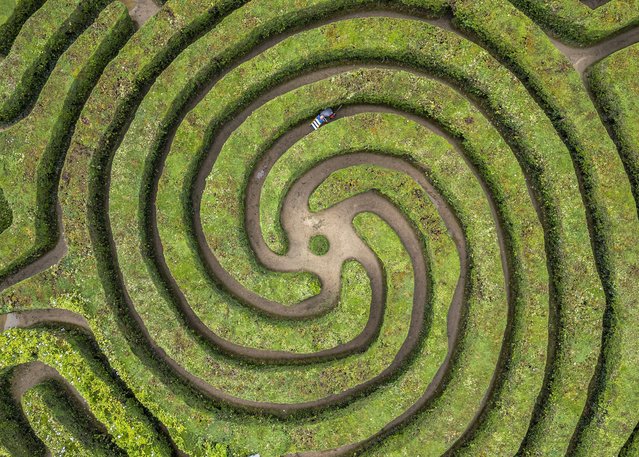
Groundsman Darren Cordingley on his way out of the maze on July 11, 2024. Gardeners have had their work cut out after spending a whopping 520 hours trimming one of the world's biggest hedge mazes. It has taken a team of 13 working eight hours a day for five days to tackle the enormous maze at the Longleat estate in Wiltshire, UK. (Photo by Max Willcock/Bournemouth News)
A giant devil figure burns during the annual celebration of the “Burning of the Devil”, a festivity associated with the Feast of the Immaculate Conception that honours the city's patron saint and marks the start of the Christmas season, at Colonia Arrivillaga in Guatemala City, Guatemala on December 7, 2024. (Photo by Cristina Chiquin/Reuters)
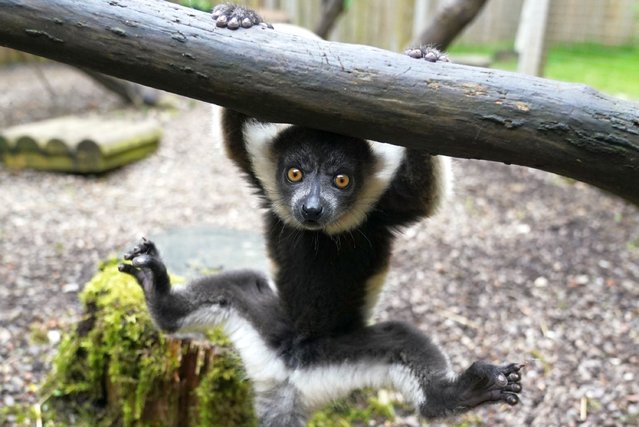
One of two black-and-white ruffed lemur pups born at Blair Drummond Safari and Adventure Park, near Stirling, UK on Friday, May 24, 2024.The critically endangered lemur pups, both female were born on April 14 and have been named Nova, meaning “new” and Evie meaning “life”. (Photo by Andrew Milligan/PA Images via Getty Images)
Netherlands' Joosje Burg, left, reacts after Argentina's Agustina Gorzelany's stick catches her on the face during the women's semifinal field hockey match between Argentina and Netherlands at the Yves-du-Manoir Stadium during the 2024 Summer Olympics, Wednesday, August 7, 2024, in Colombes, France. (Photo by Aijaz Rahi/AP Photo)
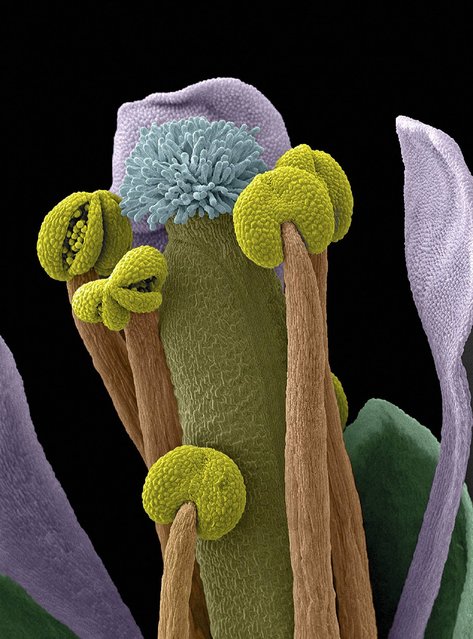
Beautiful, strange and occasionally alarming pictures from the shortlist for this year’s Wellcome image awards – which celebrate the very best in science photography and imaging – from an x-ray of a bat to a micrograph of a kidney stone. The exhibition opens on 12 March at three science centres and the Museum of Science and Industry in Manchester. Photo: Scanning electron micrograph (SEM) of an Arabidopsis thaliana flower, also commonly known as thale cress. Some of the anthers are open, revealing pollen grains ready for dispersal. Arabidopsis was the first plant to have its entire genome sequenced and is widely used as a model organism in molecular and plant biology. Horizontal width of image is 1200 microns. Magnification 100x. (Photo by Stefan Eberhard/Wellcome Images)