Loading...
Done
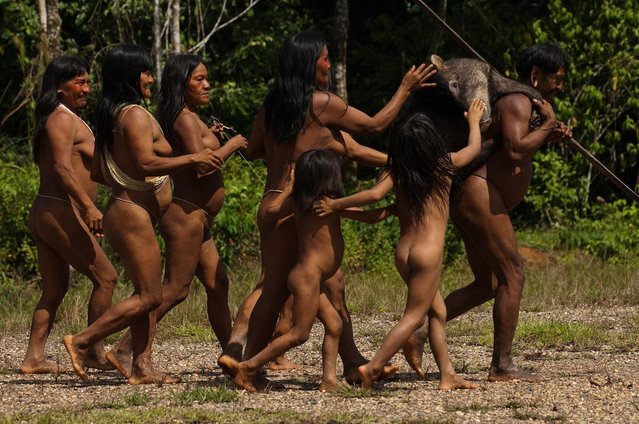
Spectacular images offering insight into the lives of the Huaorani people in the Ecuadorian Amazon have been revealed showing how they use traditional methods to hunt monkeys for food. The stunning pictures were taken by conservation photographer Pete Oxford from Torquay, Devon in the Ecuadorian Amazon. “The Huaorani Indians are a forest people highly in tune with their environment. Many are now totally acculturated since the 1950s by missionaries”, said Pete. “Today they face radical change to their culture to the proximity of oil exploration within their territory and the Yasuni National Park and Biosphere Reserve, they are vastly changed. Some still live very traditionally and for this shoot, through my Huaorani friend, a direct relative of those photographed he wanted to depict them as close to their original culture as possible. They still largely hunt with blow pipes and spears eating a lot of monkeys and peccaries”. The Huaorani are also known as the Waorani, Waodani or the Waos and are native Amerindians. Their lands are located between the Curaray and Napo rivers and speak the Huaorani language. Pete says that during his visit he was welcomed into the group and hopes that ancient cultures can be saved. Here: The tribe were seen celebrating after a hunter returned to camp with a wild pig. (Photo by Pete Oxford/Mediadrumworld.com)

Spectacular images offering insight into the lives of the Huaorani people in the Ecuadorian Amazon have been revealed showing how they use traditional methods to hunt monkeys for food. The stunning pictures were taken by conservation photographer Pete Oxford from Torquay, Devon in the Ecuadorian Amazon. Here: The tribe were seen celebrating after a hunter returned to camp with a wild pig. (Photo by Pete Oxford/Mediadrumworld.com)
Details
20 Jan 2017 07:58:00
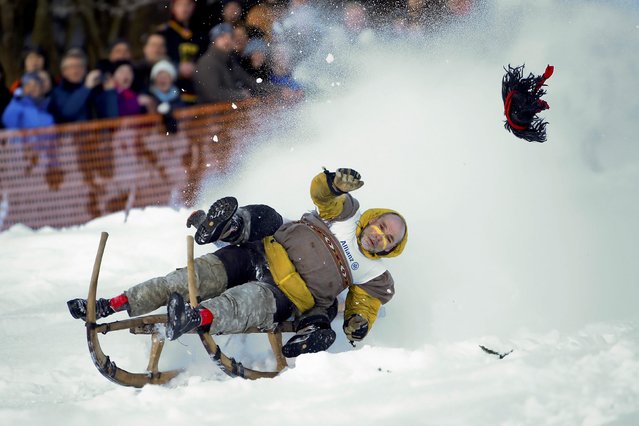
Men soar through the air on a wooden sledge during a traditional Bavarian horn sledge race, known as “Schnablerrennen”, in Gaissach near Bad Toelz, Germany, January 22, 2017. (Photo by Michael Dalder/Reuters)

Men soar through the air on a wooden sledge during a traditional Bavarian horn sledge race, known as “Schnablerrennen”, in Gaissach near Bad Toelz, Germany, January 22, 2017. (Photo by Michael Dalder/Reuters)
Details
23 Jan 2017 09:57:00
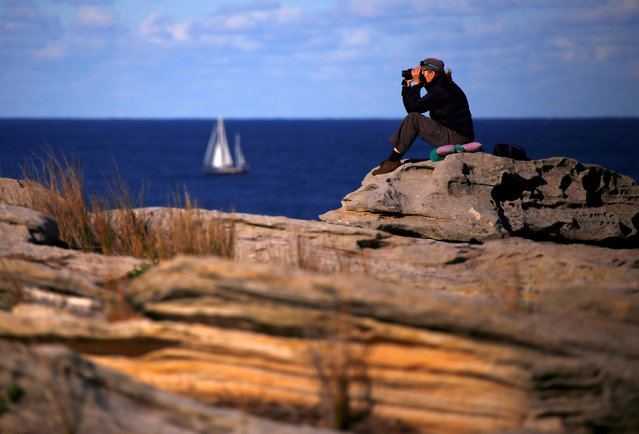
A boat sails behind a woman looking through binoculars as she sits on a cliff on a sunny day in Sydney, Australia, May 29, 2016. (Photo by David Gray/Reuters)

A boat sails behind a woman looking through binoculars as she sits on a cliff on a sunny day in Sydney, Australia, May 29, 2016. (Photo by David Gray/Reuters)
Details
05 Jun 2016 13:33:00
A woman takes pictures with her mobile phone at a building, which is made by half of a replica of the Qinian Hall of the Temple of the Heaven (R) and half of a western building, at a studio for productions of films and television shows on the outskirts of Shijiazhuang, Hebei province, China, December 3, 2015. (Photo by Reuters/Stringer)

A woman takes pictures with her mobile phone at a building, which is made by half of a replica of the Qinian Hall of the Temple of the Heaven (R) and half of a western building, at a studio for productions of films and television shows on the outskirts of Shijiazhuang, Hebei province, China, December 3, 2015. (Photo by Reuters/Stringer)
Details
05 Dec 2015 08:01:00
Dubai. (Photo by Airpano/Caters News)

These are the stunning panoramic shots of some of the worlds most beautiful locations. Company AirPano travel the world photographing its wonders from above. Their shots include famous cities – such as New York, Paris and Barcelona – as well as natural marvels, like volcanoes and waterfalls. The team, which consists of 12 members – nine photographers and three tech specialists – began looking into this style of photography in 2006. Project coordinator Sergey Semenov revealed after initially working with spherical panoramas on land, the group decided to take to the skies. They made a list of the 100 Best Places on the Planet, which they hoped to photograph over the coming years. Here: Dubai. (Photo by Airpano/Caters News)
Details
20 Mar 2015 11:23:00
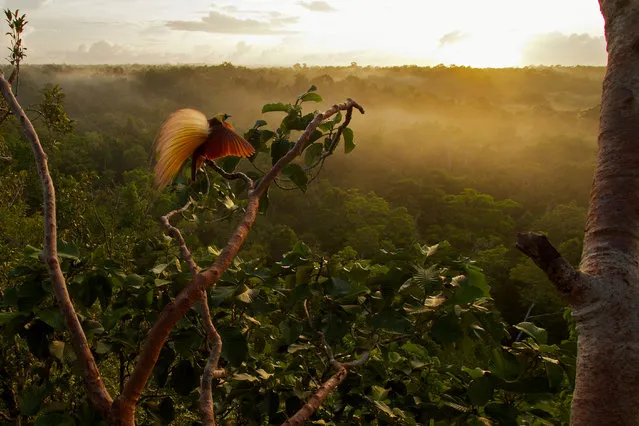
A greater bird of paradise (Paradisaea apoda) displaying in Badigaki Forest, Wokam Island (Aru Islands, Indonesia). Found here in Aru and on adjacent New Guinea, the greater bird of paradise represents about 40 different species of birds of paradise that depend on intact rainforest across the New Guinea region spanning eastern Indonesia and Papua New Guinea. With more than 80% of forest cover still intact, this region represents the largest remaining block of rainforest in the entire Asia-Pacific. (Photo by Tim Laman/naturepl.com/LDY Agency)

A greater bird of paradise (Paradisaea apoda) displaying in Badigaki Forest, Wokam Island (Aru Islands, Indonesia). Found here in Aru and on adjacent New Guinea, the greater bird of paradise represents about 40 different species of birds of paradise that depend on intact rainforest across the New Guinea region spanning eastern Indonesia and Papua New Guinea. With more than 80% of forest cover still intact, this region represents the largest remaining block of rainforest in the entire Asia-Pacific. (Photo by Tim Laman/naturepl.com/LDY Agency)
Details
14 Nov 2021 05:57:00


Nazis won't run away - I'll finish them in their lair! - Viktor Koretsky (1945)
Details
17 Aug 2013 10:23:00
An anti-government protester sits on the ground in front of police during a demonstration in Sarajevo February 6, 2014. Hundreds of people turned out in solidarity in the capital Sarajevo, with teenagers throwing eggs and stones at a government building and fought with police. Four officers were taken to hospital, officials said. (Photo by Dado Ruvic/Reuters)

An anti-government protester sits on the ground in front of police during a demonstration in Sarajevo February 6, 2014. Hundreds of people turned out in solidarity in the capital Sarajevo, with teenagers throwing eggs and stones at a government building and fought with police. Four officers were taken to hospital, officials said. (Photo by Dado Ruvic/Reuters)
Details
09 Feb 2014 13:26:00