Loading...
Done
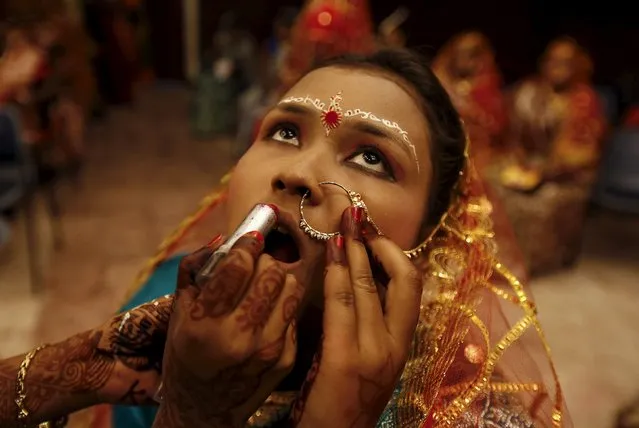
A bride gets her make-up done before the start of a mass marriage ceremony in Kolkata, India, February 14, 2016. A total of 150 tribal Hindu, Muslim and Christian couples from various villages across the state took their wedding vows on Sunday during the day-long mass marriage ceremony organised by a social organisation, the organisers said. (Photo by Rupak De Chowdhuri/Reuters)

A bride gets her make-up done before the start of a mass marriage ceremony in Kolkata, India, February 14, 2016. A total of 150 tribal Hindu, Muslim and Christian couples from various villages across the state took their wedding vows on Sunday during the day-long mass marriage ceremony organised by a social organisation, the organisers said. (Photo by Rupak De Chowdhuri/Reuters)
Details
15 Feb 2016 10:44:00
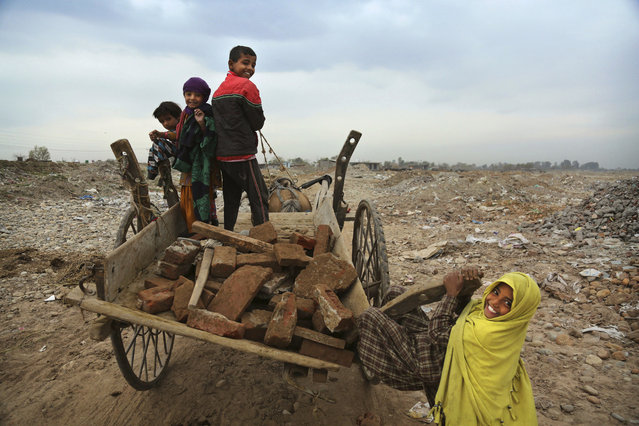
An Indian nomadic Gujjar girl hangs on to a horse cart after collecting bricks from debris on the outskirts of Jammu, India, Tuesday, March 7, 2017. The Gujjar tribal communities are considered by some to be economically and socially backward and the lack of care by the state government has led to resentment amongst the community. The tribe moves to the plains from the hills to escape the cold winters. (Photo by Channi Anand/AP Photo)

An Indian nomadic Gujjar girl hangs on to a horse cart after collecting bricks from debris on the outskirts of Jammu, India, Tuesday, March 7, 2017. The Gujjar tribal communities are considered by some to be economically and socially backward and the lack of care by the state government has led to resentment amongst the community. The tribe moves to the plains from the hills to escape the cold winters. (Photo by Channi Anand/AP Photo)
Details
09 Jun 2017 06:36:00
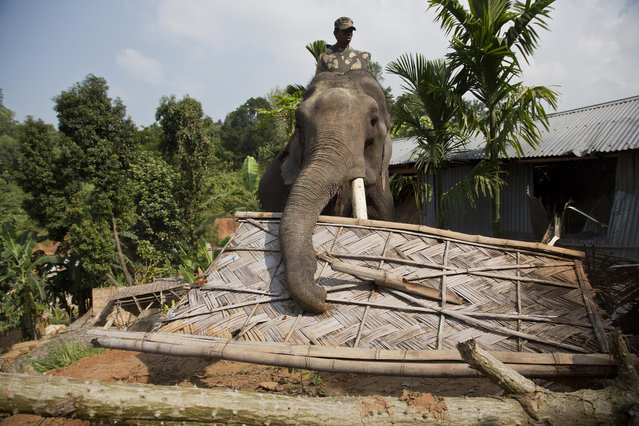
An elephant is used to demolish a house during an eviction drive inside Amchang Wildlife Sanctuary on the outskirts of Gauhati, Assam, India, Monday, November 27, 2017. Indian police on Monday took the unusual step of using elephants in an attempt to evict hundreds of people living illegally in the protected forest area in the country's remote northeast. Police used bulldozers and the elephants in a show of force, and the forest dwellers responded by hurling rocks. (Photo by Anupam Nath/AP Photo)

An elephant is used to demolish a house during an eviction drive inside Amchang Wildlife Sanctuary on the outskirts of Gauhati, Assam, India, Monday, November 27, 2017. Indian police on Monday took the unusual step of using elephants in an attempt to evict hundreds of people living illegally in the protected forest area in the country's remote northeast. Police used bulldozers and the elephants in a show of force, and the forest dwellers responded by hurling rocks. (Photo by Anupam Nath/AP Photo)
Details
29 Nov 2017 09:13:00
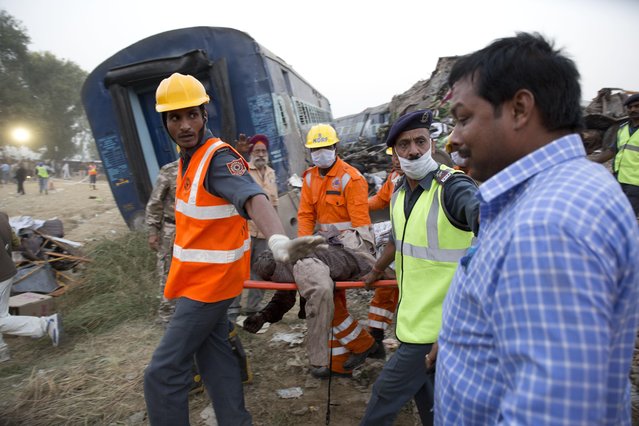
A relative, right, breaks down as rescuers carry the body of a victim after 14 coaches of an overnight passenger train rolled off the track near Pukhrayan village Kanpur Dehat district, Uttar Pradesh state, India, Sunday, November 20, 2016. Dozens were killed and dozens more were injured in the accident. (Photo by Rajesh Kumar Singh/AP Photo)

A relative, right, breaks down as rescuers carry the body of a victim after 14 coaches of an overnight passenger train rolled off the track near Pukhrayan village Kanpur Dehat district, Uttar Pradesh state, India, Sunday, November 20, 2016. Dozens were killed and dozens more were injured in the accident. (Photo by Rajesh Kumar Singh/AP Photo)
Details
21 Nov 2016 10:16:00
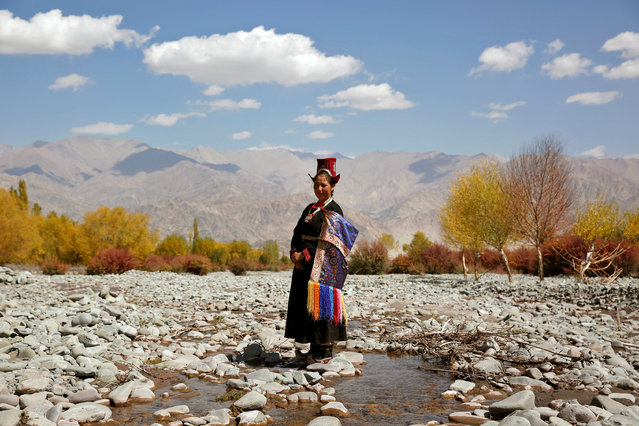
Tsewang Dolma, 33, a farmer and housewife poses for a photograph in Matho, a village nestled high in the Indian Himalayas, India September 29, 2016. When asked how living in the world's fastest growing major economy had affected life, Dolma replied: “Our culture is spoiled now. We don't wear our traditional dress”. (Photo by Cathal McNaughton/Reuters)

Tsewang Dolma, 33, a farmer and housewife poses for a photograph in Matho, a village nestled high in the Indian Himalayas, India September 29, 2016. When asked how living in the world's fastest growing major economy had affected life, Dolma replied: “Our culture is spoiled now. We don't wear our traditional dress”. (Photo by Cathal McNaughton/Reuters)
Details
13 Oct 2016 11:32:00
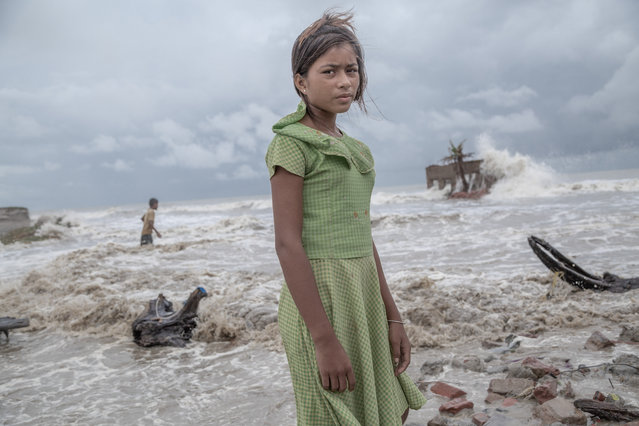
A girl, standing before her tea shop, which is completely ruined by sea water in Frazerganj, Sundarbans, India on August 18, 2020. After Cyclone Aila struck the Sundarbans in 2009, it became clear that frequent cyclonic events will turn the residents of Sundarbans into climate refugees. Within May 5, 2019 – May 25, 2021, Sundarbans faced cyclones- Fani, Bulbul, Amphan & Yaas – each devastating enough to justify the fear of mass displacement. (Photo by Supratim Bhattacharjee/Mangrove Photography Awards)

A girl, standing before her tea shop, which is completely ruined by sea water in Frazerganj, Sundarbans, India on August 18, 2020. After Cyclone Aila struck the Sundarbans in 2009, it became clear that frequent cyclonic events will turn the residents of Sundarbans into climate refugees. Within May 5, 2019 – May 25, 2021, Sundarbans faced cyclones- Fani, Bulbul, Amphan & Yaas – each devastating enough to justify the fear of mass displacement. (Photo by Supratim Bhattacharjee/Mangrove Photography Awards)
Details
26 Sep 2024 03:06:00
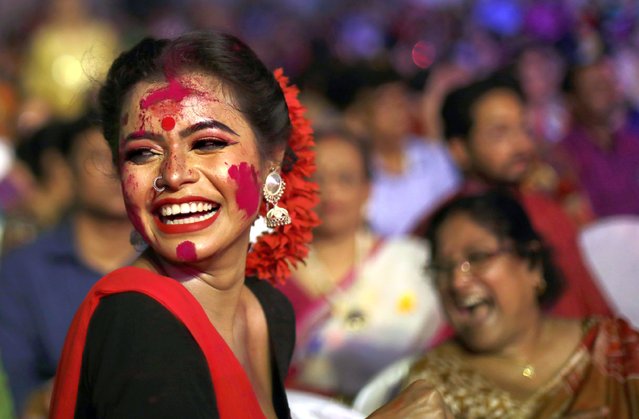
Students of Rabindrabharati University apply colour dust or Gulal on each other during a celebration the festival of colour Holi in Kolkata, Eastern India, 23 March 2024. Holi, also known as the Festival of Colors, is an ancient Hindu festival symbolizing the victory of good over evil and marking the arrival of spring. It is observed with joyful gatherings during which revelers cover each other in colored powders. (Photo by Piyal Adhikary/EPA/EFE)

Students of Rabindrabharati University apply colour dust or Gulal on each other during a celebration the festival of colour Holi in Kolkata, Eastern India, 23 March 2024. Holi, also known as the Festival of Colors, is an ancient Hindu festival symbolizing the victory of good over evil and marking the arrival of spring. It is observed with joyful gatherings during which revelers cover each other in colored powders. (Photo by Piyal Adhikary/EPA/EFE)
Details
05 Jul 2025 03:40:00
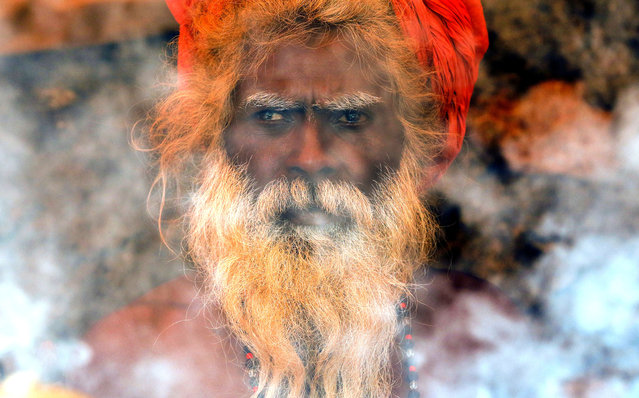
A Naga sadhu, or naked Hindu holy man, performs a ritual inside his tent during Kumbh Mela, or Pitcher festival, at Trimbakeshwar, India, Friday, August 28, 2015. Hindus believe taking a dip in the waters of a holy river during the festival will cleanse them of their sins. The festival is held four times every 12 years. (Photo by Rajanish Kakade/AP Photo)

A Naga sadhu, or naked Hindu holy man, performs a ritual inside his tent during Kumbh Mela, or Pitcher festival, at Trimbakeshwar, India, Friday, August 28, 2015. Hindus believe taking a dip in the waters of a holy river during the festival will cleanse them of their sins. The festival is held four times every 12 years. (Photo by Rajanish Kakade/AP Photo)
Details
29 Aug 2015 11:44:00