Loading...
Done
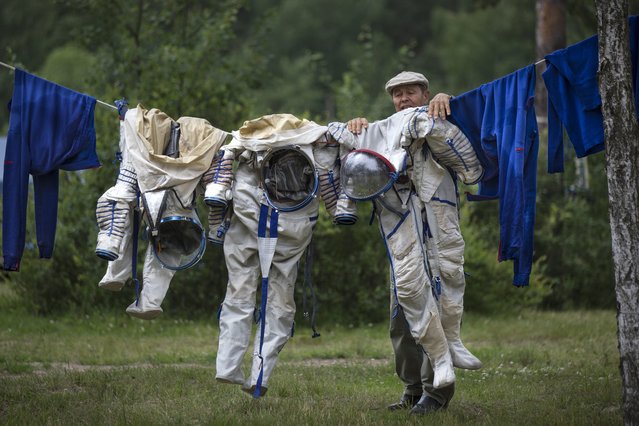
An employe of Russian Space Training Center hangs out to dry space suits of Russian cosmonaut Anatoly Ivanishin, NASA's U.S. flight engineer Kathleen Rubins, and Japanese space agency's flight engineer Takuya Onishi, right, after their undergoing  training near in Noginsk, 60 km (38 miles) east of Moscow, Russia, Wednesday, July 2, 2014. (Photo by Alexander Zemlianichenko/AP Photo)

An employe of Russian Space Training Center hangs out to dry space suits of Russian cosmonaut Anatoly Ivanishin, NASA's U.S. flight engineer Kathleen Rubins, and Japanese space agency's flight engineer Takuya Onishi, right, after their undergoing training near in Noginsk, 60 km (38 miles) east of Moscow, Russia, Wednesday, July 2, 2014. The training was intended to simulate the capsule landing on water. Russian cosmonaut Anatoly Ivanishin, Japanese space agency's flight engineer Takuya Onishi, and NASA's U.S. flight engineer Kathleen Rubins are being trained for a future mission to the International Space Station. (Photo by Alexander Zemlianichenko/AP Photo)
Details
05 Jul 2014 11:47:00
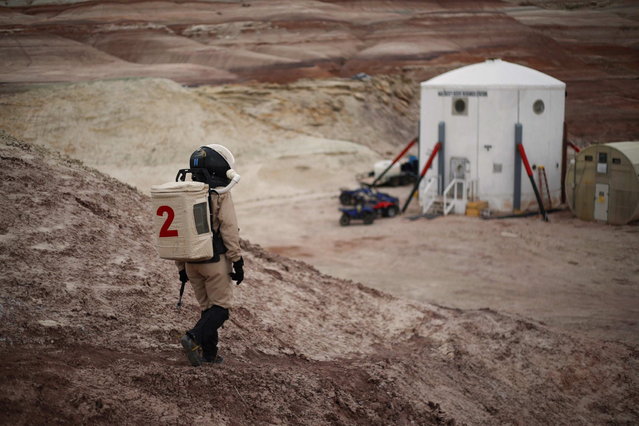
Csilla Orgel, a geologist of Crew 125 EuroMoonMars B mission, makes her way back to the Mars Desert Research Station (MDRS) in the Utah desert March 3, 2013. (Photo by Jim Urquhart/Reuters)

NASA says it could be another 20 years before humans touch down on Mars, but in a sense, the Mars Society has been exploring the red planet for more than a decade – in Utah. Photo: Csilla Orgel, a geologist of Crew 125 EuroMoonMars B mission, makes her way back to the Mars Desert Research Station (MDRS) in the Utah desert March 3, 2013. The MDRS aims to investigate the feasibility of a human exploration of Mars and uses the Utah desert's Mars-like terrain to simulate working conditions on the red planet. Scientists, students and enthusiasts work together developing field tactics and studying the terrain. All outdoor exploration is done wearing simulated spacesuits and carrying air supply packs and crews live together in a small communication base with limited amounts of electricity, food, oxygen and water. Everything needed to survive must be produced, fixed and replaced on site. (Photo by Jim Urquhart/Reuters)
Details
14 Mar 2013 12:11:00
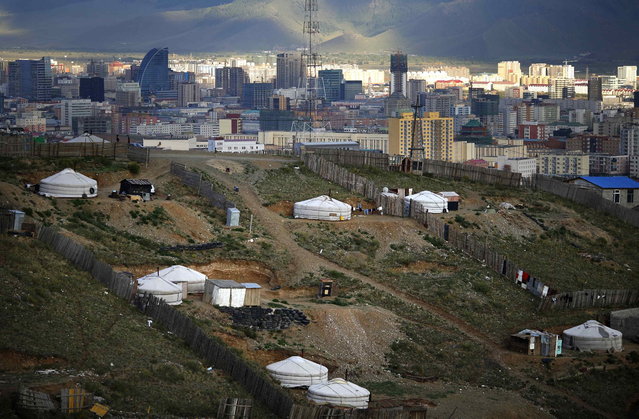
Gers, traditional Mongolian tents, are seen on a hill in an area known as a ger district in Ulan Bator June 26, 2013. (Photo by Carlos Barria/Reuters)

Gers, traditional Mongolian tents, are seen on a hill in an area known as a ger district in Ulan Bator June 26, 2013. Approximately 60 percent of the population of Ulan Bator live in settlements known as ger districts and in many cases residents have limited access to basic services such as water and sanitation. According to a 2010 National Population Center census, every year between thirty and forty thousand people migrate from the countryside to the capital Ulan Bator. Ger districts in the city have been expanding rapidly in recent years. Mongolia is the world's least densely populated country, with 2.8 million people spread across an area around three times the size of France. (Photo by Carlos Barria/Reuters)
Details
11 Aug 2013 11:45:00
Young migrants gesture during a day of solidarity organised by local organizations and resdients for asylum seekers at a makeshift camp outside the foreign office in Brussels, Belgium September 6, 2015. (Photo by Yves Herman/Reuters)

Young migrants gesture during a day of solidarity organised by local organizations and resdients for asylum seekers at a makeshift camp outside the foreign office in Brussels, Belgium September 6, 2015. Over 150,000 people seeking to enter Europe have reached Hungary this year, most coming through the southern border with Serbia, and many apply for asylum but quickly try to leave for wealthier EU countries. (Photo by Yves Herman/Reuters)
Details
07 Sep 2015 13:34:00
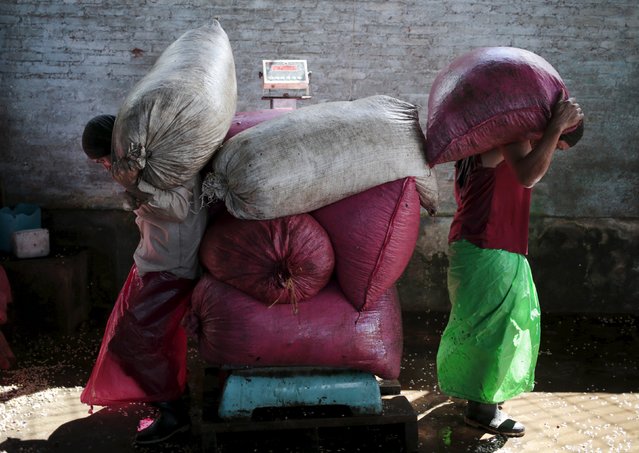
Workers carry sacks of coffee beans at a warehouse at the Nogales farm in Jinotega, Nicaragua January 7, 2016. (Photo by Oswaldo Rivas/Reuters)

Workers carry sacks of coffee beans at a warehouse at the Nogales farm in Jinotega, Nicaragua January 7, 2016. Soaring temperatures in Central America due to climate change are forcing farmers to pull up coffee trees and replace them with cocoa, spurring a revival in the cultivation of a crop once so essential to the region's economy. (Photo by Oswaldo Rivas/Reuters)
Details
20 Jan 2016 08:00:00
Yang Juan, an employee at Goopal Group, takes a nap in her seat after lunch, in Beijing, China, April 21, 2016. (Photo by Jason Lee/Reuters)

Yang Juan, an employee at Goopal Group, takes a nap in her seat after lunch, in Beijing, China, April 21, 2016. Office workers sleeping on the job is a common sight in China, where a surplus of cheap labour can lead to downtime at work. But in China's technology sector, where business is growing faster than many start-up firms can hire new staff, workers burn the midnight oil to meet deadlines and compete with their rivals. Some companies provide sleeping areas and beds for workers to rest during late nights. (Photo by Jason Lee/Reuters)
Details
12 May 2016 14:53:00
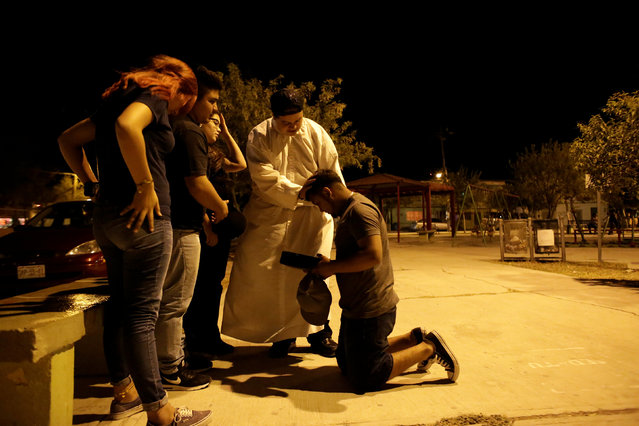
An aspiring Catholic priest Jose Luis Guerra, a member of Raza Nueva in Christ, a project of the archdiocese of Monterrey, and other missionaries hand out a Bible to Angel Castillo, who wants to become a missionary with Raza Nueva, in the municipality of Garcia, outskirts of Monterrey, Mexico, July 12, 2016. (Photo by Daniel Becerril/Reuters)

An aspiring Catholic priest Jose Luis Guerra, a member of Raza Nueva in Christ, a project of the archdiocese of Monterrey, and other missionaries hand out a Bible to Angel Castillo, who wants to become a missionary with Raza Nueva, in the municipality of Garcia, outskirts of Monterrey, Mexico, July 12, 2016. In the troubled fringes of the northern Mexican city of Monterrey, an aspiring priest is using his faith to reach out to young gang members and at-risk youth, and bring them into his “Gang of Christ”. (Photo by Daniel Becerril/Reuters)
Details
28 Jul 2016 13:22:00
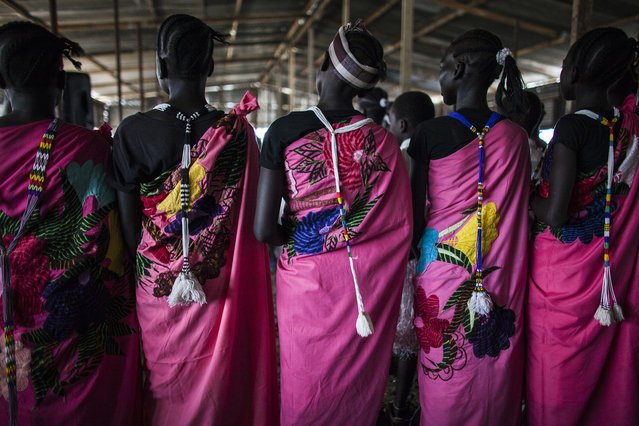
Church members pray at the Dolieb Hill Presbyterian Church in the Protection of Civilians (POC) site at the United Nations Mission in South Sudan (UNMISS) compound in Malakal, South Sudan on Saturday, July 9, 2016. (Photo by Jane Hahn/The Washington Post)

Church members pray at the Dolieb Hill Presbyterian Church in the Protection of Civilians (POC) site at the United Nations Mission in South Sudan (UNMISS) compound in Malakal, South Sudan on Saturday, July 9, 2016. (Photo by Jane Hahn/The Washington Post)
Details
09 Aug 2016 12:50:00