Loading...
Done
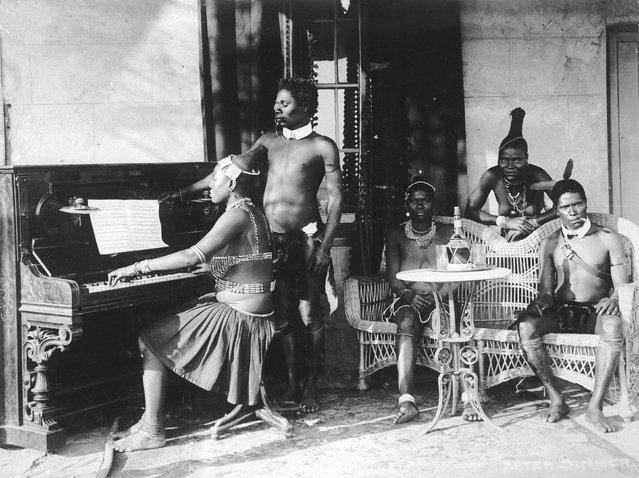
circa 1925:  A Zulu woman playing the piano while a group of others sit and listen.  (Photo by General Photographic Agency/Getty Images)

“The Zulu are the largest South African ethnic group, with an estimated 10–11 million people living mainly in the province of KwaZulu-Natal. Small numbers also live in Zimbabwe, Zambia, and Mozambique. Their language, Zulu, is a Bantu language; more specifically, part of the Nguni subgroup. The Zulu Kingdom played a major role in South African history during the 19th and 20th centuries. Under apartheid, Zulu people were classed as third-class citizens and suffered from state-sanctioned discrimination. They remain today the most numerous ethnic group in South Africa, and now have equal rights along with all other citizens”. – Wikipedia.

Photo: A Zulu woman playing the piano while a group of others sit and listen (to put it briefly, Englishmen scoff over Zulu). South Africa, circa 1925. (Photo by General Photographic Agency)

Details
03 Feb 2014 09:40:00
Eton Wall Game

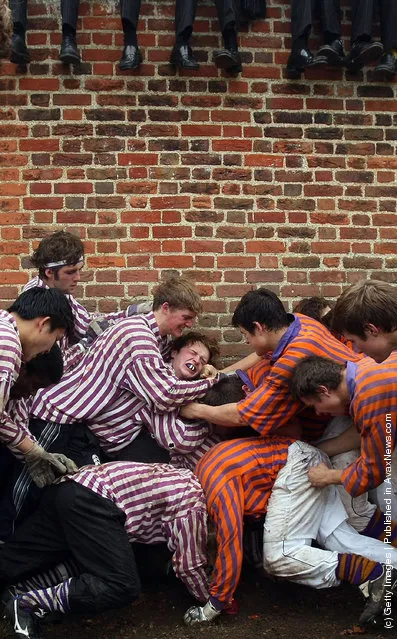
“The Eton wall game is a game similar to football and Rugby Union, that originated from and is still played at Eton College. It is played on a strip of ground 5 metres wide and 110 metres long next to a slightly curved brick wall, erected in 1717”. – Wikipedia

Photo: The “Collegers” and the “Oppidans” of Eton College take part in the “Wall Game” as boys in their traditional school uniform watch from on top of the wall on November 17, 2007 in Eton, near Windsor, Berkshire, England. The first recorded “Wall Game” took place in 1766 with competition between the two houses at the boarding school remaining as fierce as ever on the annual St. Andrew's day event. The object of the game is to get the ball to either end of the wall and score a goal, which has not happened since 1909. As well as scoring a goal the players can win points with a “shy”, where the ball is held against the wall and touched by the hand and awarded one point. (Photo by Christopher Furlong/Getty Images)
Details
22 Sep 2011 11:01:00
A life-size robot named “Mark 1”, built by product and graphic designer Ricky Ma, 42, is seen in Hong Kong, China March 31, 2016. Ma, a robot enthusiast, spent a year-and-a half and more than HK$400,000 ($51,000) to create the humanoid robot, which is modelled after a Hollywood star, to fulfil his childhood dream. The eyes of the robot include face and color tracking functions. (Photo by Bobby Yip/Reuters)

A life-size robot named “Mark 1”, built by product and graphic designer Ricky Ma, 42, is seen in Hong Kong, China March 31, 2016. Ma, a robot enthusiast, spent a year-and-a half and more than HK$400,000 ($51,000) to create the humanoid robot, which is modelled after a Hollywood star, to fulfil his childhood dream. The eyes of the robot include face and color tracking functions. (Photo by Bobby Yip/Reuters)
Details
02 Apr 2016 09:38:00
Robot Xian'er is placed in the main building of Longquan Buddhist temple for photographs by the temple's staff, on the outskirts of Beijing, April 20, 2016. (Photo by Kim Kyung-Hoon/Reuters)

Robot Xian'er is placed in the main building of Longquan Buddhist temple for photographs by the temple's staff, on the outskirts of Beijing, April 20, 2016. (Photo by Kim Kyung-Hoon/Reuters)
Details
23 Apr 2016 13:43:00
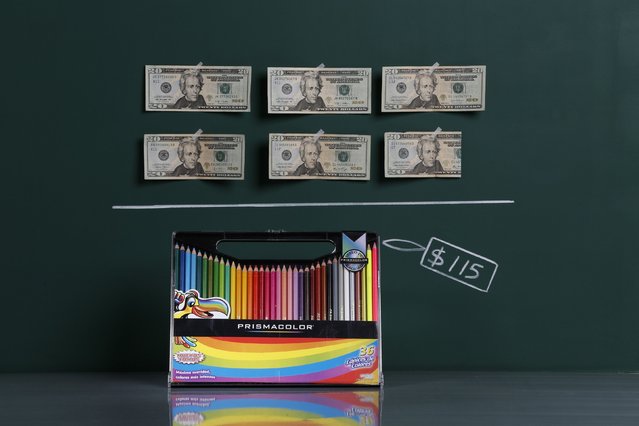
A box of 36 coloured pencils as photographed in a studio with an illustrative price tag of $115 (US dollars), equivalent to the Bs. 725 (bolivars) that it costs on average to purchase in Caracas at the official exchange rate of 6.3 bolivars per dollar, in Caracas September 29, 2014. Venezuela's economic crisis has led to some shocking and surreal price distortions that hit people's buying power dramatically. (Photo by Carlos Garcia Rawlins/Reuters)

A box of 36 coloured pencils as photographed in a studio with an illustrative price tag of $115 (US dollars), equivalent to the Bs. 725 (bolivars) that it costs on average to purchase in Caracas at the official exchange rate of 6.3 bolivars per dollar, in Caracas September 29, 2014. Venezuela's economic crisis has led to some shocking and surreal price distortions that hit people's buying power dramatically. (Photo by Carlos Garcia Rawlins/Reuters)
Details
05 Oct 2014 11:25:00
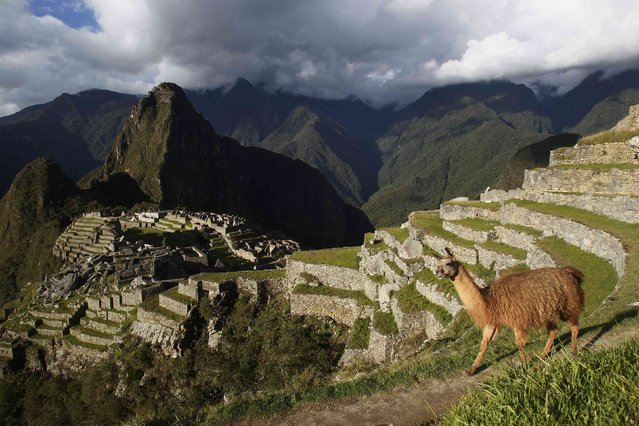
An alpaca is seen near the Inca citadel of Machu Picchu in Cusco December 2, 2014. Machu Picchu, a UNESCO World Heritage Site, is Peru's top tourist attraction, with the government limiting tourists to 2,500 per day due to safety reasons and concerns over the preservation of the ruins. (Photo by Enrique Castro-Mendivil/Reuters)

An alpaca is seen near the Inca citadel of Machu Picchu in Cusco December 2, 2014. Machu Picchu, a UNESCO World Heritage Site, is Peru's top tourist attraction, with the government limiting tourists to 2,500 per day due to safety reasons and concerns over the preservation of the ruins. (Photo by Enrique Castro-Mendivil/Reuters)
Details
04 Dec 2014 11:24:00
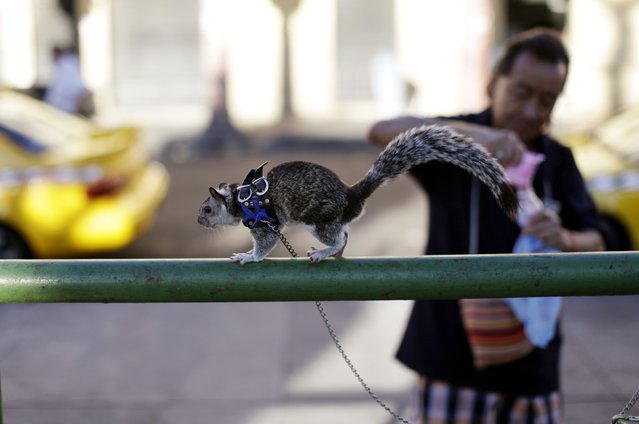
Carlos Melendez prepares to feed his pet squirrel “Colita” in downtown San Salvador January 29, 2015. (Photo by Jose Cabezas/Reuters)

Carlos Melendez prepares to feed his pet squirrel “Colita” in downtown San Salvador January 29, 2015. (Photo by Jose Cabezas/Reuters)
Details
31 Jan 2015 13:35:00
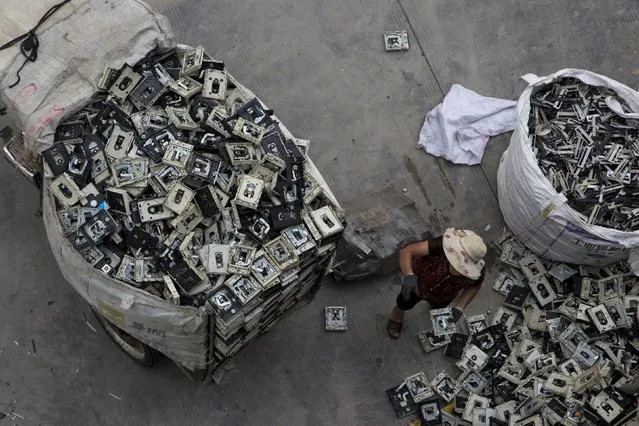
A worker distributes electronic waste at a government managed recycling centre at the township of Guiyu in China's southern Guangdong province June 10, 2015. (Photo by Tyrone Siu/Reuters)

A worker distributes electronic waste at a government managed recycling centre at the township of Guiyu in China's southern Guangdong province June 10, 2015. The town of Guiyu in the economic powerhouse of Guangdong province in China has long been known as one of the world’s largest electronic waste dump sites. At its peak, some 5,000 workshops in the village recycle 15,000 tonnes of waste daily including hard drives, mobile phones, computer screens and computers shipped in from across the world. (Photo by Tyrone Siu/Reuters)
Details
04 Jul 2015 10:28:00