Loading...
Done
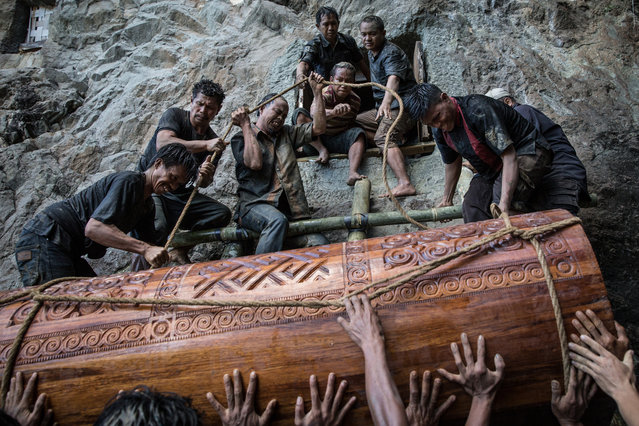
It is said that Torajans are people who “live to die”. For this Indonesian ethnic group, funerals are such extravagant events that they sometimes attract tourists. Families can postpone burials years (and the deceased are considered sick and hosted at home until the funeral) until the family can raise enough money and gather as many relatives as possible. And then it’s a jubilant multiday social event with a parade, dances and animal sacrifices. Agung Parameswara photographed these funerary practices when he traveled to South Sulawesi province, where the Torajans live. But often, their funeral isn’t the last time the dead are seen. In August, crypts are opened, coffins are slid back out and bodies delicately unsheathed. This tender ritual is known as Ma’Nene, which is customarily performed every few years. (Photo by Agung Parameswara/The Washington Post)

It is said that Torajans are people who “live to die”. For this Indonesian ethnic group, funerals are such extravagant events that they sometimes attract tourists. Families can postpone burials years (and the deceased are considered sick and hosted at home until the funeral) until the family can raise enough money and gather as many relatives as possible. And then it’s a jubilant multiday social event with a parade, dances and animal sacrifices. Agung Parameswara photographed these funerary practices when he traveled to South Sulawesi province, where the Torajans live. (Photo by Agung Parameswara/The Washington Post)
Details
06 Oct 2016 09:15:00
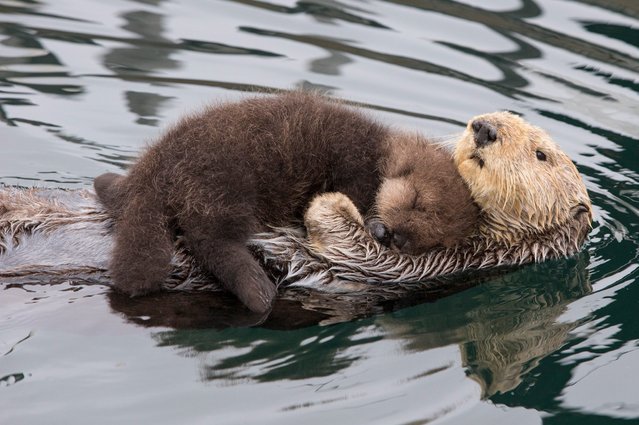
The sea otter mother with her three day old newborn pup ontop of her to keep it dry and warm while it sleeps. This devoted mother otter kept her newborn pup dry as she let the baby ride on her belly. Nature photographer Suzi Eszterhas, 40, spotted the adorable pair of southern sea otters swimming in Monterey Bay, California. The mother lifted the pup out of the water and on to her belly to keep it warm and dry and also blew air into the pup's fur to groom it. Ms Eszterhas was shocked to see the otters come closer to where she was standing and the mother left her child to float alone in the water. (Photo by Suzi Eszterhas/Minden Pictures/Solent News & Photo Agency)

The sea otter mother with her three day old newborn pup ontop of her to keep it dry and warm while it sleeps. This devoted mother otter kept her newborn pup dry as she let the baby ride on her belly. Nature photographer Suzi Eszterhas, 40, spotted the adorable pair of southern sea otters swimming in Monterey Bay, California. The mother lifted the pup out of the water and on to her belly to keep it warm and dry and also blew air into the pup's fur to groom it. Ms Eszterhas was shocked to see the otters come closer to where she was standing and the mother left her child to float alone in the water. (Photo by Suzi Eszterhas/Minden Pictures/Solent News & Photo Agency)
Details
30 Oct 2016 10:44:00
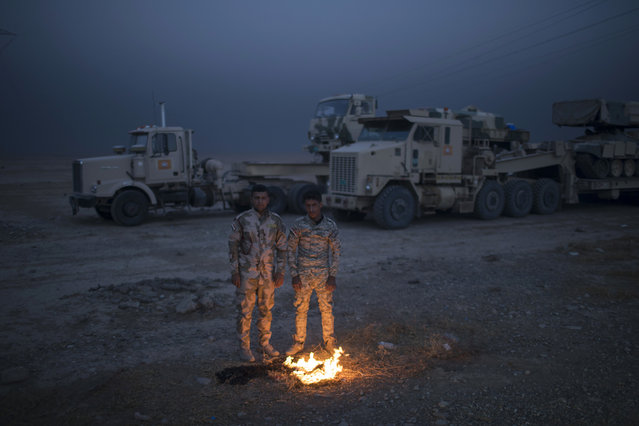
Iraqi army soldiers warm themselves next to a fire near the Qayara air base, south of Mosul, Iraq, Tuesday, November 1, 2016. The U.N. human rights office is lauding efforts by the U.S.-led coalition in the battle against the Islamic State group in Mosul. The office in Geneva says coalition flights over Iraq have largely succeeded in preventing IS from bringing in 25,000 more civilians to the city center, where the militant group has been using people as human shields as Iraqi forces advance on Mosul. (Photo by Felipe Dana/AP Photo)

Iraqi army soldiers warm themselves next to a fire near the Qayara air base, south of Mosul, Iraq, Tuesday, November 1, 2016. The U.N. human rights office is lauding efforts by the U.S.-led coalition in the battle against the Islamic State group in Mosul. The office in Geneva says coalition flights over Iraq have largely succeeded in preventing IS from bringing in 25,000 more civilians to the city center, where the militant group has been using people as human shields as Iraqi forces advance on Mosul. (Photo by Felipe Dana/AP Photo)
Details
03 Nov 2016 12:43:00
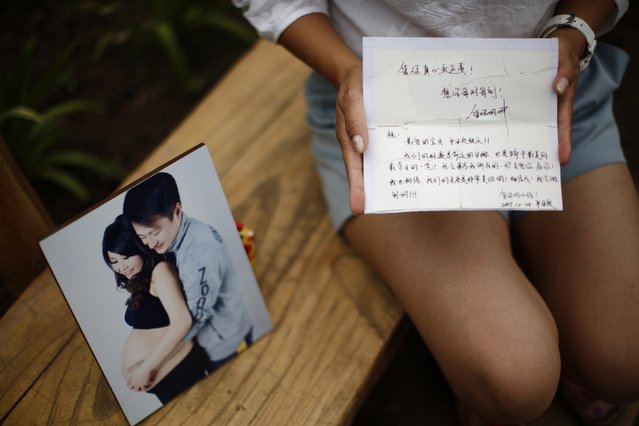
Cheng Liping, whose husband Ju was onboard Malaysia Airlines Flight MH370 which disappeared on March 8, 2014, shows a picture of she and her husband together and an old card with a message given by her husband, at a park near her house where she and her husband used to visit during an interview with Reuters in Beijing July 24, 2014. (Photo by Kim Kyung-Hoon/Reuters)

Cheng Liping, whose husband Ju was onboard Malaysia Airlines Flight MH370 which disappeared on March 8, 2014, shows a picture of she and her husband together and an old card with a message given by her husband, at a park near her house where she and her husband used to visit during an interview with Reuters in Beijing July 24, 2014. Cheng said her life has been totally changed since the incident. Their two little sons, who don't know about this incident, keep asking her when their dad is coming back. Six months after Malaysia Airlines Flight MH370, with 239 mostly Chinese people on board, disappeared about an hour into a routine journey from Kuala Lumpur to Beijing March 8, loved ones of missing passengers derive what comfort they can from what's left behind after the world's greatest aviation mystery. More than two dozen countries have been involved in the air, sea and underwater search for the Boeing 777 but months of sorties failed to turn up any trace – even after narrowing the search area to the southern Indian Ocean – long after batteries on the black box voice and data recorders had gone flat. (Photo by Kim Kyung-Hoon/Reuters)
Details
05 Sep 2014 11:27:00
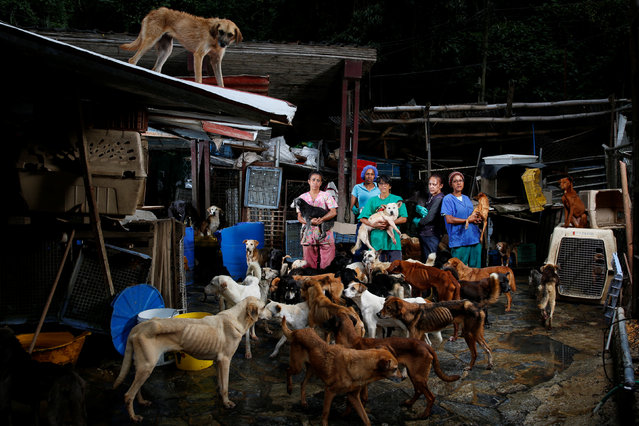
(L-R) Maria Silva, Milena Cortes, Maria Arteaga, Jackeline Bastidas and Gissy Abello pose for a picture at the Famproa dogs shelter where they work, in Los Teques, Venezuela, August 25, 2016. Venezuelans struggling to feed their families let alone their pets are dumping animals on the streets, in parks and at makeshift homes overrun with scrawny animals amid an economic crisis. An hour from Caracas in Los Teques, hundreds of dogs bark and run around the streets scavenging for food outside a makeshift shelter. People come by every few hours to hand over scrawny dogs which are fed by volunteers every day. Venezuela is undergoing a major economic and social crisis, with shortages of basic foods and medicines. Triple digit inflation is hitting everybody hard, including those who own pets. (Photo by Carlos Garcia Rawlins/Reuters)

(L-R) Maria Silva, Milena Cortes, Maria Arteaga, Jackeline Bastidas and Gissy Abello pose for a picture at the Famproa dogs shelter where they work, in Los Teques, Venezuela, August 25, 2016. Venezuelans struggling to feed their families let alone their pets are dumping animals on the streets, in parks and at makeshift homes overrun with scrawny animals amid an economic crisis. An hour from Caracas in Los Teques, hundreds of dogs bark and run around the streets scavenging for food outside a makeshift shelter. (Photo by Carlos Garcia Rawlins/Reuters)
Details
08 Sep 2016 10:01:00
A man carries a smoke flare as far-right activists march during the Gay Pride parade on June 12, 2016 in Kiev. More than 700 gay rights activists marched through central Kiev on June 12 amid a massive police presence for the third such gay pride event in the ex-Soviet country where homophobia remains widespread. The June 12 march was the first ever gay pride rally to be held in central Kiev, prompting an unprecedented security operation with several thousand police and National Guard officers lining the route during the event, which lasted around 20 minutes. (Photo by Yuriy Kirnichny/AFP Photo)

A man carries a smoke flare as far-right activists march during the Gay Pride parade on June 12, 2016 in Kiev. More than 700 gay rights activists marched through central Kiev on June 12 amid a massive police presence for the third such gay pride event in the ex-Soviet country where homophobia remains widespread. The June 12 march was the first ever gay pride rally to be held in central Kiev, prompting an unprecedented security operation with several thousand police and National Guard officers lining the route during the event, which lasted around 20 minutes. (Photo by Yuriy Kirnichny/AFP Photo)
Details
13 Jun 2016 11:08:00
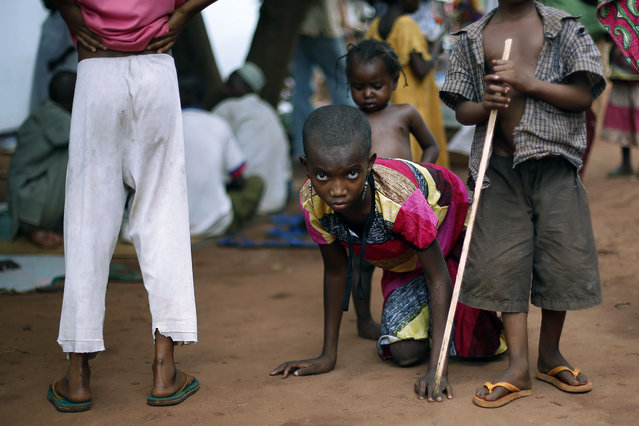
In this April 14, 2014 file photo, Hamamatou Harouna, 10, who lost the use of her legs to polio, crawls to the restroom on the grounds of the Catholic Church where she and hundreds of others found refuge after fleeing violence in her village, in Carnot, Central African Republic. Health authorities on Tuesday, August 25, 2020 are expected to declare the African continent free of the wild poliovirus after decades of effort, though cases of vaccine-derived polio are still sparking outbreaks of the paralyzing disease in more than a dozen countries. (Photo by Jerome Delay/AP Photo/File)

In this April 14, 2014 file photo, Hamamatou Harouna, 10, who lost the use of her legs to polio, crawls to the restroom on the grounds of the Catholic Church where she and hundreds of others found refuge after fleeing violence in her village, in Carnot, Central African Republic. Health authorities on Tuesday, August 25, 2020 are expected to declare the African continent free of the wild poliovirus after decades of effort, though cases of vaccine-derived polio are still sparking outbreaks of the paralyzing disease in more than a dozen countries. (Photo by Jerome Delay/AP Photo/File)
Details
15 Sep 2020 00:03:00
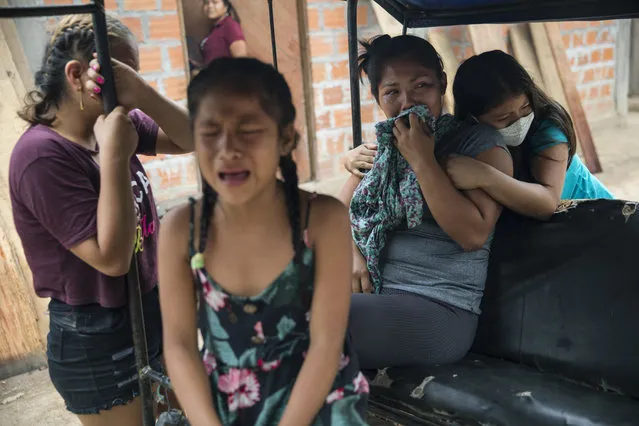
Family members mourn the passing of Manuela Chavez, who died from symptoms related to the new coronavirus at the age of 88, as a government team prepares to remove her body from inside her home, in the Shipibo Indigenous community of Pucallpa, in Peru's Ucayali region, Monday, August 31, 2020. While the lucky are cured with ancestral ailments, the less fortunate often die at home. A government team travels from one spartan, thatch-roofed home to the next, removing the dead from their homes where they took their last breaths. (Photo by Rodrigo Abd/AP Photo)

Family members mourn the passing of Manuela Chavez, who died from symptoms related to the new coronavirus at the age of 88, as a government team prepares to remove her body from inside her home, in the Shipibo Indigenous community of Pucallpa, in Peru's Ucayali region, Monday, August 31, 2020. While the lucky are cured with ancestral ailments, the less fortunate often die at home. A government team travels from one spartan, thatch-roofed home to the next, removing the dead from their homes where they took their last breaths. (Photo by Rodrigo Abd/AP Photo)
Details
18 Sep 2020 00:03:00