Loading...
Done
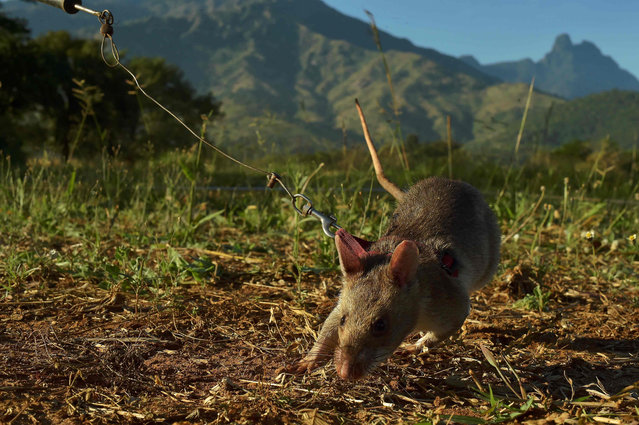
An African giant pouched rat sniffs for traces of landmine explosives at APOPO's training facility in Morogoro on June 17, 2016. (Photo by Carl De Souza/AFP Photo)

An African giant pouched rat sniffs for traces of landmine explosives at APOPO's training facility in Morogoro on June 17, 2016. APOPO trains the rats to detect both tuberculosis and landmines at its facility. Every year landmines kill or maim thousands of people worldwide. The trained rats sniff for explosive and so are able to detect the presence of landmines far faster than conventional methods which involve metal detection. (Photo by Carl De Souza/AFP Photo)
Details
19 Jun 2016 09:52:00
Men carry a dog, wearing a costume and seated on a stool, as a form of respect as they believe that dogs found water for their ancestors, during a local festival for the Miao ethnic minority in Jianhe county, Guizhou Province, China, August 14, 2016. (Photo by Reuters/China Daily)

Men carry a dog, wearing a costume and seated on a stool, as a form of respect as they believe that dogs found water for their ancestors, during a local festival for the Miao ethnic minority in Jianhe county, Guizhou Province, China, August 14, 2016. (Photo by Reuters/China Daily)
Details
16 Aug 2016 09:43:00
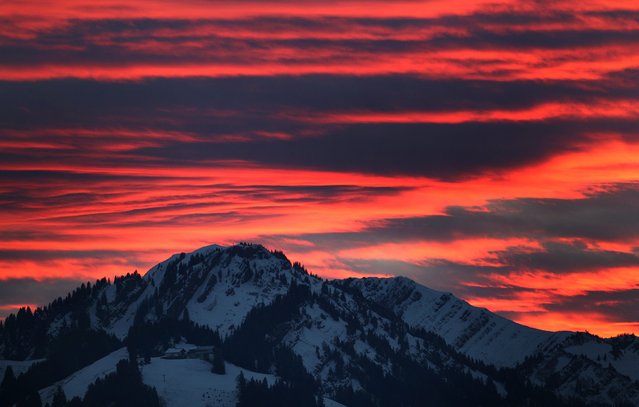
A colorful sky at sunset over the snowy mountains in Immenstadt, Bavaria, Germany, 20 November 2014. Cloudy weather is forecast in the region on 21 November. (Photo by Karl-Josef Hildenbrand/EPA)

A colorful sky at sunset over the snowy mountains in Immenstadt, Bavaria, Germany, 20 November 2014. Cloudy weather is forecast in the region on 21 November. (Photo by Karl-Josef Hildenbrand/EPA)
Details
22 Dec 2014 12:55:00
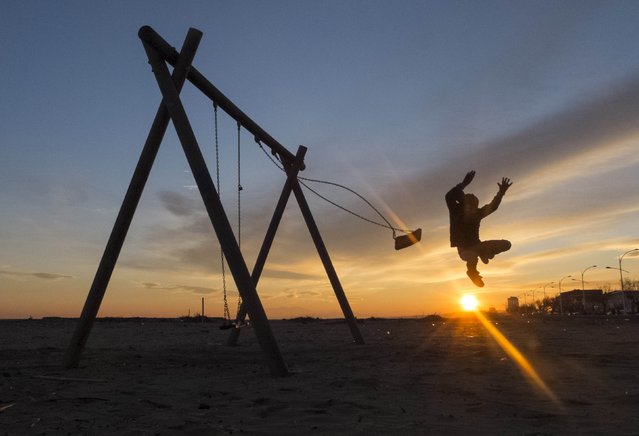
A boy jumps from a swing during sunset in Valras-Plage, southern France December 29, 2014. (Photo by Yves Herman/Reuters)

A boy jumps from a swing during sunset in Valras-Plage, southern France December 29, 2014. (Photo by Yves Herman/Reuters)
Details
05 Jan 2015 12:55:00
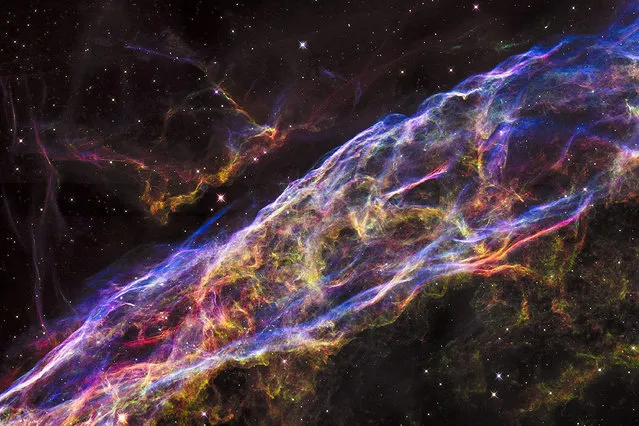
A small section of the expanding remains of the Veil Nebula, a massive star that exploded about 8,000 years ago. The entire nebula is 110 light-years across, covering six full moons on the sky as seen from Earth, and resides about 2,100 light-years away in the constellation Cygnus, the Swan. (Photo by Reuters/NASA/ESA/Hubble)

A small section of the expanding remains of the Veil Nebula, a massive star that exploded about 8,000 years ago. The entire nebula is 110 light-years across, covering six full moons on the sky as seen from Earth, and resides about 2,100 light-years away in the constellation Cygnus, the Swan. (Photo by Reuters/NASA/ESA/Hubble)
Details
29 Feb 2016 11:30:00
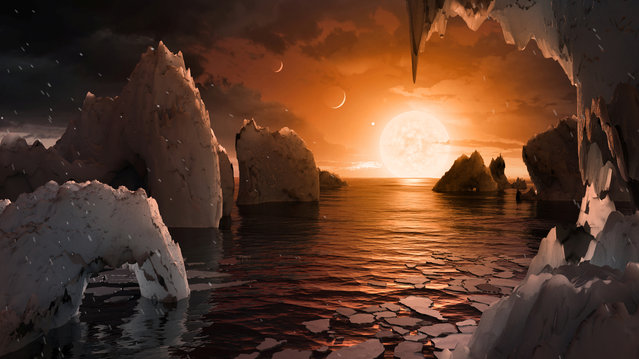
The possible surface of TRAPPIST-1f, one of seven newly discovered planets in the TRAPPIST-1 system that scientists using the Spitzer Space Telescope and ground based telescopes have discovered. (Photo by Reuters/NASA/JPL-Caltech)

The possible surface of TRAPPIST-1f, one of seven newly discovered planets in the TRAPPIST-1 system that scientists using the Spitzer Space Telescope and ground based telescopes have discovered. (Photo by Reuters/NASA/JPL-Caltech)
Details
07 Mar 2017 00:02:00
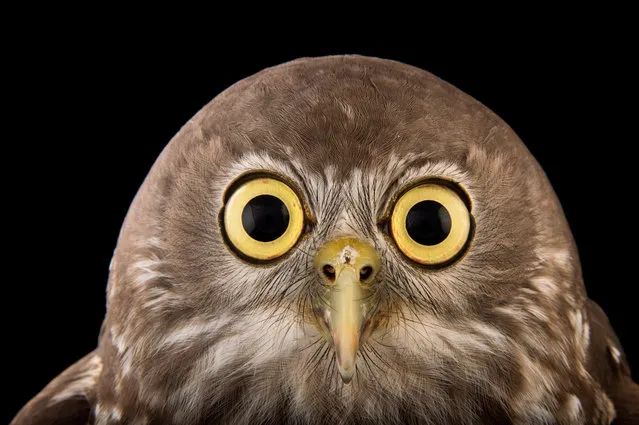
The National Geographic Photo Ark is a travelling exhibition of photographer Joel Sartore’s quest to create a photo archive of biodiversity around the world. So far, Sartore has captured studio portraits of more than 6,000 species – a number that he hopes to double. On 1 July, the ark will open at Melbourne zoo – the first time it has been exhibited in the southern hemisphere. More than 50 portraits will be on display, including many of Australian endangered animals being protected by programs at the zoo itself. These captions have been edited from text supplied by Melbourne zoo. Here: Barking owl. So-named because its call sounds like a barking dog, these birds are native to Australia, Indonesia and Papua New Guinea. In Victoria they are listed as an endangered species, and in 2003 there were estimated to be fewer than 50 breeding pairs. The main threat to the species in Victoria is loss of habitat, especially large trees with hollows in which they can nest and on which many of their prey depend. Apart from a bark, they may utter a chilling scream when they feel threatened. (Photo by Joel Sartore/National Geographic Photo Ark/The Guardian)

The National Geographic Photo Ark is a travelling exhibition of photographer Joel Sartore’s quest to create a photo archive of biodiversity around the world. So far, Sartore has captured studio portraits of more than 6,000 species – a number that he hopes to double. On 1 July, the ark will open at Melbourne zoo – the first time it has been exhibited in the southern hemisphere. More than 50 portraits will be on display, including many of Australian endangered animals being protected by programs at the zoo itself. These captions have been edited from text supplied by Melbourne zoo. Here: Barking owl. (Photo by Joel Sartore/National Geographic Photo Ark/The Guardian)
Details
01 Jul 2017 07:45:00
A young boy plugs his ears as his sister (C) and nanny (L) watch from Gravelly Point Park as planes land at Reagan National Airport in Arlington, Virginia on June 29, 2017. President Donald Trump' s travel ban on people from six mostly Muslim countries will come into force late Thursday, as controversy swirls over who qualifies for an exemption based on family ties. (Photo by Jim Watson/AFP Photo)

A young boy plugs his ears as his sister (C) and nanny (L) watch from Gravelly Point Park as planes land at Reagan National Airport in Arlington, Virginia on June 29, 2017. President Donald Trump' s travel ban on people from six mostly Muslim countries will come into force late Thursday, as controversy swirls over who qualifies for an exemption based on family ties. (Photo by Jim Watson/AFP Photo)
Details
01 Jul 2017 07:52:00